










Capital Infra Trust says HAM receipts partly hedge 58% debt
Key highlights
- Capital Infra Trust had Rs 1,680.48 crore of floating-rate borrowings, equal to 58.4% of its disclosed debt mix at 30 September 2026.
- Capital Infra Trust reported a 2.27x debt-service coverage ratio, Rs 2,429.58 crore of net debt and a 7.3% effective borrowing cost.
- Capital Infra Trust's largest scheduled repayment bucket was Rs 987.5 crore due after five years.
- Capital Infra Trust reported Q2FY27 total income of Rs 342.47 crore, up from Rs 294.95 crore in Q1FY27.
powered by IRIS
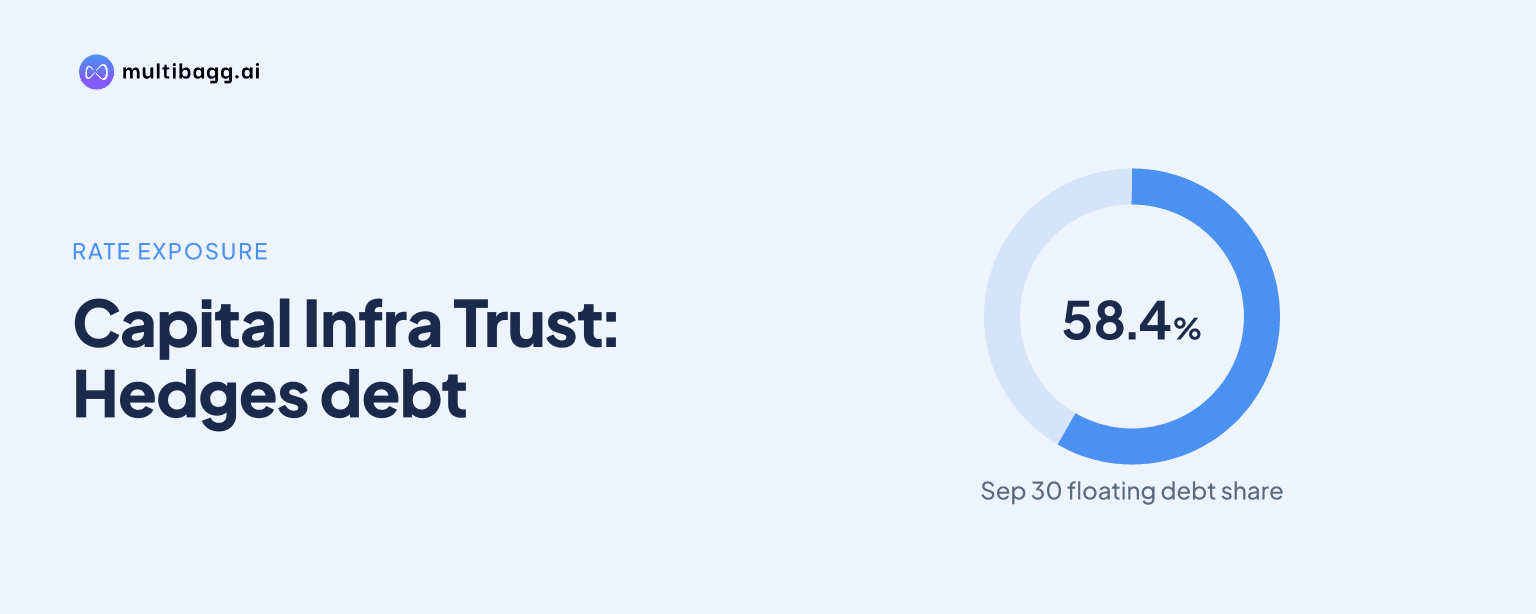
At 30 September 2026, Capital Infra Trust reported that 58.4% of its disclosed debt mix was floating-rate, while benchmark-linked hybrid annuity model (HAM) receipts were intended to partly offset higher rates; the Trust also reported a 2.27x debt-service coverage ratio and a 7.3% effective borrowing cost.
Know Capital Infra Trust inside out
Results, valuation, peers and who's buying, in one view.
How is Capital Infra Trust's debt split between fixed and floating rates?
Capital Infra Trust's disclosed debt mix was 58.4% floating-rate and 41.6% fixed-rate at 30 September 2026. Floating-rate borrowings were Rs 1,680.48 crore at 7.01% per annum, compared with fixed-rate borrowings of Rs 1,197.6 crore at 7.71% per annum. The Rs 2,878.08 crore total in the debt-composition schedule had an effective borrowing cost of 7.30% per annum.
The floating-rate share was larger than the fixed-rate share by 16.8 percentage points, although its stated rate was 0.70 percentage points lower at the reporting date. Capital Infra Trust says fixed-rate debt remains protected when market reference rates rise, while floating-rate interest expense increases. The mix therefore leaves Rs 1,680.48 crore exposed to benchmark-rate movements under the disclosed structure.
Capital Infra Trust separately reported gross debt of Rs 2,895.05 crore and net debt of Rs 2,429.58 crore in its consolidated debt metrics. It also reported net debt to enterprise value of 40.3%, consistent with the 40.31% debt-to-enterprise-value figure in its acquisition roadmap. The presentation labels the debt-mix disclosure and consolidated debt metrics separately, so their totals should not be treated as the same measure.
When are Capital Infra Trust's debt repayments due?
Capital Infra Trust's largest scheduled repayment bucket was Rs 987.5 crore due after five years, while Rs 165.7 crore was due within one year. The disclosed repayment buckets totalled Rs 1,719.6 crore, with Rs 289.2 crore due in one to three years and Rs 277.2 crore due in three to five years.
Capital Infra Trust said it repaid Rs 49.77 crore in Q2FY27. It also disclosed that non-convertible debentures of Rs 243.8 crore and Rs 914.7 crore would be subject to put or call options in Q4FY27 and Q4FY28, respectively. The presentation does not state whether those options will be exercised, refinanced or retained under their contractual terms.
The more-than-five-years bucket accounted for over half of the disclosed Rs 1,719.6 crore repayment schedule, compared with Rs 165.7 crore in the next 12 months. However, the Q4FY27 and Q4FY28 option dates are earlier decision points for the Rs 1,158.5 crore of identified non-convertible debentures. Capital Infra Trust has not disclosed an outcome for either option in the presentation.
Got a follow-up? Ask IRIS
How do Capital Infra Trust's HAM receipts partly offset rate risk?
Capital Infra Trust says that higher benchmark rates raise floating-rate interest expense, but interest-linked HAM receipts reset with benchmark rates and provide a partial offset. Its stated sequence is that fixed-rate debt remains protected, higher HAM receipts provide an offset, and the net result is a “partial hedge / potential upside.” The presentation does not quantify the size of the receipt uplift or whether it would match the interest-cost increase.
Capital Infra Trust frames this mechanism against an interest-rate upcycle in which the Reserve Bank of India raised the repo rate by 25 basis points to 5.50% and adopted “calibrated tightening.” According to the presentation, higher rates expand annuity interest income while also raising the cost of floating borrowings. The 58.4% floating-rate share and the 41.6% fixed-rate share determine which portion of the disclosed debt mix is directly affected.
Inflation is a separate element of the Trust's stated cash-flow framework. The presentation cited headline wholesale price index inflation of about 10% in Q2FY27 and said this increases operations and maintenance inflows from the National Highways Authority of India while operating expenses remain fixed-price. Capital Infra Trust also says its distributions are supported by inflation-linked HAM annuity receivables, no traffic-risk exposure and largely fixed operations and maintenance obligations.
What do Capital Infra Trust's debt and cash-flow metrics show?
Capital Infra Trust reported a 2.27x debt-service coverage ratio, an AAA Stable credit rating and a 7.3% per annum effective borrowing cost at 30 September 2026. The presentation provides no calculation inputs or earlier comparison for the debt-service coverage ratio. Its consolidated metrics also show Rs 2,895.05 crore of gross debt and Rs 2,429.58 crore of net debt.
Capital Infra Trust's Q2FY27 total income rose to Rs 342.47 crore from Rs 294.95 crore in Q1FY27, while operating expenses increased to Rs 111.8 crore from Rs 108.38 crore. Earnings before interest, tax, depreciation and amortisation increased to Rs 224.21 crore from Rs 180.74 crore, and profit after tax rose to Rs 149.51 crore from Rs 125.62 crore. The Trust attributed the higher operating expenditure to planned maintenance and asset-upkeep costs.
Annuity accrued moved in the opposite direction, falling to Rs 227.22 crore in Q2FY27 from Rs 380.37 crore in Q1FY27. Capital Infra Trust did not reconcile that change with the increase in total income in the presentation. It reported distribution per unit of Rs 2.3 in both Q1FY27 and Q2FY27 and management set an FY27 distribution-per-unit target of Rs 9.0 to Rs 9.25. Since its initial public offering, the Trust said it had distributed Rs 1,358.88 crore, equal to cumulative distribution per unit of Rs 40.1.
Conclusion
Capital Infra Trust's disclosed capital structure combines a majority floating-rate debt share with fixed-rate protection and benchmark-linked HAM receipts that management says partly offset rate-driven financing costs. The 2.27x debt-service coverage ratio, Rs 2,429.58 crore of net debt and Rs 987.5 crore in repayments due after five years provide the main reported measures of coverage, leverage and maturity timing.
The next disclosed milestones are the Rs 243.8 crore non-convertible debenture put or call option in Q4FY27 and the Rs 914.7 crore option in Q4FY28. Management's FY27 distribution-per-unit target of Rs 9.0 to Rs 9.25 and its plan to evaluate further right-of-first-offer and third-party acquisitions after six asset acquisitions are additional items to watch.