










Capital Infra Trust projects Rs 8.8 lakh crore road InvIT pool
Key highlights
- Capital Infra Trust projects road InvIT AUM of Rs 8.8 lakh crore by FY30E.
- More than 150 HAM projects are expected to achieve COD or PCOD within two years.
- MoRTH has a FY27 monetisation target of Rs 3 lakh crore, split evenly between ToT and InvITs.
- Roads and highways account for 51% of the NIP 2.0 sectoral split for FY25 to FY28E.
powered by IRIS
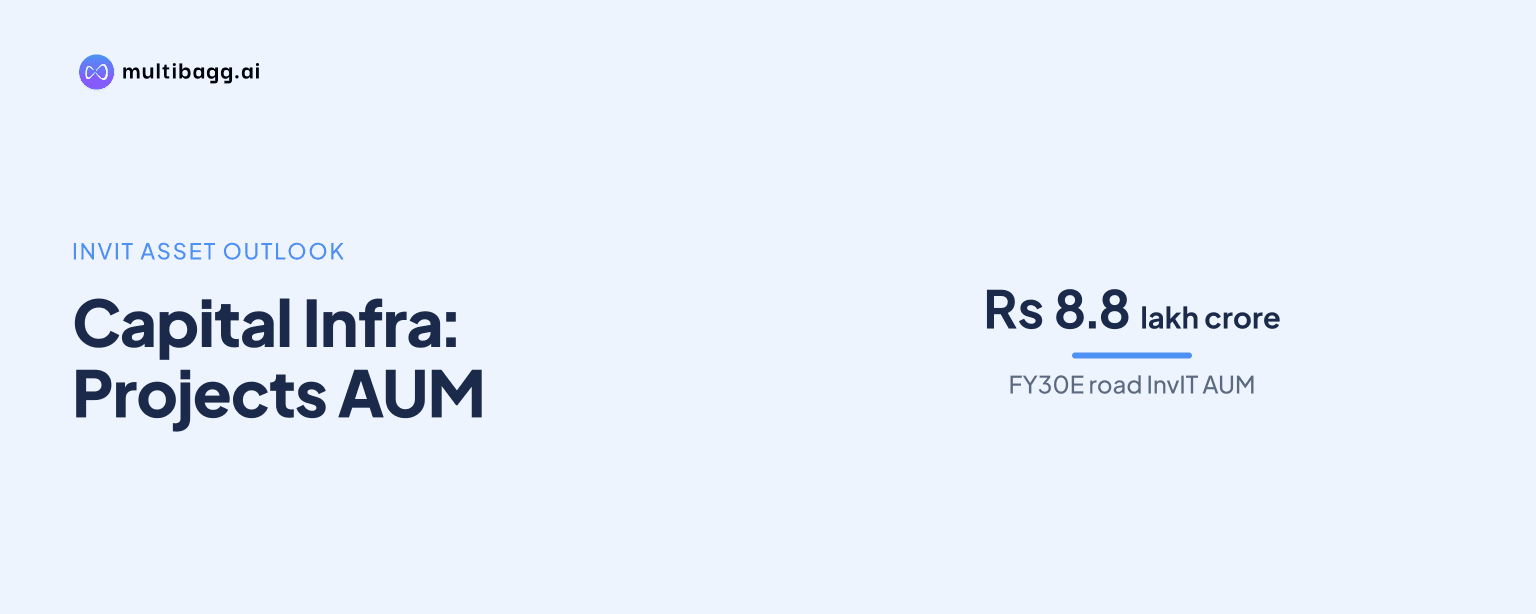
Capital Infra Trust projects the road infrastructure investment trust, or InvIT, assets-under-management, or AUM, opportunity will reach Rs 8.8 lakh crore by FY30E, about 2.8 times its stated 2026 base of Rs 3.2 lakh crore, supported by more than 150 Hybrid Annuity Model projects expected to reach operating milestones within two years and Rs 3 lakh crore of FY27 highway monetisation.
Know Capital Infra Trust inside out
Results, valuation, peers and who's buying, in one view.
How large could the road InvIT pool become by FY30E?
Capital Infra Trust projects road InvIT AUM of Rs 8.8 lakh crore in FY30E, compared with Rs 3.2 lakh crore in 2026 in its narrative outlook. The presentation describes this change as an expansion of about 2.8 times, linking the projected increase to a larger pool of operational HAM annuity roads and traffic-linked toll assets.
Capital Infra Trust’s chart shows a slightly different FY26 base of Rs 3.3 lakh crore, rather than the Rs 3.2 lakh crore used in the narrative statement, while retaining the same Rs 8.8 lakh crore FY30E endpoint. The charted AUM series rose from Rs 0.7 lakh crore in FY22 to Rs 2.5 lakh crore in FY25 before reaching Rs 3.3 lakh crore in FY26.
The FY22-to-FY26 chart series shows the road InvIT pool increased by Rs 2.6 lakh crore before the FY30E forecast period. Capital Infra Trust does not identify individual road assets that will form the FY30E pool, nor does it provide a split of the Rs 8.8 lakh crore estimate between HAM annuity assets and toll-operate-transfer, or ToT, assets.
What HAM pipeline could supply road InvIT assets?
Capital Infra Trust says more than 150 HAM projects are expected to achieve commercial operation date, or COD, or provisional commercial operation date, or PCOD, during the next two years. These milestones indicate that roads have reached, or are provisionally ready for, operation, creating a potential future asset base for ownership and monetisation structures.
A further approximately 140 HAM projects are under implementation and are expected to become operational after FY28, according to Capital Infra Trust. The presentation does not state the value, individual completion timetable or ownership route for these 140 projects, so their inclusion in future InvIT transactions is not confirmed.
Capital Infra Trust cites Avendus Spark Research Report data estimating that HAM will account for 74% of National Highways Authority of India, or NHAI, project awards in FY26. Build-operate-transfer, or BOT, projects account for 15% and engineering, procurement and construction, or EPC, projects account for 11%, leaving HAM above the other two models’ combined 26% share.
The FY26 award mix supports Capital Infra Trust’s view that HAM remains the preferred model, but it does not establish how many FY26 awards will ultimately be monetised through InvITs. HAM roads are identified in the presentation as annuity assets, whereas ToT and InvIT structures can also include traffic-linked toll roads, with no numerical future split disclosed between the two types.
Got a follow-up? Ask IRIS
How is government spending and monetisation supporting supply?
Capital Infra Trust says the Ministry of Road Transport and Highways, or MoRTH, received an FY27 Union Budget allocation of Rs 3.09 lakh crore, about 8% above Rs 2.87 lakh crore. The presentation frames the higher allocation as policy support for the road sector, although it does not allocate the budget among HAM, BOT, EPC or InvIT-eligible projects.
The capital-outlay chart rises from Rs 1.2 lakh crore in FY22 to Rs 2.2 lakh crore in FY23 and Rs 2.8 lakh crore in both FY24 and FY25. It then shows Rs 2.9 lakh crore in FY26 and Rs 3.1 lakh crore in FY27E, which Capital Infra Trust describes as a 2.5-times increase since FY22; the rounded FY27E chart value differs slightly from the stated Rs 3.09 lakh crore budget allocation.
Capital Infra Trust says MoRTH has set a FY27 monetisation target of Rs 3 lakh crore, split evenly between ToT and InvIT structures. On that stated even split, each route represents Rs 1.5 lakh crore, although the presentation does not provide an asset roster, transaction timetable or forecast of completed monetisation proceeds.
The FY27 target is a government target rather than a reported transaction total. Capital Infra Trust does not state that every one of the more than 150 HAM projects nearing COD or PCOD will be monetised, and it does not estimate what share of the Rs 3 lakh crore target may be available to any particular InvIT.
What do NIP 2.0 and NMP 2.0 indicate for roads?
Capital Infra Trust says National Infrastructure Pipeline, or NIP, 2.0 covers FY25 to FY28E and includes about Rs 17 lakh crore of public-private partnership, or PPP-led, infrastructure capital expenditure across approximately 852 planned projects. Roads and highways account for 51% of the displayed sectoral split, ahead of power at 20% and other sectors at 29%.
The 51% roads-and-highways share is more than double the 20% power share in the NIP 2.0 mix. However, Capital Infra Trust does not disclose the number of road projects within the approximately 852 total projects, a road-only capital-expenditure figure, or the proportion of planned projects that could become InvIT assets.
Capital Infra Trust separately says National Monetisation Pipeline, or NMP, 2.0 identifies about Rs 3.35 lakh crore of highway assets for monetisation through InvIT and ToT structures. The presentation describes highways as the largest share of NMP 2.0 monetisation targets, without providing a percentage or a separate value for each monetisation route.
NIP 2.0 and NMP 2.0 serve different purposes in the presentation: NIP 2.0 describes planned PPP-led infrastructure investment through FY28E, while NMP 2.0 identifies highway assets for monetisation. Capital Infra Trust does not say whether the two pools overlap, so their Rs 17 lakh crore and Rs 3.35 lakh crore figures should not be combined as a single measure of road InvIT supply.
Conclusion
Capital Infra Trust’s outlook points to a larger potential road InvIT market by FY30E, combining a projected Rs 8.8 lakh crore AUM pool with more than 150 HAM projects approaching COD or PCOD and around 140 further HAM projects expected to operate after FY28. The presentation links the opportunity to both new road completions and monetisation of operating highway assets.
The next disclosed markers are the FY27 MoRTH allocation of Rs 3.09 lakh crore, progress toward the Rs 3 lakh crore FY27 monetisation target and operating milestones for the more than 150 near-term HAM projects. Future disclosures may also clarify why the presentation uses both Rs 3.2 lakh crore and Rs 3.3 lakh crore as the FY26 road InvIT AUM base.