










Capital Infra Trust NAV falls to Rs 73.1 per unit in September
Key highlights
- Capital Infra Trust reported NAV of Rs 73.1 per unit in Sep'26, up 8% from Rs 67.5 per unit in Sep'25.
- CIT's Sep'26 NAV was Rs 0.1 per unit below the Rs 73.2 per unit reported for Jun'26.
- CIT reported Q2FY27 annuity accrued of Rs 227.22 crore, compared with Rs 380.37 crore in Q1FY27.
- CIT projects post-acquisition AUM of about Rs 9,410.3 crore and has an FY27 ambition of about Rs 10,000 crore.
powered by IRIS
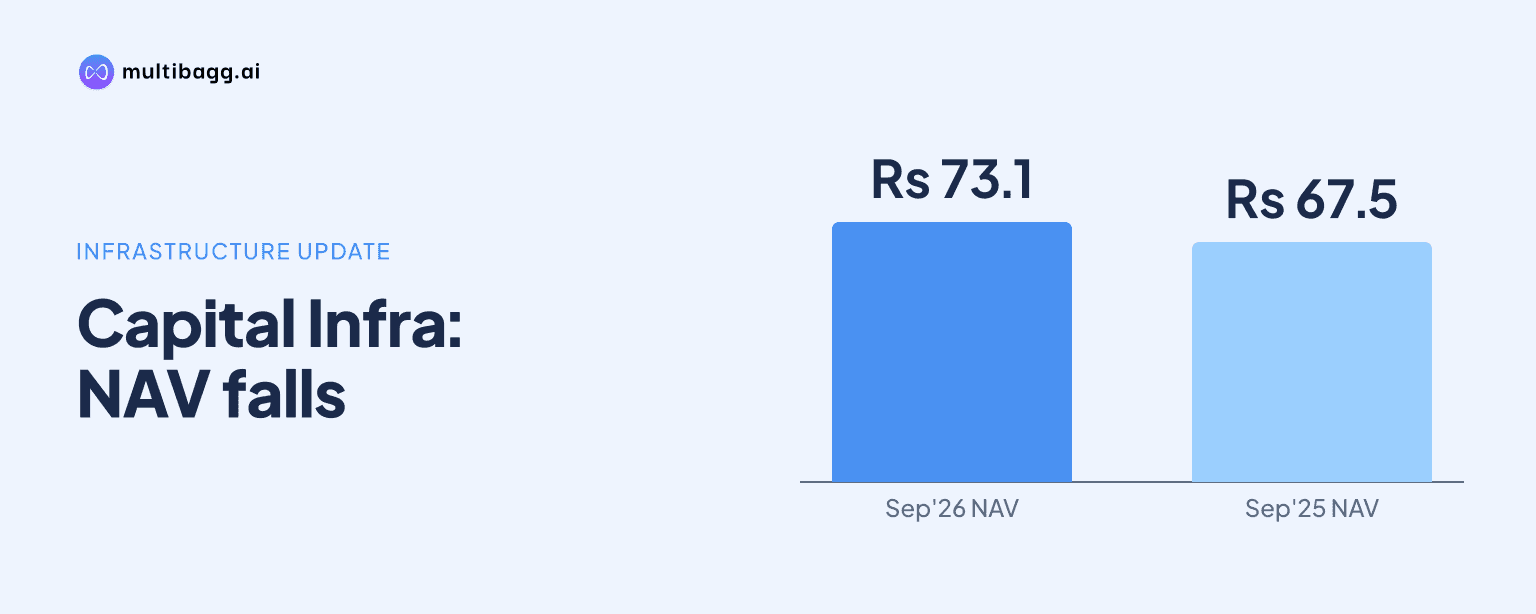
Capital Infra Trust reported net asset value (NAV) of Rs 73.1 per unit in Sep'26, 8% above Rs 67.5 in Sep'25 but Rs 0.1 below Jun'26, with the presentation attributing the near-term movement to acquisition timing and a higher weighted average cost of capital (WACC).
Know Capital Infra Trust inside out
Results, valuation, peers and who's buying, in one view.
Why did CIT's NAV fall sequentially?
CIT's NAV fell marginally because management cited acquisition timing and higher WACC as factors affecting the Sep'26 reported valuation. NAV moved from Rs 73.2 per unit in Jun'26 to Rs 73.1 in Sep'26, a decline of Rs 0.1 per unit. The presentation does not disclose the WACC assumption, the size of its change, or the separate valuation effect of each factor.
The longer comparison shows a different trend. NAV rose from Rs 67.5 per unit in Sep'25 to Rs 72.3 in Dec'25 and Rs 74.7 in Mar'26, before declining to Rs 73.2 in Jun'26 and Rs 73.1 in Sep'26. Sep'26 NAV was therefore Rs 5.6 per unit above the prior-year level, while remaining Rs 1.6 below the Mar'26 level.
Does CIT's September NAV include the six acquired assets?
No, CIT stated that its Sep'26 NAV of Rs 73.1 per unit excludes the six acquired special purpose vehicles (SPVs). This qualification matters because the presentation says the acquisitions are expected to support NAV going forward, but it does not provide a pro forma Sep'26 NAV that includes the six SPVs.
The Jun'26 NAV of Rs 73.2 per unit also carries a separate qualification. CIT said that valuation was undertaken after the quarter end for institutional placement purposes, while the Sep'26 figure excludes the acquired SPVs. The presentation identifies both reporting contexts but does not quantify how either one changes the comparison between the two periods.
What supports CIT's cash-flow visibility?
CIT says hybrid annuity model (HAM) assets provide predictable annuity-based receipts and that fixed project management and administration (PMA) costs improve visibility over operating costs. The mechanism is intended to improve the matching of annuity inflows and operating expenses across the 18-asset portfolio following the Nov'26 acquisition.
Reported annuity accrued was Rs 380.37 crore in Q1FY27 and Rs 227.22 crore in Q2FY27, a quarter-on-quarter reduction of Rs 153.15 crore. Despite that decline, CIT describes cash flows as strong and cites inflation-linked HAM annuity receivables from the National Highways Authority of India (NHAI), no traffic-risk exposure and largely fixed operating and maintenance obligations as supports for distribution planning.
Got a follow-up? Ask IRIS
What does CIT's distribution record show?
CIT paid distribution per unit (DPU) of Rs 2.3 in both Q1FY27 and Q2FY27, leaving the quarterly payout unchanged sequentially. The Q2FY27 DPU was lower than Rs 3.3 in Q2FY26 and Rs 3.6 in Q1FY26. Management has disclosed an FY27 DPU range of Rs 9.0 to Rs 9.25 per unit rather than a fixed distribution commitment.
Since its initial public offering (IPO), CIT has distributed Rs 1,358.88 crore to unitholders, equivalent to cumulative DPU of Rs 40.1 per unit. The presentation says operating-asset additions expand the annuity base and underpin cash-flow visibility, but it does not state how much of the FY27 DPU range had been distributed by Q2FY27.
How could the six-asset acquisition change CIT's valuation base?
CIT transacted the six assets in Nov'26 at enterprise value (EV) of Rs 2,781.8 crore after working-capital adjustments. That value was Rs 139.6 crore below the Jun'26 valuer's EV of Rs 2,921.4 crore and Rs 6.5 crore above the Rs 2,775.3 crore EV approved by unitholders. The transaction doubled the asset count from nine at IPO to 18 in Nov'26.
CIT reported assets under management (AUM) of Rs 6,488.9 crore in Sep'26, compared with Rs 4,281.8 crore in Sep'25, a stated 51% increase. It projects post-acquisition AUM of about Rs 9,410.3 crore and has set an FY27 ambition of about Rs 10,000 crore. Average residual asset life is shown rising from 11.3 years at IPO to more than 12 years after the acquisition.
How does CIT's debt profile relate to the valuation discussion?
CIT reported gross debt of Rs 2,895.05 crore and net debt of Rs 2,429.58 crore at 30 September 2026, with net debt to EV of 40.3%. Its effective borrowing cost was 7.3% per annum, providing context for management's reference to higher WACC, although the presentation does not equate the borrowing cost with WACC.
Floating-rate loans represented 58.4% of CIT's debt, or Rs 1,680.48 crore, while fixed-rate borrowings represented 41.6%, or Rs 1,197.60 crore. CIT says an increase in benchmark rates raises floating-rate interest expense but can be partly offset as interest-linked HAM receipts reset with benchmark rates. The presentation reports a debt service coverage ratio of 2.27 times and a AAA Stable credit rating at 30 September 2026.
Conclusion
CIT's Sep'26 NAV result separates annual valuation growth from a small sequential decline: NAV was 8% higher year on year at Rs 73.1 per unit, but Rs 0.1 below Jun'26. Management attributes the movement to acquisition timing and higher WACC, while the reported NAV excludes six acquired SPVs and Q2FY27 annuity accrued was Rs 227.22 crore, below Rs 380.37 crore in Q1FY27.
The next disclosed milestones are incorporation of the six Nov'26 acquired assets into the valuation base and progress toward management's FY27 AUM ambition of about Rs 10,000 crore. Investors can also watch delivery against the FY27 DPU range of Rs 9.0 to Rs 9.25 per unit, as well as put or call options on Rs 243.8 crore of non-convertible debentures in Q4FY27 and Rs 914.7 crore in Q4FY28.