










Capital Infra Trust says rate hikes can support receipts and NAV
Key highlights
- Capital Infra Trust expects 50 to 75 basis points of further rate hikes over the next nine to 12 months.
- Capital Infra Trust reported NAV of Rs 73.10 per unit in September 2026, compared with Rs 67.50 per unit a year earlier.
- Capital Infra Trust reported Q2 FY27 net distributable cash flow of Rs 161.20 crore and approved a Rs 150.95 crore distribution.
- Capital Infra Trust said it could acquire about Rs 2,500 crore of assets through debt only at a 57.5% net borrowing ratio.
powered by IRIS
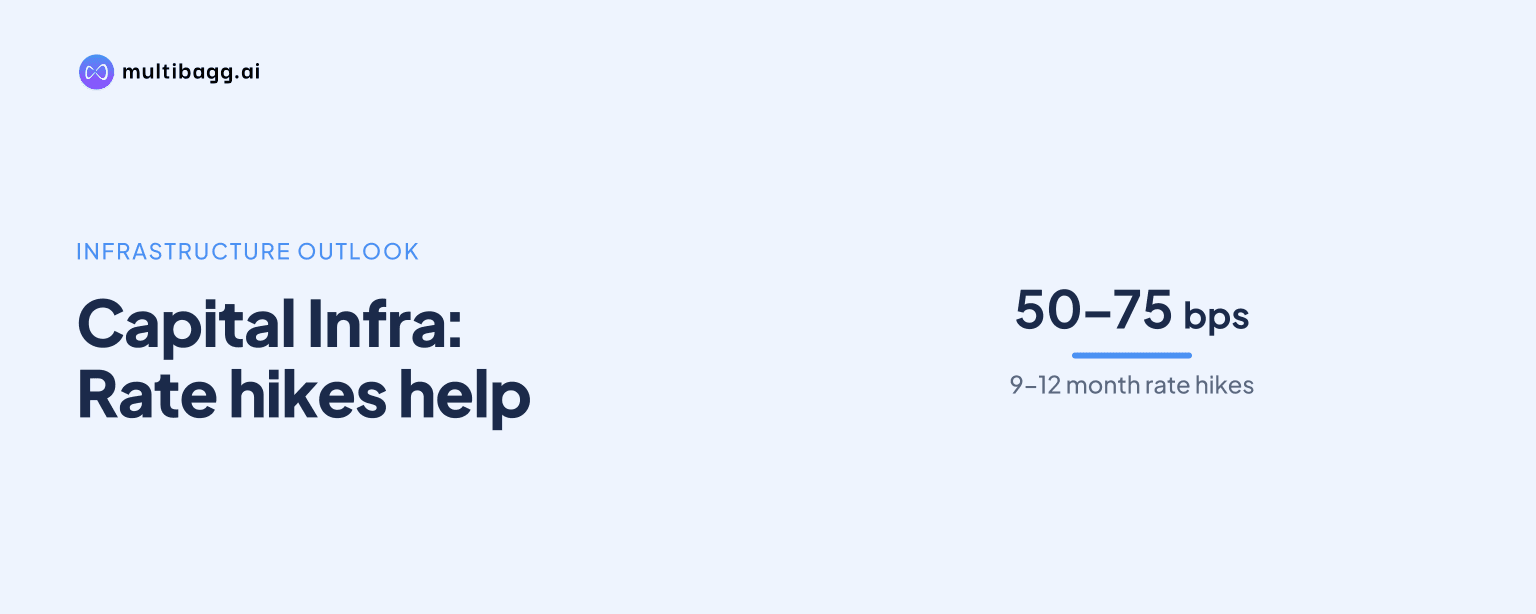
Capital Infra Trust said a further 50 to 75 basis points of bank-rate increases over the next nine to 12 months could raise its National Highways Authority of India annuity receipts and support net asset value, or NAV. Management said operating and maintenance costs are fixed under annual project contracts, although the outlook remains conditional on Indian and global macroeconomic conditions.
Know Capital Infra Trust inside out
Results, valuation, peers and who's buying, in one view.
How do higher bank rates change Capital Infra Trust's receipts and costs?
Higher bank rates increase Capital Infra Trust's receipts because its completed hybrid annuity model, or HAM, road projects receive quarterly annuity cash flows from the National Highways Authority of India, or NHAI, with an interest-rate component linked to the Reserve Bank of India bank rate. Management said this mechanism means a rate increase lifts NHAI receipts rather than affecting only the Trust's funding costs.
Capital Infra Trust's operating costs use a different structure: its sponsor, acting as project manager, operates and maintains the assets under fixed-price contracts agreed at acquisition. Management said each project pays a fixed amount for the financial year, with operating and maintenance, or O&M, expense increasing 5% annually. It said there was no O&M variation between Q2 FY27 and Q1 FY27, despite accounting items linked to newer projects making reported expenses appear marginally higher.
Management also distinguished the portfolio from toll roads exposed to traffic growth and toll-rate changes. Capital Infra Trust said its revenue is predictable because it comes from NHAI annuities, while expenditure is planned annually across the portfolio. At September 2026, however, 58% of borrowings were floating rate and 42% fixed rate, so higher policy rates can also affect the cost of the Trust's floating-rate debt.
What further rate increase does Capital Infra Trust expect?
Capital Infra Trust expects 50 to 75 basis points of further hikes over the next nine to 12 months after one 25-basis-point increase had already occurred. Management said any subsequent increase depends on Indian and global macroeconomic conditions, making this an expectation rather than formal guidance on the path of the bank rate.
The first 25-basis-point rise was already reflected in Capital Infra Trust's September 2026 valuation. Management said the rise increased forecast cash flows but was also incorporated in the weighted average cost of capital, or WACC, which rose to 7.22% in September from 7.0% previously. According to management, the effects of the higher receipts and higher discount rate broadly offset each other in that valuation.
Rate changes can also affect accounting income. Capital Infra Trust classifies assets held in special purpose vehicles, or SPVs, as financial assets and uses the percentage-completion method of accounting. Management said a modification gain or loss arises when major assumptions change, including the bank rate; inflation can also contribute because it affects the O&M income received from NHAI.
Can higher rates lift Capital Infra Trust's NAV?
Higher rates can support Capital Infra Trust's NAV over time through higher bank-rate-linked annuity cash flows, but management said NAV is difficult to predict. NAV was Rs 73.10 per unit in September 2026, compared with Rs 67.50 per unit in September 2025, representing approximately 8% annualised growth even though the September figure excluded six assets acquired later.
The September 2026 NAV was marginally below Rs 73.20 per unit in June 2026. Management attributed the movement to updated valuation assumptions, including the 7.22% WACC, and an increase in the SPV income-tax rate to 28.6% from 25.2%. It said the tax-rate change alone lowered NAV by almost Rs 1.05 per unit.
Acquisition discounts have been another driver of NAV movement. Management said three assets acquired in December 2025 were bought at more than a 9% discount to enterprise value, helping the 12-month NAV increase. The six later acquisitions were completed at about a 5% discount to their June valuation; management said September 2026 NAV would have been about Rs 76.50 per unit if those assets were included at June values.
Got a follow-up? Ask IRIS
What do rate-linked receipts mean for Capital Infra Trust's earnings and distributions?
Capital Infra Trust reported consolidated total income of Rs 342.47 crore in Q2 FY27, compared with Rs 294.95 crore in Q1 FY27. Earnings before interest, tax, depreciation and amortisation, or EBITDA, rose to Rs 224.21 crore from Rs 180.74 crore, while profit after tax rose to Rs 149.51 crore from Rs 125.62 crore. Management said quarterly income can vary with the timing and seasonality of recognition within assets.
For H1 FY27, consolidated total income was Rs 637.42 crore, up from Rs 393.34 crore in H1 FY26, and EBITDA was Rs 404.95 crore against Rs 72.05 crore. Management attributed the year-on-year increase to contributions from 12 assets versus nine in the previous year, as well as the bank-rate-linked modification gain. It cautioned that this accounting gain is distinct from cash available for distribution.
Cash collections and distributions remained below the accounting income figures in Q2 FY27. Five of six due annuities, totalling Rs 186.33 crore, were received in the quarter, while the remaining approximately Rs 40.89 crore was received in October 2026. SPV-level operating cash flow was Rs 285.10 crore and net distributable cash flow at InvIT level was Rs 161.20 crore, against which the board approved a Rs 150.95 crore distribution and retained about Rs 10.25 crore.
The Q2 FY27 distribution was Rs 2.30 per unit, taking H1 cash yield to approximately 6%. Capital Infra Trust reiterated FY27 distribution per unit, or DPU, guidance of Rs 9 to Rs 9.25 per unit. Management said it was initially looking at 5% to 10% DPU growth in FY28, but would be better placed to comment in the next call or the Q4 FY27 earnings call.
How does Capital Infra Trust fund growth while managing rate exposure?
Capital Infra Trust had consolidated net debt equal to 40.3% of enterprise value at September 2026 and expects the ratio to be about 45% after the completed acquisitions. Its annualised borrowing cost was 7.3% in the September quarter. Management said it aims to maintain leverage around 60%, although the applicable limit is 70%, leaving capacity for debt-funded acquisitions.
Management said Capital Infra Trust could add about Rs 2,500 crore of assets through debt only if its net borrowing ratio reached 57.5%. The Trust raised Rs 125 crore through a preferential issue in September 2026 and Rs 1,115 crore through a qualified institutional placement in October, alongside approximately Rs 1,540 crore of debt, to support six acquisitions.
The near-term acquisition focus remains HAM-based road assets. Capital Infra Trust said the sponsor's right-of-first-offer, or ROFO, pipeline includes 12 projects with a bid project cost of around Rs 15,500 crore maturing over three to four years. Two assets may be ready for acquisition in May 2027, once they receive provisional or commercial operations dates, and management said it would seek a 3% to 5% discount to independent valuation.
Conclusion
Capital Infra Trust's rate sensitivity comes from the link between the bank rate and NHAI annuity receipts, alongside annual fixed-price O&M contracts. The structure can increase receipts when rates rise, but the September 2026 valuation showed that a higher discount rate can offset the immediate NAV effect, while 58% floating-rate borrowings leave part of funding costs exposed to rates.
The next-quarter results should provide management's first fuller view of expenses across the 18-asset portfolio. Investors can also watch whether the projected 50 to 75 basis points of further hikes occur, whether the two ROFO assets targeted for May 2027 reach required operating milestones, and management's FY28 DPU commentary at or before the Q4 FY27 earnings call.