










Capital Infra Trust says tax change cut NAV by Rs 1.05 per unit
Key highlights
- Capital Infra Trust said the SPV tax rate rose to 28.6% from 25.2%, reducing NAV by about Rs 1.05 per unit.
- September 2026 NAV was Rs 73.1 per unit excluding six acquisitions, while management's illustrative value including them at June valuation was Rs 76.5.
- Capital Infra Trust used a 7.22% WACC in September versus 7.0% earlier and said the 25-basis-point bank-rate effect offset the higher discount rate.
- Q2 FY27 net distributable cash flow was Rs 161.2 crore and the approved distribution was Rs 150.95 crore.
powered by IRIS
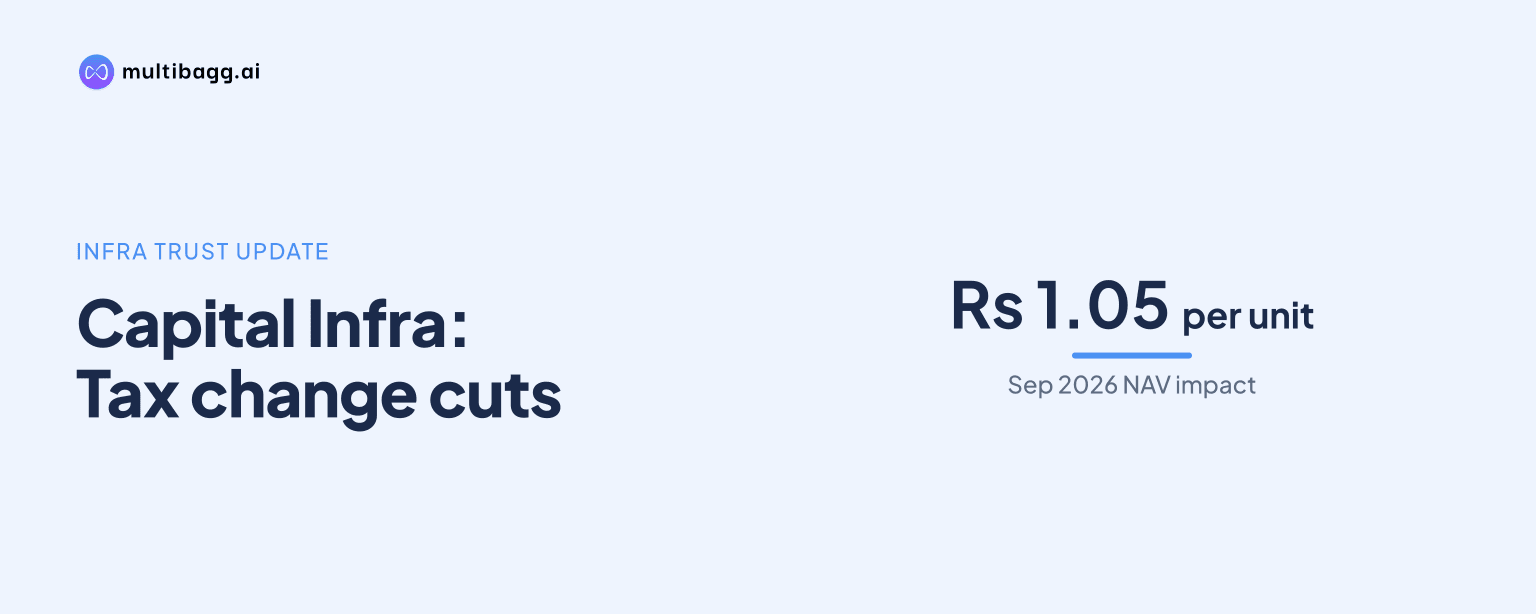
In September 2026, Capital Infra Trust said a special purpose vehicle tax-rate increase from 25.2% to 28.6% reduced net asset value by about Rs 1.05 per unit, partly offsetting an 8% annualised increase in reported NAV to Rs 73.1 per unit, excluding six recently acquired assets.
Know Capital Infra Trust inside out
Results, valuation, peers and who's buying, in one view.
How did the tax-rate increase affect Capital Infra Trust NAV?
The tax-rate change reduced Capital Infra Trust NAV by almost Rs 1.05 per unit. Management said the income-tax rate within the investment trust's special purpose vehicles, or SPVs, increased to 28.6% from 25.2% during the June quarter, lowering the NAV calculation discussed for September 2026.
Management identified the tax change separately from the interest-rate and acquisition effects on valuation. The reported September 2026 NAV was Rs 73.1 per unit, excluding six assets acquired after September. Management said NAV would have been around Rs 76.5 per unit if those six assets had been included at their June valuation, but that was an illustration rather than reported NAV.
The comparison shows that the tax-related reduction occurred while NAV was also influenced by acquisitions. Management said the six assets were acquired at about a 5% discount to their June valuation. Their absence from the September NAV calculation means the Rs 73.1 figure did not include their potential valuation contribution.
Why did the higher discount rate not reduce Capital Infra Trust NAV further?
Management said the higher weighted average cost of capital, or WACC, did not have a net effect on September NAV because higher rate-linked cash flows offset it. WACC increased to 7.22% in the September valuation from 7.0% previously, while a 25-basis-point increase in the bank rate was incorporated in both cash flows and WACC.
Capital Infra Trust invests in hybrid annuity model, or HAM, road assets, under which receipts from the National Highways Authority of India, or NHAI, include an interest-rate-linked component tied to the Reserve Bank of India bank rate. Management said this mechanism means a bank-rate increase can increase receipts, while a higher WACC reduces the present value applied in the NAV calculation.
Management also said SPV assets are accounted for as financial assets under the percentage-completion method. Changes in major assumptions can therefore create modification gains or losses. The 25-basis-point bank-rate increase was the main contributor to the modification gain discussed on the call, while higher inflation-linked operations and maintenance, or O&M, income from NHAI also contributed.
Got a follow-up? Ask IRIS
What drove Capital Infra Trust NAV growth before the tax effect?
Capital Infra Trust said NAV rose at an annualised 8% from around Rs 67.5 per unit in September 25 to Rs 73.1 per unit in September 2026, excluding the six recent acquisitions. Management attributed much of this increase to three assets acquired in December of the prior year at a discount of more than 9% to enterprise value.
The later six acquisitions were bought at about a 5% discount to their June valuation, management said. These assets would take assets under management, or AUM, to around Rs 9,400 crore, although they were not included in September AUM. Management's Rs 76.5 illustrative NAV value used the June value of those assets and was not guidance for the next reported NAV.
Cash flows and distributions were separate from the accounting valuation movements. During Q2 FY27, SPV-level operating cash flow was Rs 285.1 crore and net distributable cash flow at the investment trust level was Rs 161.2 crore. Capital Infra Trust approved a distribution of Rs 150.95 crore and retained about Rs 10.25 crore.
Of six annuities due in Q2 FY27, five totalling Rs 186.33 crore were received during the quarter. The remaining annuity of approximately Rs 40.89 crore was received in October 2026. Management said the accounting modification gain should be distinguished from distributable cash flows, which are reflected in the approved distribution and retained amount.
What could change Capital Infra Trust NAV next?
Management said future NAV is difficult to predict because acquisitions, interest-rate movements and changes in valuation assumptions can all affect it. It expects a further 50 to 75 basis points of bank-rate increases over the next nine to 12 months, subject to Indian and global macroeconomic conditions, and said such increases would benefit its rate-linked receipt model.
Capital Infra Trust also has debt capacity that could alter the portfolio's size. Management said leverage was around 40.3%, versus a regulatory limit of 70%, while its strategy is to keep leverage near 60%. It said it had debt-funded capacity to acquire assets worth approximately Rs 2,000 crore to Rs 2,500 crore.
Management separately said that, after the acquisitions, net debt to enterprise value would be around 45%. A leverage target of 57.5% could support approximately Rs 2,500 crore of additional AUM through debt, according to management. The September-quarter annualised borrowing cost was 7.3%, and management said it saw no current need to refinance existing borrowings.
The sponsor right-of-first-offer, or ROFO, pipeline comprises 12 projects with bid project cost of around Rs 15,500 crore that are expected to mature over the next three to four years. Two assets worth around Rs 1,250 crore are expected to be ready for acquisition in Q1 of the next financial year, or May 2027, subject to receiving provisional commercial operations date or commercial operations date.
Conclusion
Capital Infra Trust's September 2026 NAV discussion separates a tax-driven valuation headwind from rate-linked cash-flow and acquisition effects. The SPV tax rate rose by 3.4 percentage points and reduced NAV by about Rs 1.05 per unit, while reported NAV still rose from Rs 67.5 in September 25 to Rs 73.1 in September 2026, excluding six acquisitions.
The next results should show the contribution from the full portfolio of 18 assets after the six acquisitions were excluded from September NAV. Investors can watch for the two ROFO assets targeted for May 2027, use of the stated Rs 2,000 crore to Rs 2,500 crore debt acquisition headroom, and management's fuller FY28 distribution-per-unit outlook; management indicated a 5% to 10% increase in distribution per unit next year.