










Capital Infra Trust targets Rs 3,000-3,500 crore FY28 additions
Key highlights
- Capital Infra Trust targets Rs 3,000 crore to Rs 3,500 crore of FY28 asset additions.
- Capital Infra Trust estimates Rs 2,000 crore to Rs 2,500 crore of debt headroom for acquisitions.
- Six post-September acquisitions increased Capital Infra Trust’s indicative asset base to about Rs 9,410 crore.
- Two sponsor ROFO assets worth around Rs 1,250 crore may be ready in Q1 of FY28.
powered by IRIS
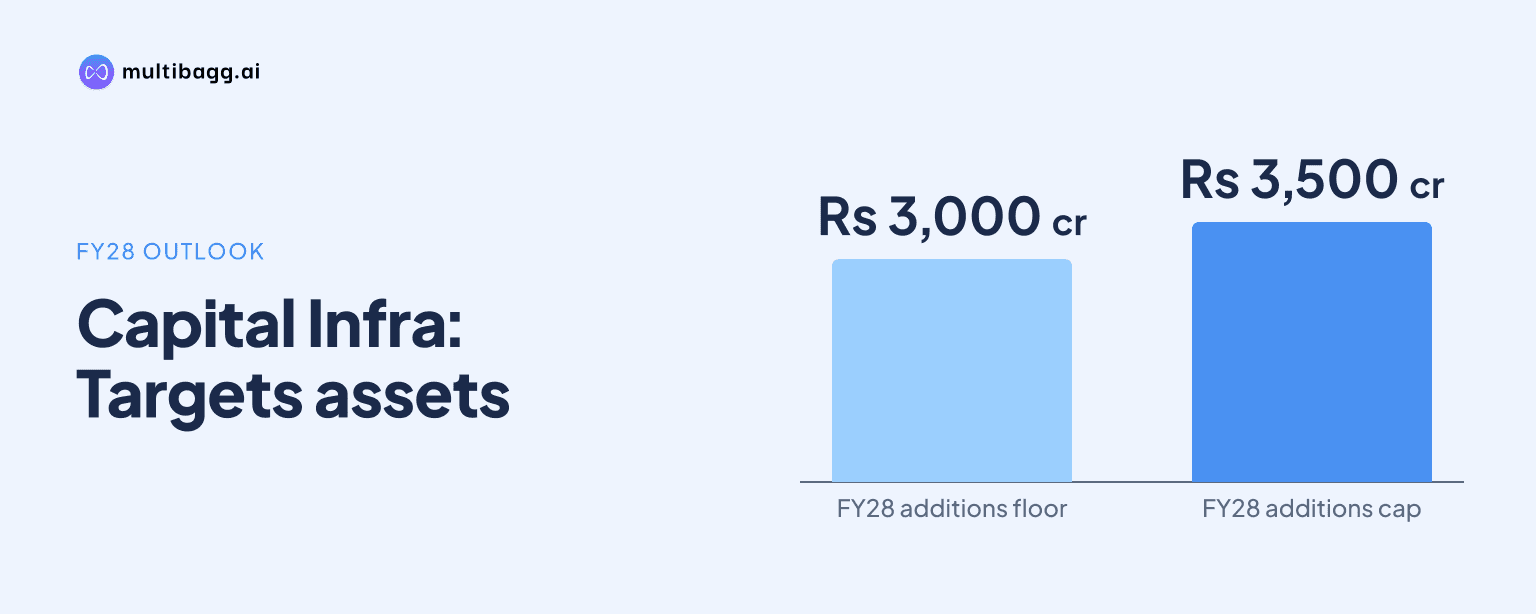
Capital Infra Trust Limited plans to add at least Rs 3,000 crore to Rs 3,500 crore of assets by FY28-end, using Rs 2,000 crore to Rs 2,500 crore of leverage headroom before another equity raise, management said on November 16, 2026, after six acquisitions lifted its indicative asset base to about Rs 9,410 crore.
Know Capital Infra Trust inside out
Results, valuation, peers and who's buying, in one view.
What is Capital Infra Trust’s FY28 asset-addition target?
Capital Infra Trust targets at least Rs 3,000 crore to Rs 3,500 crore of asset additions by the end of FY28, which management described as the next financial year. The stated plan is in addition to the portfolio it had after the six acquisitions completed following September 2026, rather than a replacement for its FY27 ambition of about Rs 10,000 crore in assets under management, or AUM.
The Trust reported AUM of Rs 6,489 crore at September 2026, when it held 12 assets. Including the independent valuation of the six subsequently acquired assets, its indicative asset base increased to about Rs 9,410 crore and the portfolio rose to 18 assets. The six assets were bought from the sponsor’s right-of-first-offer, or ROFO, pipeline for an enterprise value of Rs 2,781 crore, approximately 5% below independent valuation.
The acquired assets have an average residual concession life of 12 years, according to management. Capital Infra Trust said it will continue to pursue completed hybrid annuity model, or HAM, road assets in the short to medium term, using sponsor ROFO opportunities and third-party operational assets as the two acquisition channels.
How will Capital Infra Trust fund FY28 acquisitions?
Capital Infra Trust plans to deploy Rs 2,000 crore to Rs 2,500 crore of debt capacity for acquisitions before conducting another equity raise. Management said the leverage headroom could first fund assets worth at least that amount, after which the Trust would seek fresh equity to support further expansion.
The latest six-asset purchase was funded with Rs 1,240 crore of equity and approximately Rs 1,540 crore of debt. The equity comprised a Rs 125 crore preferential issue in September 2026 and a Rs 1,115 crore qualified institutional placement, or QIP, in October 2026. This transaction provides the comparison for the proposed sequence of using debt capacity before another capital raise.
Consolidated net debt to enterprise value was 40.3% at September 2026, and management expected the post-acquisition net borrowing ratio to be about 45%. It said the applicable leverage limit is 70%, while its operating approach is to keep leverage around 60%. At September-end, 42% of borrowings were fixed rate and 58% floating rate, at an annualised effective borrowing cost of 7.3%.
Which acquisitions are visible in Capital Infra Trust’s pipeline?
Capital Infra Trust has visibility on two sponsor ROFO assets worth around Rs 1,250 crore that management expects to be ready for acquisition in Q1 of FY28. Those assets account for part of the Rs 3,000 crore to Rs 3,500 crore annual addition plan, while management said it is also actively pursuing third-party assets.
The sponsor’s identified ROFO pipeline contained 12 projects with aggregate bid project cost of about Rs 15,500 crore, expected to mature over the next three to four years. It includes Shillong-Silchar, where the sponsor had recently been selected as L1, or lowest bidder, but the project award was pending as of the November 16 call.
Management said the current road-sector pipeline provides visibility for Rs 3,000 crore to Rs 3,500 crore of acquisitions each year for the next three years. It said Capital Infra Trust does not expect to diversify into toll-operate-transfer, or TOT, assets or other sectors in the short to medium term, but may consider this once AUM reaches around Rs 20,000 crore.
Got a follow-up? Ask IRIS
What cash-flow model underpins Capital Infra Trust’s expansion?
Capital Infra Trust’s acquisition strategy is based on completed HAM road projects with annuity receipts from the National Highways Authority of India, or NHAI. Management said these receipts include an interest component linked to the Reserve Bank of India bank rate, while operating and maintenance work is contracted to its sponsor under fixed-price arrangements set at acquisition.
For Q2 FY27, special-purpose vehicle, or SPV, operating cash flow was Rs 285.1 crore and net distributable cash flow at the InvIT level was Rs 161.2 crore. The approved distribution was Rs 150.95 crore, leaving Rs 10.25 crore retained by the Trust. The Board approved a Q2 distribution of Rs 2.30 per unit, and management reiterated FY27 distribution-per-unit guidance of Rs 9 to Rs 9.25.
Five of six annuities due in Q2 FY27, aggregating Rs 186.33 crore, were received during the quarter. The remaining annuity of about Rs 40.89 crore was received in October 2026. Management distinguished these cash receipts from accounting modification gains, which can arise when assumptions including interest rates and inflation change.
How could the six acquisitions affect Capital Infra Trust’s NAV?
Capital Infra Trust said its reported September 2026 net asset value, or NAV, of Rs 73.10 per unit would have been around Rs 76.50 if the six assets had been included at their June valuation. The reported NAV excluded those post-September acquisitions and was Rs 73.20 in June 2026 and Rs 67.50 in September 2025, representing approximately 8% year-on-year growth.
Management said the six assets were acquired at about a 5% discount to their June valuation. It also said a 25-basis-point bank-rate increase was reflected in both cash flows and the weighted average cost of capital, or WACC, which increased to 7.22% in September from 7.0% earlier, resulting in a nullified overall valuation effect from that rate change.
A separate tax assumption reduced NAV. Management said the tax rate within SPVs increased to 28.6% from 25.2%, lowering NAV by almost Rs 1.05 per unit. It said future NAV is difficult to predict because discount rates, interest rates, inflation and tax assumptions may change alongside the effect of further acquisitions.
Conclusion
Capital Infra Trust has set out a debt-first growth plan after expanding its portfolio from 12 to 18 assets and lifting its indicative asset base to about Rs 9,410 crore. The proposed Rs 3,000 crore to Rs 3,500 crore of FY28 additions depend on HAM road acquisitions from the sponsor ROFO pipeline and third-party market, while management intends to keep leverage around 60% rather than approach the 70% limit.
The next disclosed milestone is the expected Q1 FY28 readiness of two sponsor ROFO assets worth about Rs 1,250 crore. Investors will also watch debt deployment against the stated Rs 2,000 crore to Rs 2,500 crore headroom, progress on third-party acquisitions, and the timing of the next equity raise that management said would follow this debt-funded phase.