










Acme Universal Safezone 9 profit coincides with working-capital outflow
Key highlights
- Acme Universal Safezone 9 reported a Rs 7.02 crore profit for the half year ended September 30, 2026, compared with a Rs 7.55 crore loss a year earlier.
- Inventory and trade receivables increased by a combined Rs 14.17 crore during the half year ended September 30, 2026.
- Total borrowings fell by Rs 2.05 crore to Rs 55.99 crore at September 30, 2026, as short-term debt declined by Rs 3.99 crore.
- Investing activities used Rs 6.04 crore in the September 2026 half year, including Rs 6.71 crore spent on property, plant and equipment, intangible assets and capital work-in-progress.
powered by IRIS
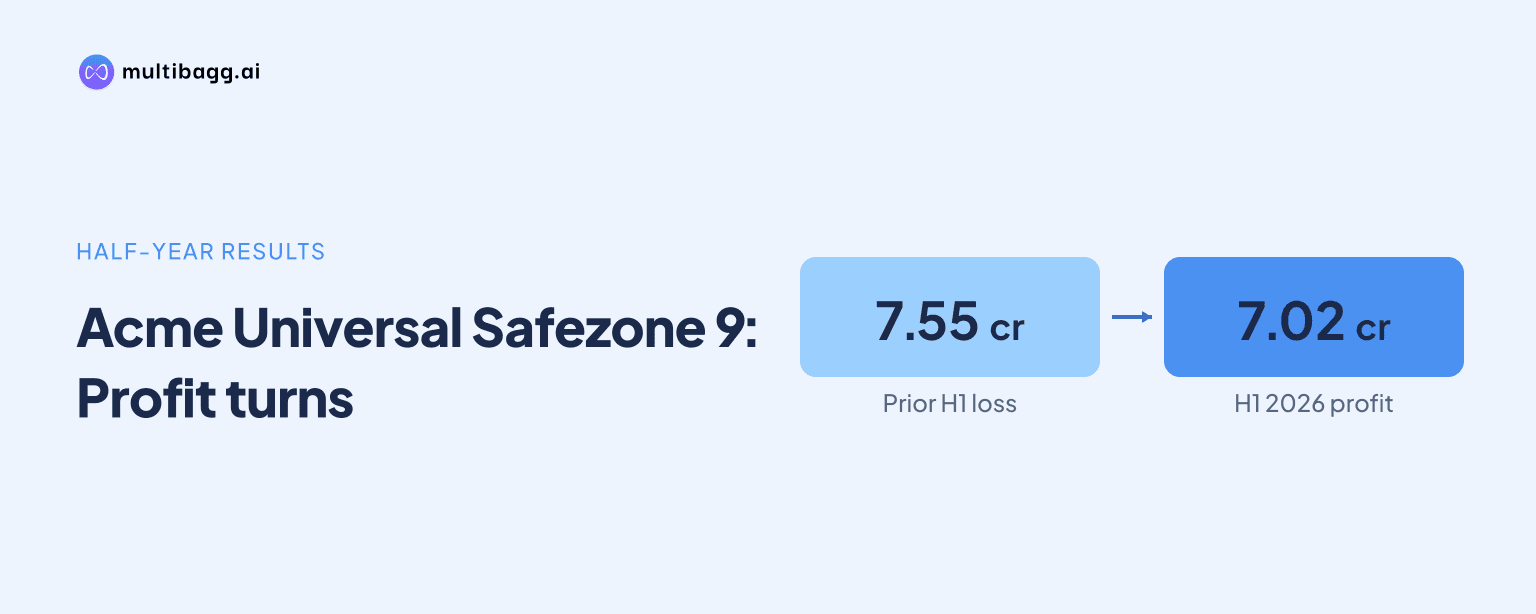
Acme Universal Safezone 9 Limited reported a Rs 7.02 crore profit for the half year ended September 30, 2026, while inventories and trade receivables rose by a combined Rs 14.17 crore. The cash-flow statement records a Rs 4.10 crore net working-capital outflow, as increases in supplier and other liabilities only partly offset higher operating assets.
Know Acme Universal Safezone 9 inside out
Results, valuation, peers and who's buying, in one view.
Why did Acme Universal Safezone 9’s working capital use cash?
Acme Universal Safezone 9 used Rs 4.10 crore of cash through working-capital movements in the half year ended September 30, 2026, because increases in operating assets exceeded increases in operating liabilities. The largest cash uses were a Rs 7.19 crore inventory increase and a Rs 6.98 crore increase in trade receivables.
The balance sheet confirms that inventory rose to Rs 42.42 crore at September 30, 2026, from Rs 35.23 crore at March 31, 2026. Trade receivables increased to Rs 35.78 crore from Rs 28.80 crore over the same period. Together, those two current-asset balances rose Rs 14.17 crore during the half year.
Other operating assets also absorbed cash. Short-term loans and advances increased by Rs 1.19 crore, other current assets increased by Rs 2.22 crore, and long-term loans and advances rose by Rs 1.14 crore. The cash-flow statement additionally records Rs 0.33 crore of higher other non-current assets and Rs 0.03 crore of higher non-current assets.
How did Acme Universal Safezone 9’s liabilities offset asset growth?
Acme Universal Safezone 9’s operating liabilities supplied Rs 14.98 crore of cash, partly offsetting Rs 19.08 crore of cash used by operating-asset increases. The difference between those movements was the Rs 4.10 crore cash used in operations before direct taxes shown in the cash-flow statement.
Trade payables rose Rs 5.48 crore to Rs 28.48 crore at September 30, 2026, from Rs 23.00 crore at March 31, 2026. Dues to micro enterprises and small enterprises increased Rs 2.19 crore to Rs 13.45 crore, while dues to creditors other than micro enterprises and small enterprises increased Rs 3.29 crore to Rs 15.03 crore.
Other current liabilities contributed Rs 1.69 crore of cash, short-term provisions contributed Rs 2.52 crore, and other non-current liabilities contributed Rs 5.29 crore. On the balance sheet, other non-current liabilities rose to Rs 8.41 crore from Rs 3.28 crore, while short-term provisions rose to Rs 3.13 crore from Rs 0.52 crore.
The comparison with the period ended March 31, 2026 shows a change in receivables. Trade receivables generated Rs 1.47 crore of cash in that period but used Rs 6.98 crore in the September 2026 half year. Inventory also used more cash in the September half year, at Rs 7.19 crore compared with Rs 6.32 crore in the period ended March 31, 2026.
Did Acme Universal Safezone 9 convert profit into operating cash?
Acme Universal Safezone 9 reported Rs 15.65 crore of operating profit before working-capital changes and Rs 9.26 crore of net cash generated from operating activities for the half year ended September 30, 2026. However, the cash-flow lines immediately above that total show Rs 4.10 crore cash used in operations and Rs 2.29 crore of direct taxes paid.
Profit before tax was Rs 9.31 crore, while depreciation and amortisation of Rs 4.78 crore and finance cost of Rs 1.76 crore were added back in the operating-cash calculation. The statement also includes a Rs 0.32 crore gratuity provision, while deducting Rs 0.13 crore of interest income, Rs 0.16 crore of government grant income and Rs 0.24 crore profit on asset sales.
The reported Rs 9.26 crore operating-cash figure does not reconcile arithmetically with the disclosed Rs 4.10 crore cash used in operations and Rs 2.29 crore direct tax payment. Those two lines imply a Rs 6.39 crore outflow before any undisclosed adjustment. The filing does not explain the difference, so the reported operating-cash total should be read alongside the component lines.
The filing also does not provide customer ageing, inventory categories, collection terms or an explanation for the Rs 14.17 crore combined increase in inventory and receivables. It therefore identifies the balance-sheet and cash-flow effects, but does not attribute them to particular products, customers or timing factors.
Got a follow-up? Ask IRIS
What happened to Acme Universal Safezone 9’s debt, investment and cash?
Acme Universal Safezone 9’s total borrowings fell Rs 2.05 crore to Rs 55.99 crore at September 30, 2026. A Rs 3.99 crore reduction in short-term borrowings, to Rs 40.22 crore, exceeded a Rs 1.94 crore increase in long-term borrowings, which reached Rs 15.77 crore.
The cash-flow statement reports Rs 3.82 crore of net cash used in financing activities for the September half year, compared with Rs 5.21 crore generated in the period ended March 31, 2026. It lists Rs 1.94 crore of net long-term borrowing proceeds, a Rs 3.99 crore short-term borrowing repayment and Rs 1.76 crore of interest and financial charges within the financing section.
Investing activities used Rs 6.04 crore in the September half year, compared with Rs 12.03 crore in the period ended March 31, 2026. Purchases of property, plant and equipment, intangible assets and capital work-in-progress totalled Rs 6.71 crore, partly offset by Rs 0.79 crore from fixed-asset sales and Rs 0.13 crore of interest received.
The cash-flow statement records cash and bank balances of Rs 0.29 crore at September 30, 2026, down from Rs 0.89 crore at the beginning of the year. The balance sheet separately shows Rs 2.92 crore in cash and other bank balances at September 30, so its broader caption should not be treated as the same measure as the cash-flow statement’s cash-and-bank balance.
How did Acme Universal Safezone 9’s profit compare with the previous half year?
Acme Universal Safezone 9 reported Rs 7.02 crore profit for the half year ended September 30, 2026, compared with a Rs 7.55 crore loss for the half year ended September 30, 2025. Revenue from operations increased to Rs 119.93 crore from Rs 103.31 crore, while profit before tax moved to Rs 9.31 crore from a Rs 6.60 crore loss.
Total expenses rose to Rs 113.43 crore from Rs 100.69 crore, including Rs 87.21 crore of material costs and Rs 17.03 crore of employee benefit expenses. Total income rose to Rs 122.74 crore from Rs 105.30 crore, leaving profit before tax of Rs 9.31 crore after the company recorded no exceptional or extraordinary item in either half year.
The company states that it has one reportable segment under Accounting Standard 17, or AS-17, issued by the Institute of Chartered Accountants of India. It therefore did not provide segment-level revenue, profit, inventory or receivables figures that could explain the working-capital movement across different business lines.
Conclusion
Acme Universal Safezone 9 combined a Rs 7.02 crore September-half profit with a Rs 14.17 crore increase in inventories and trade receivables. Higher trade payables, provisions and other liabilities partly financed those increases, but the cash-flow statement still records a Rs 4.10 crore working-capital outflow before direct taxes.
The disclosed unresolved matter is the difference between the Rs 9.26 crore reported operating-cash inflow and the component cash-flow lines, which show Rs 4.10 crore used in operations plus Rs 2.29 crore of taxes paid. Future disclosures will show whether the higher inventory and receivables balances reverse and whether the reported operating-cash total is reconciled.