










Aditya Consumer Marketing Limited retail sales fall, others grow
Key highlights
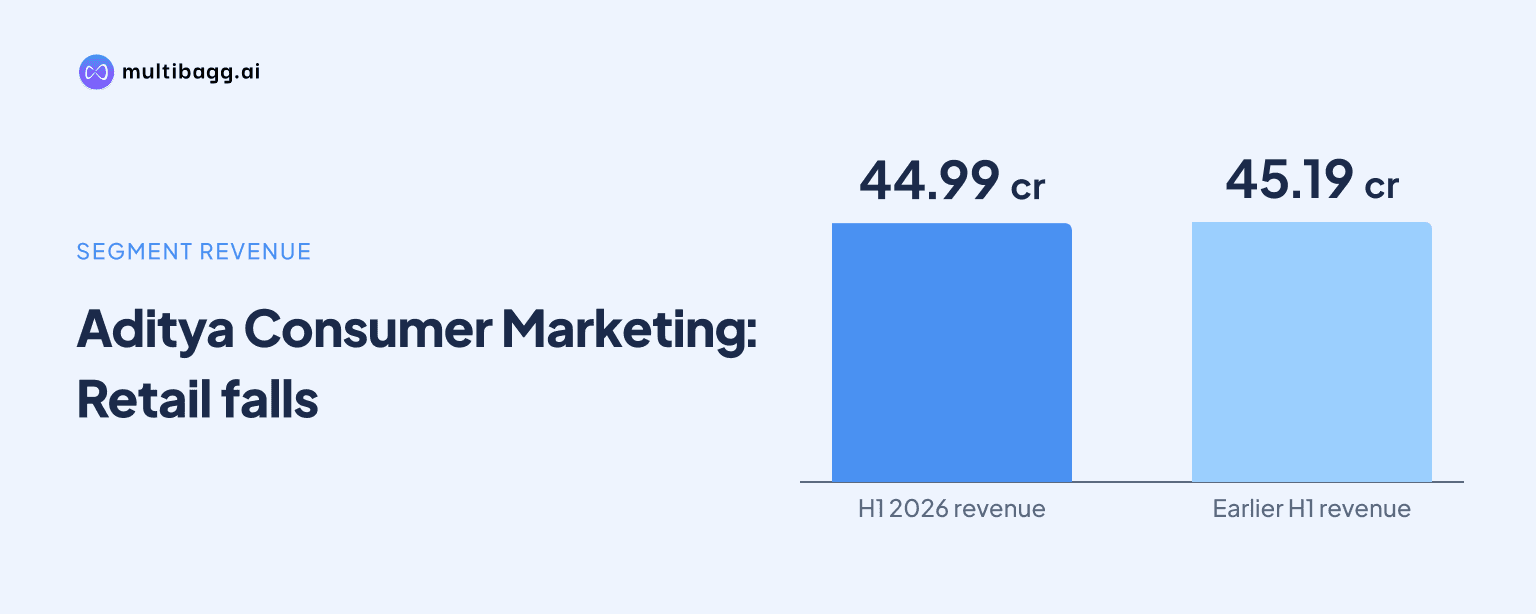
- Aditya Consumer Marketing’s total segment revenue fell to Rs 44.99 crore in the half year ended 30.09.2026 from Rs 45.19 crore a year earlier.
- Retail Store revenue declined Rs 1.58 crore year on year to Rs 28.99 crore, while Food & Beverages rose Rs 1.10 crore to Rs 12.98 crore and Salon increased Rs 0.28 crore to Rs 3.02 crore.
- Combined segment losses before tax and interest narrowed by Rs 0.93 crore to Rs 1.06 crore, with Retail Store’s loss reducing to Rs 0.70 crore from Rs 1.35 crore.
- Short-term borrowings increased to Rs 7.97 crore at 30.09.2026 from Rs 5.92 crore at 31.03.2026, while operating cash flow was an outflow of Rs 1.33 crore for the half year.
powered by IRIS
Aditya Consumer Marketing Limited reported Retail Store revenue of Rs 28.99 crore for the half year ended 30.09.2026, down Rs 1.58 crore from a year earlier. Aditya Consumer Marketing’s Food & Beverages revenue rose Rs 1.10 crore to Rs 12.98 crore and Salon revenue increased Rs 0.28 crore to Rs 3.02 crore, partly offsetting the decline.
Know Aditya Consumer Marketing inside out
Results, valuation, peers and who's buying, in one view.
How did Aditya Consumer Marketing’s segment revenue change?
Aditya Consumer Marketing’s total segment revenue declined Rs 0.20 crore year on year to Rs 44.99 crore in the half year ended 30.09.2026. The reported total matched revenue from operations of Rs 44.99 crore, compared with Rs 45.19 crore for the half year ended 30.09.2025.
Retail Store remained the largest of the three disclosed segments at Rs 28.99 crore, but its revenue fell from Rs 30.57 crore in the comparable half year. The Rs 1.58 crore reduction was larger than the combined Rs 1.38 crore increase recorded by Food & Beverages and Salon.
The annual comparison disclosed a similar pattern. Retail Store revenue was Rs 60.07 crore in the year ended 31.03.2026, down from Rs 68.07 crore in the year ended 31.03.2025, while Food & Beverages increased to Rs 24.85 crore from Rs 23.37 crore and Salon rose to Rs 6.48 crore from Rs 5.97 crore.
Which Aditya Consumer Marketing businesses increased sales?
Aditya Consumer Marketing’s Food & Beverages business delivered the largest revenue increase, adding Rs 1.10 crore year on year to Rs 12.98 crore in the half year ended 30.09.2026. Salon revenue increased Rs 0.28 crore to Rs 3.02 crore from Rs 2.74 crore in the half year ended 30.09.2025.
Food & Beverages was the second-largest reported business by sales, behind Retail Store’s Rs 28.99 crore and ahead of Salon’s Rs 3.02 crore. The two growth segments accounted for Rs 15.99 crore, or less than the Rs 28.99 crore generated by Retail Store, illustrating why the retail decline left total revenue Rs 0.20 crore lower.
Aditya Consumer Marketing identifies Salon, Food & Beverages and Retail Store as segments under Accounting Standard 17, Segment Reporting. The 30.10.2026 filing does not provide store numbers, outlet locations, customer traffic, pricing, or a management explanation for the revenue movement in any of the three businesses.
Got a follow-up? Ask IRIS
Did Aditya Consumer Marketing’s segment losses narrow?
Aditya Consumer Marketing reported narrower segment losses before tax and interest across Salon, Food & Beverages and Retail Store in the half year ended 30.09.2026. The combined segment loss narrowed Rs 0.93 crore to Rs 1.06 crore from Rs 1.99 crore a year earlier.
Retail Store’s segment loss reduced to Rs 0.70 crore from Rs 1.35 crore, the largest reduction among the three businesses. Food & Beverages narrowed its loss to Rs 0.30 crore from Rs 0.52 crore, while Salon’s loss declined to Rs 0.06 crore from Rs 0.12 crore.
At company level, Aditya Consumer Marketing recorded a loss before tax of Rs 1.78 crore, compared with Rs 2.17 crore in the corresponding 2025 half. That result included finance cost of Rs 0.20 crore and a Rs 0.52 crore exceptional prior-period item for depreciation that had been short charged up to 31.03.2026.
Aditya Consumer Marketing’s loss for the period was Rs 1.22 crore, against Rs 2.17 crore a year earlier. The notes state that a deferred-tax liability of Rs 0.56 crore carried at 31.03.2026 was reversed because no taxable timing differences existed at that date.
What changed in Aditya Consumer Marketing’s segment assets and liabilities?
Aditya Consumer Marketing’s total segment assets declined to Rs 7.99 crore at 30.09.2026 from Rs 8.94 crore at 31.03.2026. Retail Store had assets of Rs 3.60 crore, followed by Food & Beverages at Rs 2.40 crore and Salon at Rs 1.99 crore.
All three reported segment asset balances were lower than at 31.03.2026. Retail Store assets fell Rs 0.43 crore from Rs 4.03 crore, Food & Beverages assets fell Rs 0.28 crore from Rs 2.68 crore, and Salon assets declined Rs 0.24 crore from Rs 2.23 crore.
Total segment liabilities increased to Rs 38.45 crore at 30.09.2026 from Rs 36.18 crore at 31.03.2026. Retail Store liabilities rose to Rs 22.30 crore from Rs 20.99 crore, Food & Beverages liabilities increased to Rs 8.84 crore from Rs 8.32 crore, and Salon liabilities rose to Rs 7.31 crore from Rs 6.87 crore.
The standalone balance sheet showed short-term borrowings of Rs 7.97 crore at 30.09.2026, up from Rs 5.92 crore at 31.03.2026, and trade payables of Rs 12.25 crore, up from Rs 9.39 crore. Cash and cash equivalents were Rs 12.25 crore at 30.09.2026, while net cash from operating activities was an outflow of Rs 1.33 crore for the half year.
Conclusion
Aditya Consumer Marketing’s segment disclosure shows that Retail Store remained its largest sales and asset business in the half year ended 30.09.2026, but lower retail revenue outweighed gains in Food & Beverages and Salon. Each segment reduced its reported loss before tax and interest, narrowing the combined segment loss by Rs 0.93 crore despite the Rs 0.20 crore decline in total revenue.
The unresolved item to watch is deferred-tax asset recognition. Aditya Consumer Marketing said no deferred-tax asset was recognised on unabsorbed depreciation, carried-forward business losses and other timing differences because virtual certainty supported by convincing evidence was absent, while it reversed a Rs 0.56 crore deferred-tax liability in the half year.