










Aegis Logistics targets Q4 FY27 close for US$809m Tristar deal
Key highlights
- Aegis Logistics signed a definitive agreement on October 13, 2026, to buy 89.8% of Tristar Holdings for US$809 million.
- Aegis Logistics expects the Tristar transaction to close in Q4 FY27, subject to approvals and customary conditions.
- Aegis Logistics reported H1 FY27 normalized segment EBITDA of Rs 1,184 crore, up 97% year on year.
- Aegis Logistics held Rs 6,400 crore of cash on its September balance sheet, management said.
powered by IRIS
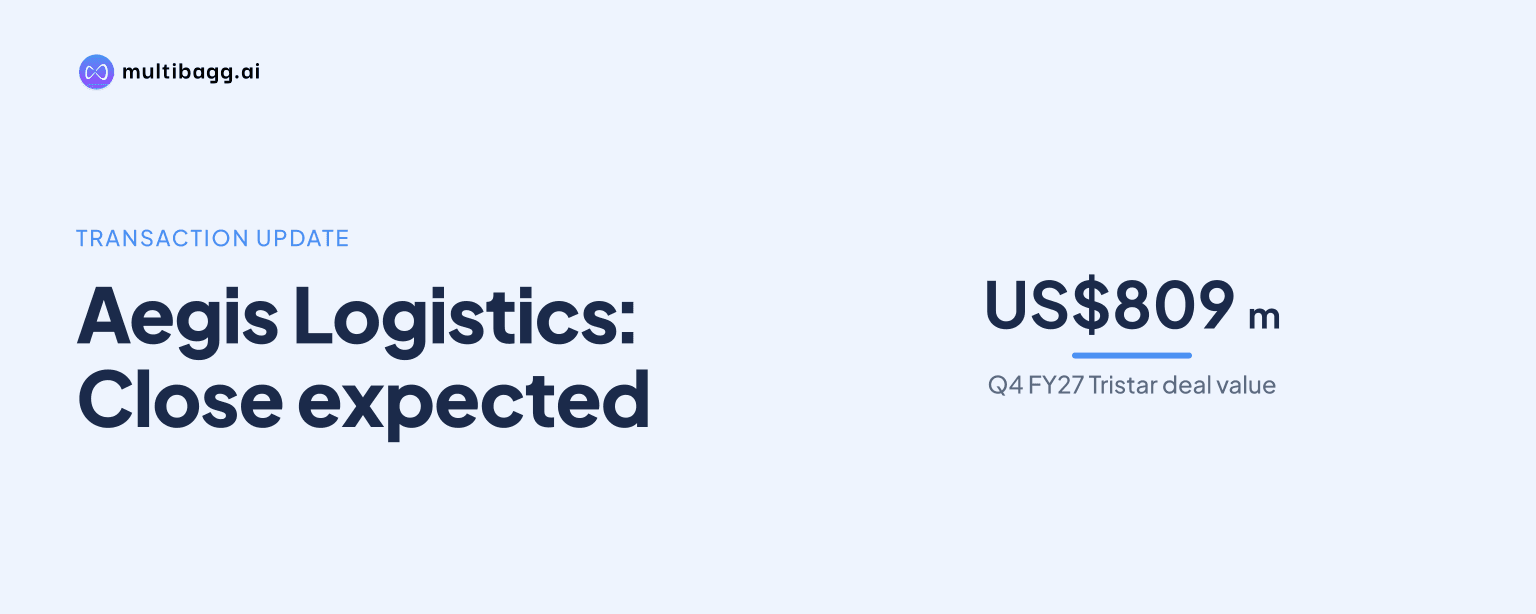
Aegis Logistics Limited agreed on October 13, 2026, to acquire 89.8% of Dubai-headquartered Tristar Holdings Limited for US$809 million, targeting completion in Q4 FY27 subject to regulatory approvals and customary closing conditions. Management said the transaction would add international terminals, ships, trucks, distribution operations and multinational customer relationships to Aegis Logistics’ Indian platform.
Know Aegis Logistics inside out
Results, valuation, peers and who's buying, in one view.
What has Aegis Logistics agreed to buy from Tristar?
Aegis Logistics has signed a definitive agreement to acquire an 89.8% stake in Tristar Holdings Limited for US$809 million. The agreement, announced during the November 3, 2026 Q2 FY27 earnings call, concerns a Dubai-headquartered integrated energy-logistics company with global operations rather than a single terminal or domestic distribution asset.
Management described Tristar as a business built over 30 years with liquid-storage terminals, ships, trucks and distribution capabilities across multiple markets. Aegis Logistics said Tristar has more than 20 ships, with management referring to 28 ships in total, and noted that several of those vessels already call at ports where Aegis Logistics operates.
When is the Tristar acquisition expected to close?
Aegis Logistics expects the Tristar acquisition to close in Q4 FY27, subject to regulatory approvals and customary closing conditions. Management referred on November 3 to completion in the next few months, but did not specify the regulators involved, a fixed closing date or a timetable for individual approvals.
The company said Tristar’s existing management team would remain in place after completion, which management presented as the mechanism for maintaining operating continuity. Management also declined to quantify revenue, procurement or cost synergies before the transaction closes, saying it would provide more detail once it can discuss the combined business without the constraints of an unfinished deal.
Why does Aegis Logistics want to acquire Tristar?
Aegis Logistics says Tristar would move the group from a predominantly India-focused operator toward a global integrated energy-logistics platform. The stated strategic case is to combine Aegis Logistics’ domestic infrastructure and distribution operations with Tristar’s international network, diversified services and established relationships with global energy customers.
Management identified Tristar’s relationships with Shell, Glencore, BP, Total, Saudi Aramco, Abu Dhabi National Oil Company and other suppliers as a potential benefit for Aegis Logistics over the next 3 to 10 years. It also cited Tristar’s end-to-end liquids distribution, shipping, inert-gas capabilities and aircraft-refuelling expertise as areas that could be relevant to Aegis Logistics’ future operations in India.
The transaction could also connect source and destination markets more directly. Management said Tristar has relationships in Middle Eastern supply markets while Aegis Logistics has assets at Indian receiving ports, but it did not commit to a volume target, a new customer contract or a financial contribution from this connection. The company’s comments establish the intended operating logic, rather than quantified deal benefits.
Got a follow-up? Ask IRIS
How does Aegis Logistics plan to fund the Tristar purchase?
Aegis Logistics said it had shareholder authority from an extraordinary general meeting to raise Rs 6,000 crore and held Rs 6,400 crore of cash on its September balance sheet. Management said this liquidity meant it did not expect to rely on high debt for the US$809 million acquisition, but it did not disclose a final mix of cash, equity issuance or borrowings for the purchase.
The Tristar acquisition sits alongside a separate expansion programme at Aegis Vopak Terminals Limited, or AVTL. Management said AVTL expects cumulative capital expenditure to reach about US$1.2 billion by the following year and has planned about US$5 billion of aggregate investment through 2030-31, funded through equity, internal accruals and debt with a targeted gearing ceiling of 0.6 times.
That distinction matters because AVTL’s funding framework was not presented as the direct funding plan for Tristar. At the parent level, management said Aegis Logistics had little or no debt and cash available for the acquisition, while the final transaction funding structure remains undisclosed pending completion.
What operating base will Aegis Logistics bring to Tristar?
Aegis Logistics enters the proposed deal after reporting H1 FY27 revenue of Rs 4,570 crore, normalized segment earnings before interest, tax, depreciation and amortisation, or EBITDA, of Rs 1,184 crore, and profit after tax of Rs 866 crore. Compared with H1 FY26, revenue rose 14%, EBITDA rose 97% from Rs 602 crore, and profit after tax rose 108% from Rs 417 crore.
In Q2 FY27, revenue declined to Rs 2,213 crore from Rs 2,294 crore a year earlier, yet normalized segment EBITDA increased 32% to Rs 456 crore and profit after tax increased 32% to Rs 321 crore. The comparison shows that reported quarterly profit growth occurred despite lower revenue, with management citing operating performance across its businesses.
The liquefied petroleum gas, or LPG, distribution business handled 2.41 lakh metric tonnes in Q2 FY27, up 25% year on year, while H1 volume reached 5.18 lakh metric tonnes, up 54%. Management attributed the increase partly to large cryogenic LPG terminals commissioned in the prior year, including 48,000 metric tonnes at Pipavav and 82,000 metric tonnes at Mangalore, which increased the company’s ability to receive larger cargoes and expand distribution.
Aegis Logistics also reported 2 million cubic metres of liquid-storage capacity and said its Liquid Division generated H1 FY27 EBITDA of Rs 284 crore, up 28%. At JNPA, it plans an expansion costing about Rs 1,675 crore, including 318,000 cubic metres of liquid storage and about 77,286 metric tonnes of LPG storage; the first roughly 100,000-cubic-metre liquid phase is expected in Q3 FY27.
Conclusion
The proposed US$809 million purchase of 89.8% of Tristar is Aegis Logistics’ stated route to internationalising an Indian energy-logistics network that produced Rs 1,184 crore of H1 FY27 EBITDA. The deal’s strategic rationale rests on combining Indian storage and distribution infrastructure with Tristar’s global terminals, fleet, service lines and customer relationships, while the financial case has not yet been quantified.
The next milestone is the targeted Q4 FY27 closing, after regulatory approvals and customary conditions are satisfied. Investors will also watch for management’s post-completion disclosure on funding, operating integration and measurable synergies, as well as progress on the Rs 1,675 crore JNPA expansion and AVTL’s stated US$5 billion investment plan through 2030-31.