










AVTL advances 318,000-cubic-metre JNPA expansion programme
Key highlights
- AVTL commissioned a 35,000-metric-tonne annual-capacity LPG bottling plant at JNPA on October 15, 2026.
- AVTL's JNPA programme includes 318,000 cubic metres of liquid storage and about 77,286 metric tonnes of LPG storage.
- AVTL's Pipavav ammonia terminal has 36,000 metric tonnes of specialised capacity and a 15-year Hindustan Zinc take-or-pay agreement.
- AVTL's Mangalore liquid-storage capacity reached 193,000 cubic metres and was operating at 100% utilisation.
powered by IRIS
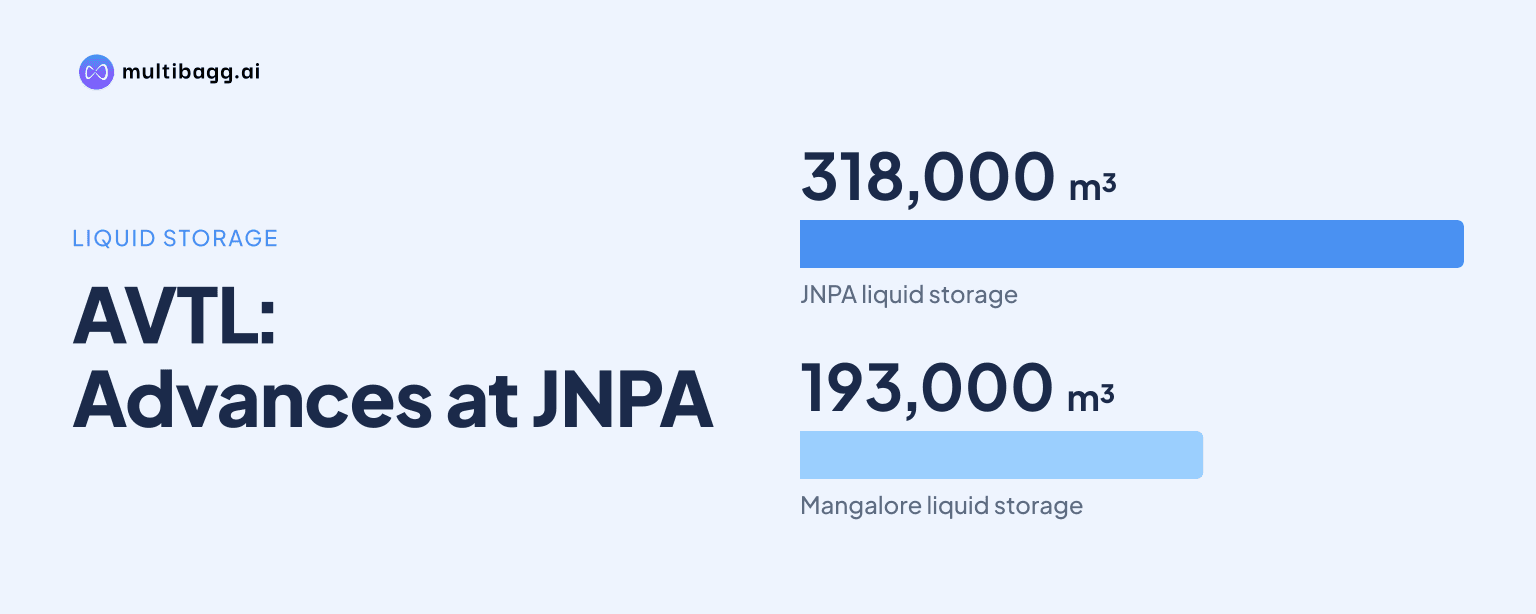
Aegis Vopak Terminals Limited is advancing a port expansion programme centred on 318,000 cubic metres of additional liquid storage at JNPA, where the first 100,000-cubic-metre phase is targeted for Q3 FY27. AVTL has also commissioned a 36,000-metric-tonne ammonia terminal at Pipavav under a 15-year take-or-pay agreement with Hindustan Zinc.
Know Aegis Logistics inside out
Results, valuation, peers and who's buying, in one view.
What has AVTL commissioned at JNPA and Pipavav?
AVTL commissioned a liquefied petroleum gas, or LPG, bottling plant at JNPA on October 15, 2026, with annual capacity of 35,000 metric tonnes. The port already has 101,900 cubic metres of liquid storage, while the new bottling plant adds downstream LPG-handling infrastructure alongside the larger storage programme still being built.
AVTL has also commissioned 36,000 metric tonnes of specialised ammonia storage and terminaling capacity at Pipavav. Hindustan Zinc has signed a 15-year take-or-pay agreement, under which the customer commits to pay for contracted capacity. Management said this arrangement gives the facility long-term revenue visibility and predictable cash flows.
The Pipavav ammonia asset has a separate ownership development. ITOCHU Corporation has acquired a 10% stake in Aegis Terminal Pipavav Limited, the ammonia-facility company, and intends to increase its holding to 25% over the next three years. Management said ammonia distribution to industrial customers could provide revenue beyond storage, while prospective clean-energy uses remain an expectation rather than a reported outcome.
How large is AVTL's JNPA expansion programme?
AVTL's JNPA greenfield programme comprises 318,000 cubic metres of additional liquid storage and about 77,286 metric tonnes of LPG storage, with investment of about Rs 1,675 crore. Management said the project was on schedule on November 3, 2026, and expects the initial liquid-storage phase of about 100,000 cubic metres to be commissioned in Q3 FY27.
The planned 318,000 cubic metres of liquid capacity is more than three times JNPA's current 101,900 cubic metres. That comparison indicates that the project is a substantial enlargement of the existing terminal, although its operational contribution depends on commissioning and customer ramp-up. Management expects the capacity additions to contribute significantly after they become operational and ramp up.
AVTL had also announced in the previous quarter a refrigerated double-wall LPG storage tank of approximately 52,000 metric tonnes at JNPA. Management said the tank would expand West Coast gas-handling capability. The bottling plant, liquid-storage project, LPG storage and proposed tank are separate parts of the JNPA build-out rather than one single commissioned asset.
Which AVTL ports are adding liquid storage?
AVTL is building or assessing liquid-storage additions at Kandla, Kochi and Mangalore, while Mumbai is adding capacity within Aegis Logistics rather than AVTL. Mumbai is developing 64,000 cubic metres of additional liquid storage with investment of Rs 125 crore, and management expects gradual commissioning as FY27 progresses.
At Kandla, AVTL is constructing the CRL-4 liquid terminal, designed to add 94,148 cubic metres and targeted for commissioning in the next financial year. Kandla currently has 952,000 cubic metres of liquid storage and 48,000 metric tonnes of static LPG storage. The new liquid terminal therefore extends an established storage base serving northern and western Indian hinterlands.
Kochi has 82,000 cubic metres of existing storage and a 49,577-cubic-metre expansion under way. Management expects total Kochi capacity to reach 132,000 cubic metres, about 60% above the existing level, in early FY28. At Mangalore, the 75,000 cubic metres added last year is operating at 100% utilisation, taking total liquid capacity to 193,000 cubic metres; AVTL has secured land and is evaluating another 60,000 cubic metres.
Got a follow-up? Ask IRIS
How will pipelines affect AVTL's LPG network?
AVTL expects the Jamnagar-Loni and Kandla-Gorakhpur LPG pipelines to support larger LPG volumes and wider distribution from Kandla and Pipavav. The Jamnagar-Loni pipeline is complete and operational. Management said the Kandla-Gorakhpur project was approximately 96% physically complete, citing the latest CRISIL Ratings report.
The Kandla-Gorakhpur project has its full 1,958-kilometre main trunk pipeline laid, and the Kandla-Lucknow section has been charged with LPG. Remaining work includes other sections and bottling-plant connections. Management said completion would improve evacuation from port terminals to customers across northern and western India, rather than merely adding storage at the coast.
Pipavav has three relevant infrastructure links: APM Terminals is developing a very large gas carrier, or VLGC, compliant jetty; the Kandla-Gorakhpur pipeline is expected to connect to the port; and AVTL already operates rail loading, bottling plants and truck-loading facilities. Management said these options could improve vessel handling and inland evacuation, but it gave no commissioning date for the jetty or pipeline connection.
How is AVTL funding the expansion programme?
AVTL reported H1 FY27 revenue of Rs 505 crore, up 15% year on year, and earnings before interest, tax, depreciation and amortisation, or EBITDA, of Rs 392 crore, up 19%. Management attributed the revenue increase to ramp-up from recently commissioned capacity and Liquid business performance. EBITDA margin rose to 77.7% from 74.7% in H1 FY26.
Profit after tax for H1 FY27 was Rs 166 crore, while earnings per share declined to Rs 1.38 from Rs 1.49 in H1 FY26. Management attributed the lower profit and per-share outcome to higher finance costs and tax. The comparison shows that operating growth and margin expansion did not fully carry through to earnings per share during the half year.
Management expects cumulative capital expenditure to reach approximately US$1.2 billion by next year and has outlined aggregate capital expenditure of about US$5 billion through 2030 and 2031. It said it plans to use a mix of equity, internal accruals and debt, while targeting gearing of no more than 0.6 times. These are management targets and funding plans, not completed expenditure.
Conclusion
AVTL's programme combines commissioned infrastructure with projects at differing stages. JNPA's LPG bottling plant and Pipavav's ammonia terminal are operating, while JNPA's much larger liquid-storage expansion, Kandla's CRL-4 terminal and Kochi's additional tanks have defined future milestones. Mangalore's 100% utilisation supports management's evaluation of a further 60,000 cubic metres there.
The next disclosed events are JNPA's first 100,000-cubic-metre liquid-storage commissioning in Q3 FY27, gradual Mumbai commissioning during FY27, Kandla CRL-4 commissioning in the next financial year and Kochi's early-FY28 target. Management also identified completion of the remaining Kandla-Gorakhpur pipeline sections and bottling connections, as well as a potential Mangalore expansion decision, as matters to watch.