








A F Enterprises FY26 Revenue Falls to ₹89.24 Lakh in Filing
MAX Plan at ₹4,999/yr

Find your next multibaggerBe a Pro Investor
Research stocks and track your picks on the go. Download the app.
Key highlights
- A F Enterprises approved audited standalone and consolidated FY26 results on 28 November 2026.
- Standalone FY26 revenue fell to ₹89.24 lakh from ₹974.86 lakh in FY25.
- Standalone loss before tax narrowed to ₹258 lakh from ₹278 lakh.
- The consolidated audit qualification concerned ₹2,343 lakh of subsidiary trade receivables outstanding for more than three years.
powered by IRIS
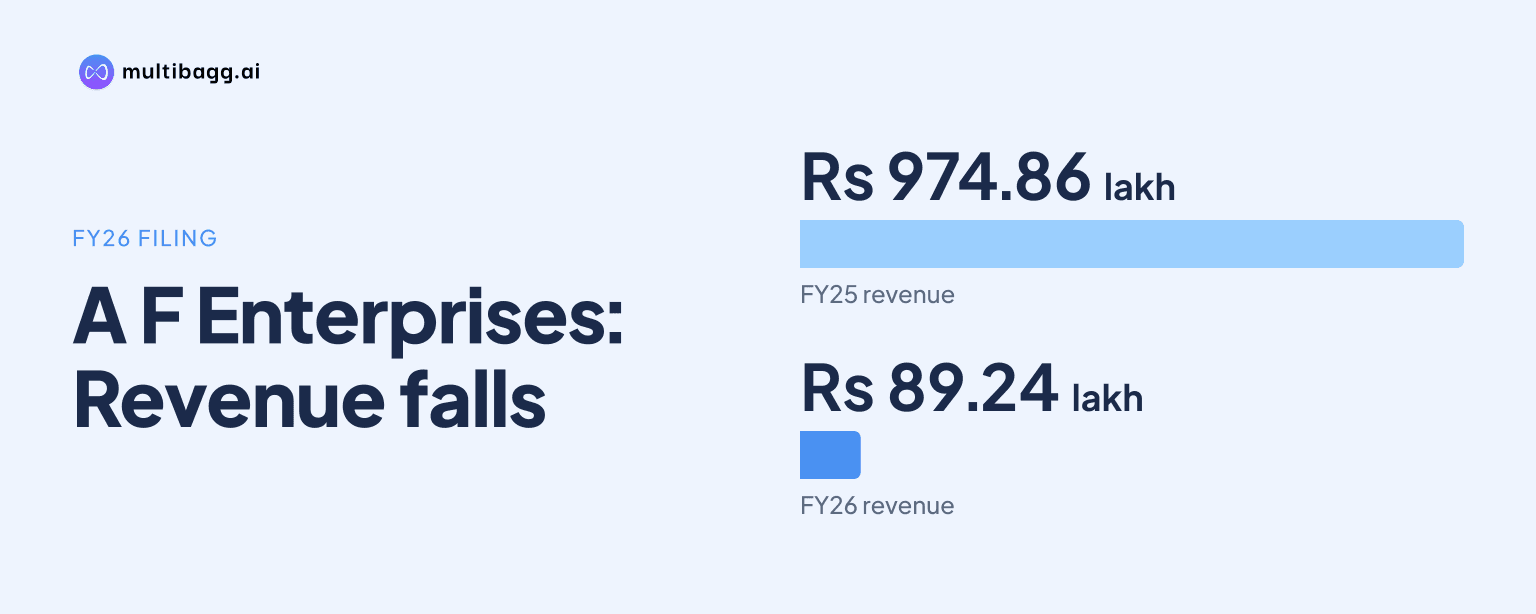
A.F. Enterprises Ltd filed audited standalone and consolidated results for FY26 after its Board approved them on 28 November 2026, reporting standalone revenue of ₹89.24 lakh against ₹974.86 lakh a year earlier. The filing also showed that standalone loss before tax narrowed to ₹258 lakh from ₹278 lakh in FY25.
Know A F Enterprises inside out
Results, valuation, peers and who's buying, in one view.
What did A F Enterprises approve in its FY26 filing?
A F Enterprises approved the audited standalone and consolidated financial results for the quarter and financial year ended 31 March 2026. The Board approval was disclosed on 28 November 2026, making the filing a formal update on the company’s FY26 financial statements and audit process.
The filing covered the March 2026 quarter and full year along with an auditor report. It also referred to results for earlier FY26 reporting periods: the quarter ended 30 June 2025, the quarter and half year ended 30 September 2025, and the quarter ended 31 December 2025. Those earlier periods were accompanied by limited review reports.
The information supplied does not provide a detailed standalone quarterly income statement for the March quarter. It does, however, provide full-year standalone revenue and loss before tax figures, allowing a comparison with FY25.
How did A F Enterprises' standalone revenue change in FY26?
A F Enterprises' standalone revenue fell to ₹89.24 lakh in FY26 from ₹974.86 lakh in FY25, a decline of about 90.85%. The fall is the most significant financial movement disclosed in the supplied FY26 results summary.
Standalone loss before tax improved to ₹258 lakh from ₹278 lakh in the preceding year. While the lower loss indicates a ₹20 lakh narrowing at the pre-tax level, the company remained loss-making on a standalone basis for the year.
The revenue decline and continuing loss are important because they show that the lower pre-tax loss did not coincide with higher operating income. The filing does not provide enough detail in the supplied material to identify individual revenue streams, expense movements or the reasons for the year-on-year change.
What did the audit report flag in the consolidated accounts?
The supplied information says A F Enterprises received a qualified consolidated audit opinion for FY26. The qualification related to ₹2,343 lakh of a subsidiary’s trade receivables that had been outstanding for more than three years, for which auditors could not obtain sufficient audit evidence.
The issue was linked to subsidiary Aunik IT Private Limited. The material also cited ₹2,298 lakh of payables and fully eroded net worth at the subsidiary, which raised a going-concern concern in the audit context. These matters concern the consolidated accounts rather than the parent company’s standalone revenue figure.
A qualified opinion does not by itself restate the reported financial results. It indicates that the auditor was unable to obtain sufficient appropriate evidence, or identified a matter requiring qualification, in relation to the specified part of the consolidated financial statements. The supplied material does not state a quantified adjustment to FY26 consolidated profit or net worth arising from the qualification.
Got a follow-up? Ask IRIS
Why does the distinction between standalone and consolidated results matter?
Standalone results reflect the parent company’s own operations, while consolidated results combine the parent with its subsidiaries. A F Enterprises' standalone revenue decline therefore measures the parent entity’s reported operating income, whereas the audit qualification concerns evidence related to a subsidiary’s balances in the consolidated statements.
For investors, the distinction is material because the revenue trend and the audit issue answer different questions. The standalone results show a substantial reduction in annual revenue and a continuing pre-tax loss. The consolidated audit qualification highlights uncertainty surrounding the recoverability or verification of significant subsidiary-level receivables.
The supplied filing details do not disclose a share-price reaction, new capital-raising plan, dividend decision or operating forecast. They also do not provide an audit opinion text beyond the stated qualification-related matters. Market participants will therefore need to assess future disclosures for updates on the subsidiary balances and any corrective action.
How does the FY26 filing compare with earlier reported periods?
A F Enterprises had previously reported a sharp deterioration in FY25 standalone operations, including FY25 revenue of ₹974.86 lakh. The FY26 figure of ₹89.24 lakh marks a further contraction in the annual revenue base disclosed in the current filing.
The company’s FY26 reporting sequence included limited reviews for the June, September and December 2025 periods, followed by the auditor report for the March 2026 quarter and full year. This progression is consistent with quarterly review requirements followed by an annual audit process.
The filing was approved after A F Enterprises had sought an extension from the Registrar of Companies, Delhi-II, on 4 November 2026 to hold its 43rd annual general meeting for FY26. The supplied material does not state whether the extension request was granted or specify the eventual AGM date.
Conclusion
A F Enterprises' FY26 filing records a steep reduction in standalone revenue to ₹89.24 lakh, from ₹974.86 lakh in FY25, while standalone loss before tax narrowed to ₹258 lakh. The audited consolidated results also carry a qualified opinion tied to ₹2,343 lakh of long-outstanding subsidiary trade receivables for which sufficient evidence was unavailable.
The next disclosures to watch are any update on recovery, confirmation or provisioning of the subsidiary receivables, the status of its payables and going-concern position, and the timing of the FY26 annual general meeting. The supplied filing does not disclose a future earnings target or operating forecast.

