










Aimtron targets 40–50% CAGR through integration, expansion
Key highlights
- Aimtron targets 40–50% CAGR over the next three to five years.
- Aimtron reported H1 FY27 revenue of Rs 224.71 crore, up 83.3% year on year.
- Aimtron’s order book was Rs 730 crore as of September 30, 2026, or about 2.4 times FY26 revenue.
- PCBA and box build represented 52.2% and 47.4% of H1 FY27 consolidated revenue, respectively.
powered by IRIS
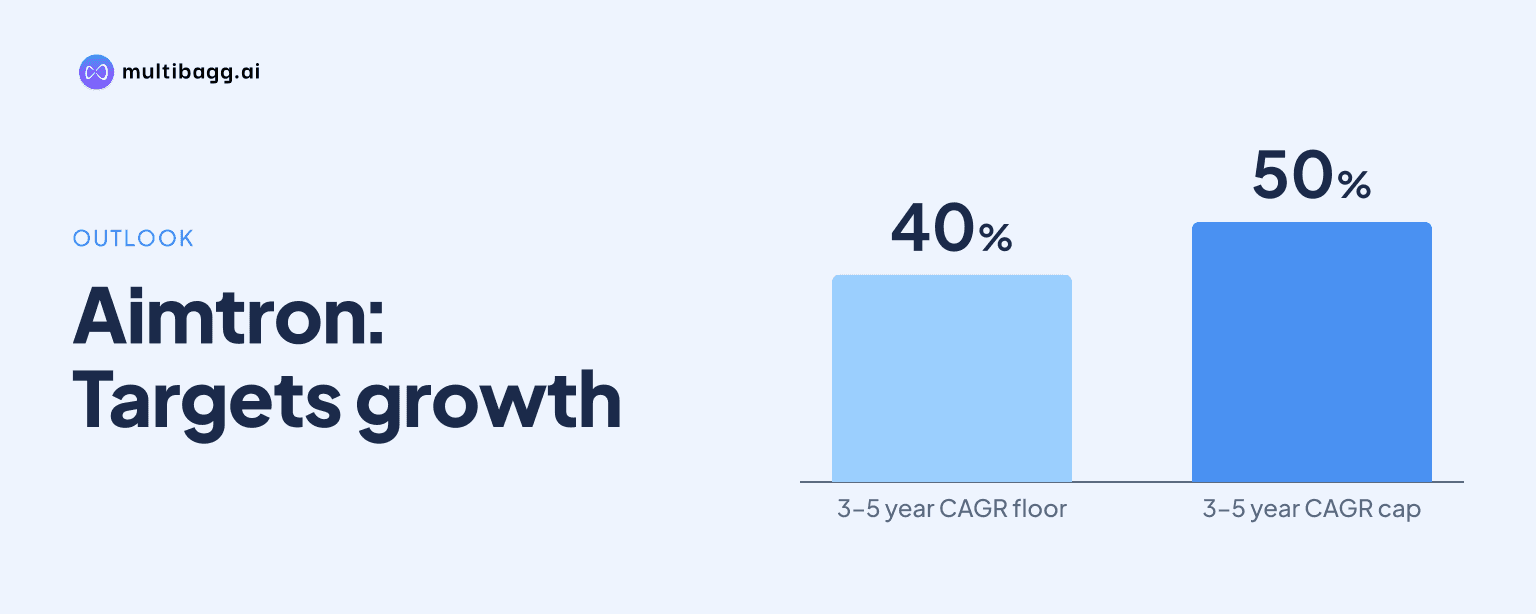
Aimtron Electronics Limited is targeting a 40–50% compound annual growth rate (CAGR) over the next three to five years, supported by planned in-house production of plastics, sheet metal and wire harnesses, expansion into Europe and Australia, and a Rs 730 crore order book as of September 30, 2026.
Know Aimtron Electronics inside out
Results, valuation, peers and who's buying, in one view.
What growth rate is Aimtron targeting?
Aimtron is targeting 40–50% CAGR for three to five years. The company presents this as a strategic objective rather than a reported outcome, and it does not disclose annual revenue milestones, a precise start date within the period or a revenue target at the end of the three-to-five-year timeframe.
The target follows rapid reported growth in H1 FY27. Revenue reached Rs 224.71 crore, up 83.3% year on year, while earnings before interest, tax, depreciation and amortisation (EBITDA) rose 61.4% to Rs 48.61 crore. Net profit increased 71.5% year on year to Rs 34.79 crore, and earnings per share rose 68.5% to Rs 16.75.
The H1 FY27 comparison shows revenue grew faster than EBITDA, with revenue up 83.3% and EBITDA up 61.4%. Aimtron does not provide a margin figure, a full-year FY27 forecast or a bridge linking the H1 FY27 financial results to the 40–50% CAGR objective.
How will Aimtron execute backward integration?
Aimtron plans to execute backward integration through its greenfield Aimtron Mechatronics project, which is intended to manufacture plastic components, sheet metal and wire harnesses in house. The stated mechanism is lower dependence on third-party suppliers and improved supply-chain efficiency through internal component-making capability.
The plan is connected to Aimtron’s box-build and system-integration activity. In H1 FY27, printed circuit board assembly (PCBA) accounted for 52.2% of consolidated revenue and box build accounted for 47.4%, while end-to-end solutions contributed 0.5%. The 4.8-percentage-point difference between PCBA and box build indicates that both assembly and higher-level build work were material parts of the reported revenue mix.
Aimtron also identifies its Aimnet digital solution as a tool for machinery utilisation and production optimisation. The company says it will optimise production capacity and supply-chain management to reduce costs and enhance economies of scale, but it does not disclose the project’s capital cost, production capacity, expected cost savings or commissioning date.
Where is Aimtron expanding and which markets matter?
Aimtron’s geographic strategy focuses on expanding into European and Australian markets through targeted sales and marketing initiatives and participation in international exhibitions. The presentation does not identify individual European or Australian countries, projected sales, new facilities, customers or a timetable for market entry.
The company’s timeline records that it started operations in Texas, United States, in 2025 through Aimtron Electronics LLC, described as a 100% subsidiary. For 2026, Aimtron records the incorporation of Aimtron International Controls LLC and the acquisition of International Control Services Inc. in Decatur, United States, alongside a strategic shift to an original design manufacturer-led model.
Aimtron identifies industrial, medical and healthcare, automobiles, power, gaming and unmanned aerial vehicles (UAVs) among its target sectors. Its market-expansion plan also covers defence and aerospace, telecom, railways, energy, power, battery energy storage systems (BESS), ruggedized electronics and drones, with AS9100 certification cited in relation to defence and aerospace.
For railways, Aimtron says it has entered the Indian Railways ecosystem with Safety Integrity Level 4 compliant systems for mission-critical applications. The presentation does not quantify railways revenue, the number of customers served, order values in this area or the contribution expected from the company’s AS9100 certification.
Got a follow-up? Ask IRIS
What does Aimtron’s H1 FY27 revenue mix show?
Aimtron’s H1 FY27 industry mix was led by telecom at 23.2% of consolidated revenue, followed by energy and power at 19.8% and internet of things, robotics and drone applications at 17.9%. Industrial and automation represented 13.5%, so these four sectors collectively contributed 74.4% of the reported industry mix.
The remaining mix was distributed across ruggedized electronics at 7.4%, battery-management systems and automotive at 4.7%, medical technology at 4.5%, BESS at 4.3%, aerospace and defence at 3.8%, and others at 0.9%. Medical technology, automotive and aerospace and defence each represented smaller shares than telecom, energy and power, and IoT, robotics and drone applications in H1 FY27.
Aimtron reported an order book of Rs 730 crore as of September 30, 2026, equivalent to about 2.4 times FY26 revenue according to the company. This comparison is the presentation’s disclosed measure of demand coverage, although it does not divide the order book by delivery period, geography, customer, industry, PCBA, box build or the planned in-house component categories.
The industry and segment data show that the stated growth plan spans markets already represented in H1 FY27 revenue, including telecom, energy and power, industrial applications, medical technology, automotive and aerospace and defence. However, the presentation does not state how much of the Rs 730 crore order book is tied to Europe, Australia, Aimtron Mechatronics or each of those end markets.
Conclusion
Aimtron’s 40–50% CAGR objective combines backward integration at the Aimtron Mechatronics greenfield project, a substantial H1 FY27 presence in both PCBA and box build, operational optimisation through Aimnet, and sales expansion in Europe and Australia. H1 FY27 revenue of Rs 224.71 crore and the Rs 730 crore order book provide the reported financial context for that strategy.
The next developments to watch are the disclosed but unquantified execution points: the timing and scale of Aimtron Mechatronics, internal production of plastics, sheet metal and wire harnesses, and progress in European and Australian market penetration. Future disclosures could also show whether the order book as of September 30, 2026 converts into revenue while supporting the three-to-five-year CAGR target.