










Airfloa Rail Technology Limited lacks H1 FY27 debt data
Key highlights
- Airfloa reported a 203-day cash conversion cycle in FY26, compared with 195 days in FY25.
- Airfloa's debtor days declined to 195 in FY26 from 230 in FY24.
- Airfloa's payable days fell to 102 in FY26 from 181 in FY25.
- Airfloa reported FY26 revenue from operations of Rs 319.6 crore and capacity utilisation of 90%.
powered by IRIS
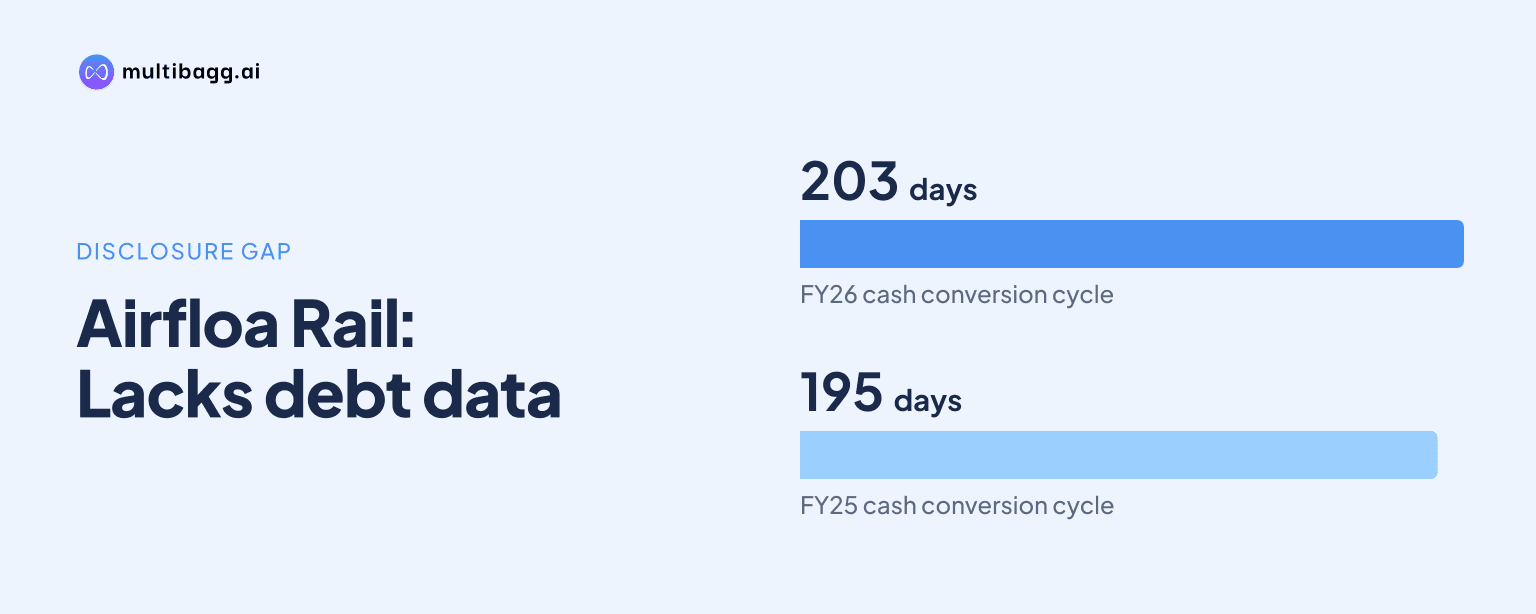
Airfloa Rail Technology Limited does not disclose the stated H1 FY27 receivables of Rs 263 crore or current borrowings of Rs 139.6 crore in the supplied presentation; its latest disclosed working-capital measure is a 203-day FY26 cash conversion cycle, up from 195 days in FY25. The presentation provides operating and efficiency data through FY26, but no H1 FY27 balance-sheet amounts.
Know Airfloa Rail Technology inside out
Results, valuation, peers and who's buying, in one view.
Does Airfloa disclose H1 FY27 receivables and current borrowings?
No, Airfloa does not disclose H1 FY27 receivables, current borrowings, or the figures of Rs 263 crore and Rs 139.6 crore in the supplied pages. The financial pages present revenue, earnings, margins, returns and working-capital day metrics for FY24, FY25 and FY26. They contain no balance-sheet table, no H1 FY27 column and no debt maturity or current-versus-non-current borrowing split.
The nearest receivables-related disclosure is debtor days, which fell from 230 days in FY24 to 218 days in FY25 and 195 days in FY26. Debtor days measure the time associated with collection rather than the rupee value of trade receivables. The supplied material therefore supports an assessment of collection efficiency through FY26, but not verification of an H1 FY27 receivable balance or current borrowing level.
How did Airfloa's working capital change through FY26?
Airfloa's working-capital cycle lengthened by eight days in FY26 because its 203-day cash conversion cycle exceeded the 195 days reported in FY25. This occurred even as debtor days improved by 23 days, to 195 from 218, and inventory days improved by 48 days, to 110 from 158. The cash conversion cycle was also 12 days above the FY24 level of 191 days.
The change reflects a sharper movement in payable days than in the other disclosed components. Payable days declined from 181 in FY25 to 102 in FY26, a 79-day reduction, following a prior decline from 276 days in FY24. Fewer days of supplier credit coincided with faster collections and lower inventory holding, leaving the FY26 cash conversion cycle at 203 days rather than reducing it below FY25.
What operating growth accompanied Airfloa's FY26 working-capital position?
Airfloa reported FY26 revenue from operations of Rs 319.6 crore, compared with Rs 192.4 crore in FY25 and Rs 119.3 crore in FY24. Earnings before interest, tax, depreciation and amortisation, or EBITDA, rose to Rs 64.2 crore in FY26 from Rs 48.3 crore in FY25. Profit after tax increased to Rs 39.1 crore from Rs 25.8 crore over the same comparison.
The operating increase was accompanied by higher capacity utilisation but lower reported EBITDA margin. Capacity utilisation rose from 79% in FY24 to 85% in FY25 and 90% in FY26, while EBITDA margin declined from 26.7% to 25.1% and then 20.1%. Profit after tax margin moved from 11.9% in FY24 to 13.4% in FY25 before easing to 12.2% in FY26, showing that revenue and profit increased in rupee terms while the reported margin profile changed.
Got a follow-up? Ask IRIS
What do Airfloa's return metrics show alongside the FY26 cycle?
Airfloa's return on equity, or RoE, declined to 22.4% in FY26 from 30.8% in FY25, after standing at 29.1% in FY24. Return on capital employed fell to 33.7% in FY26 from 53.4% in FY25 and 54.4% in FY24. These reported return measures declined in the same year that revenue reached Rs 319.6 crore and the cash conversion cycle reached 203 days.
The presentation does not attribute the FY26 movement in RoE or return on capital employed to debt, receivables, inventory or a specific funding decision. It therefore does not establish whether an unreported H1 FY27 receivable or borrowing amount caused a change in returns. It does show FY26 capacity utilisation of 90%, an EBITDA margin of 20.1% and a profit-after-tax margin of 12.2% alongside the 203-day cash conversion cycle.
What actions has Airfloa outlined that could affect future working capital?
Airfloa says it plans to prioritise delivery of its existing order book and improve throughput planning and supply-chain scheduling. Management also outlines machinery and automation additions through initial public offering fund deployment, as well as a proposed 14-acre facility of 50,000 to 1,00,000 square feet. These are disclosed strategic actions, not forecasts of future receivable days, inventory days or borrowings.
Airfloa also plans to expand products across seating systems, interiors and fibre-reinforced polymer, or FRP, solutions for Indian Railways, metro projects and original equipment manufacturers. Separately, it intends to operationalise a 51:49 joint venture with Big Bang Boom Solutions for electronic-warfare systems and artificial-intelligence-enabled defence platforms. The presentation identifies Big Bang Boom Solutions as the technology and research-and-development partner, while Airfloa is the manufacturing partner with a 51% stake.
Conclusion
The supplied presentation shows FY26 revenue of Rs 319.6 crore and capacity utilisation of 90%, alongside a 203-day cash conversion cycle. Collection and inventory metrics improved from FY25, but payable days reduced more sharply, causing the cash conversion cycle to rise from 195 to 203 days. The disclosed pages do not provide the H1 FY27 receivables or current-borrowing figures stated in the topic.
The disclosed plans to watch are delivery of the existing order book, supply-chain scheduling, machinery and automation additions through initial public offering fund deployment, and the proposed 14-acre facility. Airfloa also plans to operationalise its 51:49 defence joint venture, while a subsequent company disclosure would be required to assess H1 FY27 receivables, current borrowings, debt structure or movement from the FY26 debtor-days level of 195 days.