










Airfloa H1 Revenue Rises 143% as EBITDA Margin Falls to 21.9%
Key highlights
- Airfloa reported H1 FY27 revenue from operations of Rs 220.3 crore, up 143% year on year.
- Railway revenue rose 187% to Rs 180.8 crore and represented 82% of H1 FY27 sales.
- Reported EBITDA margin was 21.9% in H1 FY27, compared with 24.3% in H1 FY26.
- Airfloa reported a Rs 610 crore combined order book as of mid-November.
powered by IRIS
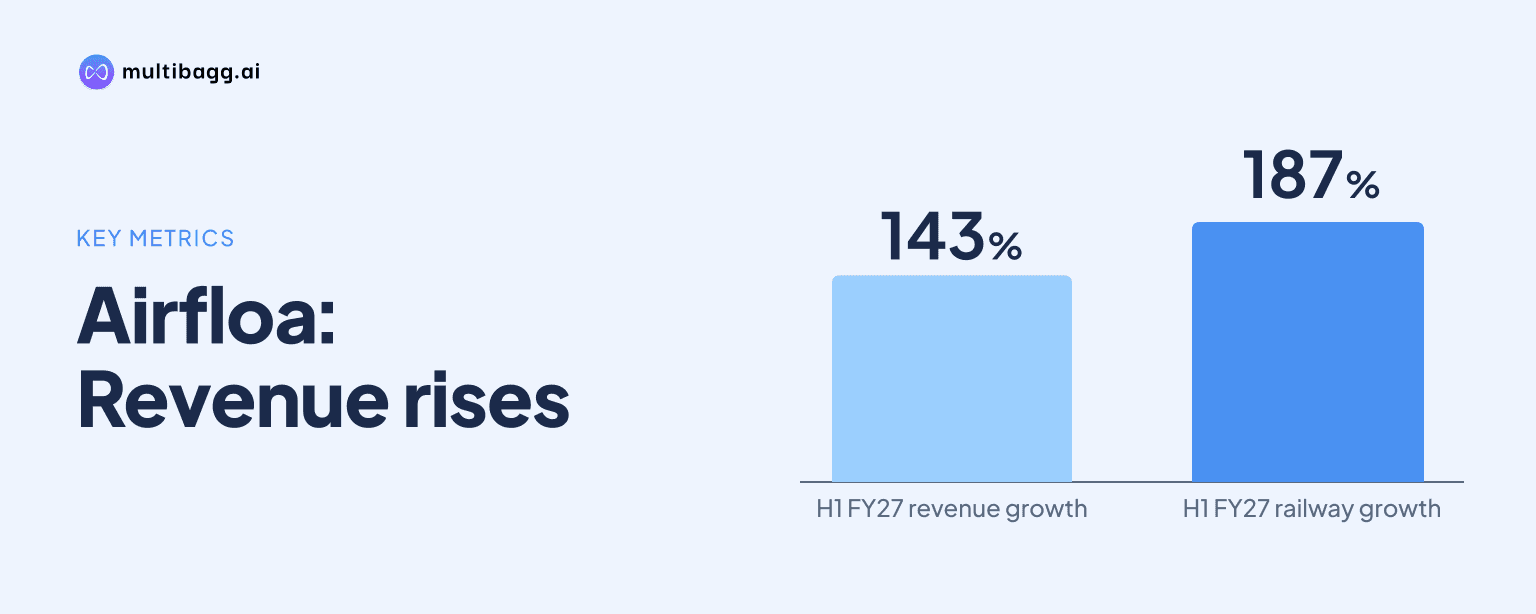
Airfloa Rail Technology Limited reported H1 FY27 revenue from operations of Rs 220.3 crore, up 143% year on year, while its reported EBITDA margin declined to 21.9% from 24.3% in H1 FY26. Railway revenue rose 187% to Rs 180.8 crore and accounted for 82% of sales.
Know Airfloa Rail Technology inside out
Results, valuation, peers and who's buying, in one view.
Why did Airfloa’s H1 FY27 revenue rise 143%?
Airfloa’s revenue rose because railway sales increased faster than its other business lines in H1 FY27. Revenue from operations grew from Rs 90.6 crore in H1 FY26 to Rs 220.3 crore in H1 FY27, an increase of Rs 129.7 crore. Railways contributed Rs 180.8 crore, compared with Rs 63.0 crore a year earlier, while aeronautical, defense and other revenue increased from Rs 27.6 crore to Rs 39.6 crore.
The result changed the sector mix towards railways. Railways accounted for 82% of H1 FY27 revenue, up from 70% in H1 FY26, while aeronautical, defense and others declined to 18% of the mix from 30%. On a full-year basis, railway revenue had already risen from Rs 124.2 crore in FY25 to Rs 228.9 crore in FY26, while the other segment increased from Rs 68.2 crore to Rs 90.8 crore.
Airfloa disclosed several railway-related developments during the period. It secured a Rs 34.9 crore Integral Coach Factory contract as consortium lead with BLUE Engineering for interior design and development of the Vande Bharat Sleeper trainset. It also signed a memorandum of understanding with KTK Group to jointly pursue Platform Screen Door projects in India, combining KTK Group’s technology expertise with Airfloa’s domestic manufacturing and execution capabilities.
How much did Airfloa’s profitability margins change?
Airfloa’s EBITDA rose 120% to Rs 48.4 crore in H1 FY27, but its reported EBITDA margin declined to 21.9% from 24.3% in H1 FY26. That is a fall of 2.4 percentage points, or 240 basis points, based on the executive-summary figures. The presentation does not disclose a cost bridge explaining the margin movement.
A separate financial-highlights bullet rounds the H1 FY27 EBITDA margin to 22.0%, rather than 21.9%. The presentation does not explain this rounding difference or provide the underlying H1 FY26 EBITDA amount. Operating-profit growth of 120% was below revenue growth of 143%, consistent with the lower margin reported in the executive summary.
Profit after tax, or PAT, rose 108% to Rs 25.1 crore in H1 FY27, while PAT margin declined to 11.4% from 13.3% in H1 FY26. The net-margin decline was 1.9 percentage points. Management retained FY28 PAT-margin guidance of 10% to 12%.
Got a follow-up? Ask IRIS
Did Airfloa become more dependent on government or private customers?
Airfloa reached an even government-private revenue split in H1 FY27, with government customers contributing Rs 111.0 crore and private customers contributing Rs 109.3 crore. Each category represented 50% of revenue from operations, compared with a 52% government and 48% private split in H1 FY26. Government revenue rose 134% from Rs 47.4 crore, while private revenue increased 153% from Rs 43.2 crore.
The balance differs from FY26, when private customers supplied 60% of revenue and government customers supplied 40%. In FY25, government revenue was 65% of the total, at Rs 124.2 crore, and private revenue was 35%, at Rs 68.2 crore. H1 FY27 therefore combined substantial growth in both channels with a more evenly split customer mix.
Airfloa’s railway exposure includes Indian Railways production units such as the Integral Coach Factory and Modern Coach Factory, along with Vande Bharat, Amrit Bharat, Regional Rapid Transit System, Metro and Vistadome platforms. Its aeronautical, defense and other grouping still increased sales by Rs 12.0 crore year on year, but its share of H1 FY27 revenue fell to 18% from 30%.
What do Airfloa’s order book and capital measures show?
Airfloa reported an H1 FY27 order book of Rs 487 crore, versus Rs 469 crore in FY26, and stated that this measure included Rs 180 crore of orders from acquired KIN Railway Equipment Private Limited. The company subsequently described its combined order book as Rs 610 crore as of mid-November. The presentation does not reconcile the Rs 123 crore difference between the H1 figure and the mid-November combined figure.
Airfloa acquired KIN Railway Equipment for Rs 41 crore, excluding goods and services tax, adding a Coimbatore manufacturing facility, technical capabilities and its existing Rs 180 crore order book. Management said the Coimbatore facility is being developed as an International Business Facility to strengthen exports and access opportunities with global railway original equipment manufacturers. H1 FY27 capacity utilisation was 90%, unchanged from FY26.
Working-capital and leverage indicators moved higher relative to FY26. Debtor days increased to 197 from 195, while the cash conversion cycle increased to 234 days from 203 days. Net debt to equity rose to 0.5 times from 0.2 times, while return on equity decreased to 20.7% from 22.4% and return on capital employed decreased to 32.1% from 33.7%.
Conclusion
Airfloa’s H1 FY27 outcome combined faster railway-led expansion with lower reported margins. Revenue increased by Rs 129.7 crore year on year, railway sales reached an 82% share, and government and private customer revenue became nearly equal. At the same time, EBITDA grew 120%, slower than revenue, while EBITDA margin declined from 24.3% to 21.9% and PAT margin fell from 13.3% to 11.4%.
The next disclosed milestones are management’s FY27 revenue guidance of Rs 500 crore or above and FY28 revenue guidance of Rs 750 crore, alongside FY28 PAT-margin guidance of 10% to 12%. Readers can watch whether the Rs 610 crore combined order book as of mid-November, KIN Railway Equipment integration and the planned International Business Facility translate into further revenue, while the presentation leaves the causes of margin compression and the order-book reconciliation unresolved.