










Ajmera debt-to-equity falls to 0.44x as cost reaches 10.75%
Key highlights
- Ajmera’s debt-to-equity ratio declined from 0.85x in September 2024 to 0.44x in September 2026.
- Ajmera’s total secured debt was Rs 646 crore in September 2026, down Rs 147 crore from Rs 793 crore in September 2024.
- Ajmera’s average cost of debt fell to 10.75% in September 2026 from 12.22% in September 2024.
- Ajmera reported H1FY27 revenue of Rs 639 crore and profit after tax of Rs 93 crore.
powered by IRIS
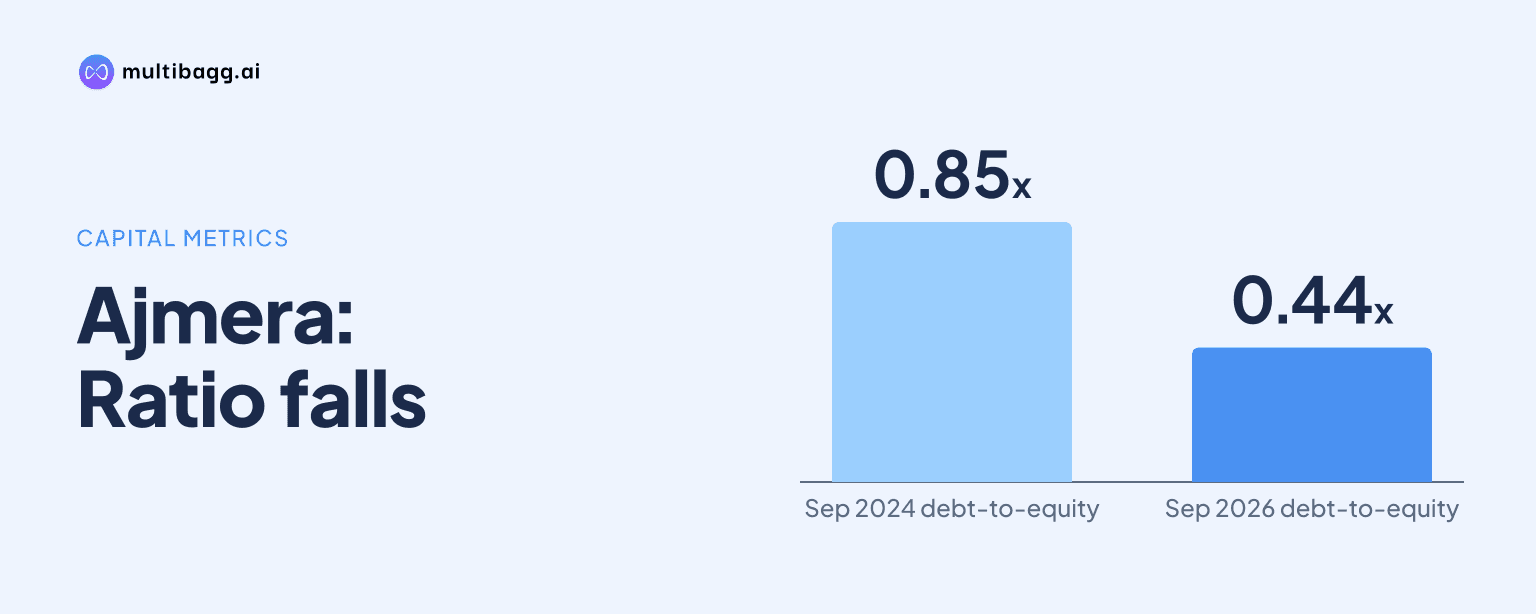
Ajmera reported a 0.44x debt-to-equity ratio in September 2026, down from 0.85x in September 2024, as total secured debt decreased by Rs 147 crore to Rs 646 crore and its average cost of debt fell to 10.75% from 12.22%. The latest reported debt balance consisted of Rs 646 crore of project debt.
Know Ajmera Realty & Infra India inside out
Results, valuation, peers and who's buying, in one view.
How much did Ajmera reduce debt and leverage?
Ajmera reduced total secured debt to Rs 646 crore in September 2026 from Rs 793 crore in September 2024, while debt-to-equity declined by 0.41x to 0.44x. The reduction was not uninterrupted: total debt fell to Rs 662 crore in March 2025, increased to Rs 737 crore in March 2026, and then declined again to Rs 646 crore.
The debt-to-equity ratio moved faster than the reported debt balance. It fell from 0.85x in September 2024 to 0.55x in March 2025, remained 0.55x in September 2025, and then declined to 0.53x in March 2026, 0.47x in June 2026 and 0.44x in September 2026. Ajmera’s presentation does not disclose the equity balances used to calculate those ratios.
At September 2026, Ajmera showed Rs 646 crore of project debt and did not provide a separate corporate-debt figure in its table. This differs from September 2024, when corporate debt was Rs 283 crore and project debt was Rs 510 crore. The presentation therefore supports a comparison of total debt and project debt across the two dates, but not a precise September 2026 corporate-debt balance.
What changed in Ajmera’s debt mix?
Ajmera’s reported debt mix shifted toward project debt, which increased by Rs 136 crore from Rs 510 crore in September 2024 to Rs 646 crore in September 2026. Project debt first declined to Rs 495 crore in March 2025, before rising to Rs 590 crore in September 2025, Rs 637 crore in March 2026 and Rs 630 crore in June 2026.
Corporate debt declined in the periods where Ajmera disclosed it separately. It reduced from Rs 283 crore in September 2024 to Rs 167 crore in March 2025, Rs 100 crore in September 2025 and March 2026, and Rs 50 crore in June 2026. The September 2026 table leaves the corporate-debt entry blank while reporting total debt and project debt at Rs 646 crore.
The shorter-term movements also differed from the two-year trend. Between June 2026 and September 2026, total debt decreased by Rs 34 crore from Rs 680 crore to Rs 646 crore, while debt-to-equity declined from 0.47x to 0.44x. Between March 2025 and March 2026, total debt rose by Rs 75 crore from Rs 662 crore to Rs 737 crore, even as the ratio edged down from 0.55x to 0.53x.
Got a follow-up? Ask IRIS
How far did Ajmera’s borrowing cost decline?
Ajmera’s average cost of debt declined by 147 basis points from 12.22% in September 2024 to 10.75% in September 2026. One basis point equals one-hundredth of a percentage point. The reported cost was 12.20% in March 2025, 11.51% in September 2025, 11.15% in March 2026 and 11.01% in June 2026.
The repo rate displayed in Ajmera’s presentation fell from 6.50% in September 2024 to 5.25% in March 2026 and remained at 5.25% in June and September 2026. Ajmera’s average debt cost nevertheless decreased by 0.40 percentage points from 11.15% in March 2026 to 10.75% in September 2026, while the displayed repo rate was unchanged over that interval.
The difference between Ajmera’s average debt cost and the displayed repo rate was 5.72 percentage points in September 2024 and 5.50 percentage points in September 2026. The average debt cost therefore fell by 1.47 percentage points over the two years, compared with a 1.25-percentage-point reduction in the displayed repo rate. Ajmera does not identify lender terms, refinancing actions or other reasons for the borrowing-cost movement.
How does Ajmera’s operating performance compare with its debt trend?
Ajmera reported FY26 revenue of Rs 1,098 crore, up from Rs 753 crore in FY25 and Rs 441 crore in FY23. Earnings before interest, taxes, depreciation and amortisation, or EBITDA, rose to Rs 306 crore in FY26 from Rs 246 crore in FY25, although the EBITDA margin declined to 28% from 33%. The March 2026 debt-to-equity ratio was 0.53x, compared with 0.55x a year earlier.
Profit after tax increased to Rs 157 crore in FY26 from Rs 126 crore in FY25 and Rs 72 crore in FY23. Its margin, however, was 14% in FY26 versus 17% in FY25. Return on capital employed was 14% in FY26, compared with 13% in FY24 and FY25, alongside total secured debt of Rs 737 crore at March 2026.
In H1FY27, Ajmera reported revenue of Rs 639 crore, 37% above Rs 481 crore in H1FY26. EBITDA increased 28% to Rs 178 crore, while its margin was 28% against 29% a year earlier; profit before tax rose 29% to Rs 129 crore and profit after tax increased 32% to Rs 93 crore. The 0.44x debt-to-equity ratio was reported at the September 2026 end of H1FY27.
Conclusion
Ajmera’s reported debt profile changed materially between September 2024 and September 2026. Total secured debt fell from Rs 793 crore to Rs 646 crore, debt-to-equity reduced from 0.85x to 0.44x, and average debt cost moved from 12.22% to 10.75%. The balance composition shifted because project debt increased from Rs 510 crore to Rs 646 crore while separately reported corporate debt declined through June 2026.
The next point to watch is whether Ajmera provides a separate corporate-debt figure after the September 2026 table left that entry undisclosed, despite reporting Rs 646 crore of total and project debt. Its future disclosures can also show whether the 10.75% average debt cost continues to decline while the presentation’s repo rate remains at 5.25%, and whether debt movement remains aligned with H1FY27 revenue of Rs 639 crore.