










Ajmera H1FY27 PAT rose 32% despite 55% sales value fall
Key highlights
- Ajmera’s H1FY27 sales value fell 55% year on year to Rs 370 crore.
- Ajmera reported H1FY27 total revenue of Rs 639 crore and PAT of Rs 93 crore.
- H1FY27 sales volume declined 60% to 1,16,620 square feet, while realisation rose 12% to Rs 31,689 per square foot.
- Ajmera reported Rs 646 crore of secured debt and a 0.44 times debt-to-equity ratio at September 2026.
powered by IRIS
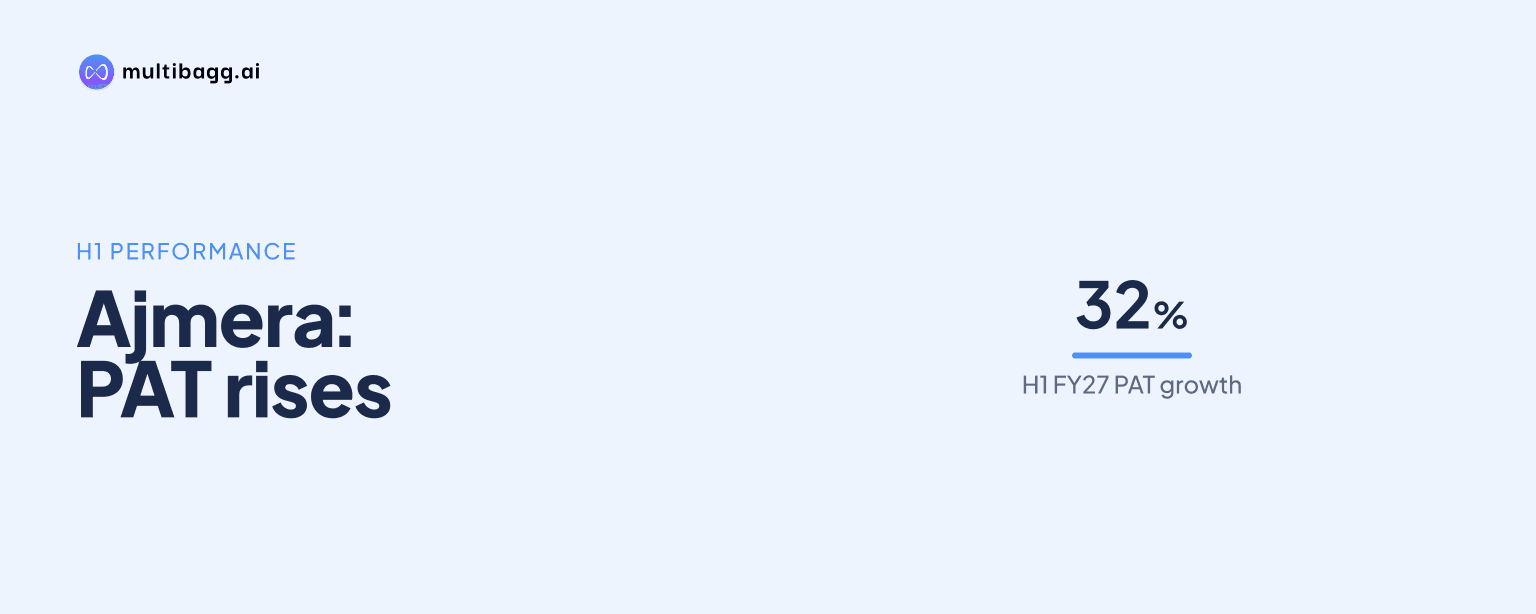
Ajmera reported H1FY27 profit after tax (PAT) of Rs 93 crore, up 32% year on year, even as sales value fell 55% to Rs 370 crore; total revenue was Rs 639 crore, 33% higher in its business highlights. The presentation also says Mumbai project 33Fifteen qualified for revenue recognition, without quantifying its contribution.
Know Ajmera Realty & Infra India inside out
Results, valuation, peers and who's buying, in one view.
Why did Ajmera’s revenue and profit rise while sales fell?
Ajmera reported higher H1FY27 revenue and PAT while identifying 33Fifteen as eligible for revenue recognition, although the presentation does not quantify the project’s revenue or profit contribution. It reported Rs 639 crore of total revenue, Rs 178 crore of earnings before interest, tax, depreciation and amortisation (EBITDA), and Rs 93 crore of PAT in the half year.
The financial comparison shows total revenue of Rs 639 crore in H1FY27 against Rs 481 crore in H1FY26, while EBITDA increased from Rs 139 crore to Rs 178 crore. Profit before tax (PBT) rose from Rs 100 crore to Rs 129 crore, and PAT increased from Rs 71 crore to Rs 93 crore. The financial table labels the revenue increase as 37%, whereas the business-highlights page states a 33% increase.
Ajmera’s reported margins changed modestly despite the increase in earnings. EBITDA margin was 28% in H1FY27 versus 29% in H1FY26, while PBT margin was 20% versus 21%. PAT margin was unchanged at 15% in both periods.
How far did Ajmera’s H1FY27 sales and collections decline?
Ajmera’s H1FY27 sales value declined to Rs 370 crore from Rs 828 crore in H1FY26, a 55% year-on-year decrease, while collections fell 20% to Rs 363 crore from Rs 454 crore. The reduction in reported sales value was therefore larger than the reduction in collections during the half year.
Sales volume contracted 60% to 1,16,620 square feet in H1FY27 from 2,93,016 square feet a year earlier. At the same time, realisation increased 12% to Rs 31,689 per square foot from Rs 28,261 per square foot. The higher realisation occurred alongside a decline of 1,76,396 square feet in sold area.
Ajmera recorded H1FY27 collections of Rs 363 crore against sales value of Rs 370 crore, compared with Rs 454 crore of collections against Rs 828 crore of sales value in H1FY26. The presentation supplies this half-year comparison but does not provide project-level H1FY26 collections, limiting like-for-like project comparisons across the two periods.
Got a follow-up? Ask IRIS
Which Ajmera projects generated H1FY27 sales and collections?
Ajmera’s largest disclosed H1FY27 sales contributor was Manhattan 2 in Mumbai, with Rs 162 crore of sales value from 44,130 square feet and 47 units. Manhattan 1 followed with Rs 87 crore from 24,329 square feet and 28 units, together accounting for Rs 249 crore of the Rs 370 crore H1FY27 sales-value total.
Other Mumbai projects included 33Fifteen, which recorded Rs 36 crore of sales value from 4,984 square feet and seven units, and Solis Phase 1, which recorded Rs 20 crore from 10,624 square feet and 19 units. Prive contributed Rs 20 crore from 3,835 square feet and two units. Vann by Ajmera recorded Rs 4 crore, and the presentation says its Q2FY27 sales came from additional carpet-area purchases by existing homeowners.
Bengaluru projects recorded lower disclosed sales values in the half year. Marina accounted for Rs 21 crore from 13,701 square feet and 12 units, Iris contributed Rs 11 crore from 8,528 square feet and nine units, and Lugaano & Florenza contributed Rs 1 crore from 1,064 square feet and two units. Nucleus - Comm, Greenfinity - AB and Eden showed collections but no H1FY27 sales value in the project table.
Collections and sales value varied materially by project. Manhattan 1 collected Rs 129 crore against Rs 87 crore of H1FY27 sales value, while Manhattan 2 collected Rs 69 crore against Rs 162 crore of sales value. Greenfinity - AB reported Rs 23 crore of collections and Nucleus - Comm Rs 16 crore, with neither project showing sales value for H1FY27.
What does Ajmera’s debt position show at September 2026?
Ajmera reported total secured debt of Rs 646 crore at September 2026 and a debt-to-equity ratio of 0.44 times, compared with Rs 680 crore and 0.47 times at June 2026. The September 2026 table lists Rs 646 crore of project debt, while its corporate-debt entry is blank.
The presentation’s debt trend shows total debt declining from Rs 793 crore at September 2024 to Rs 646 crore at September 2026. Over the same dates, project debt increased from Rs 510 crore to Rs 646 crore, while corporate debt was Rs 283 crore at September 2024 and Rs 50 crore at June 2026. The debt-to-equity ratio declined from 0.85 times to 0.44 times.
Ajmera also disclosed 2.1 million square feet of ongoing development, 10.4 million square feet of future development potential on owned land, and 3.8 million square feet across eight projects in the launch pipeline. The presentation does not disclose launch dates, expected sales values or funding requirements for those eight planned projects.
Conclusion
Ajmera’s H1FY27 presentation shows a divergence between new-sales measures and reported financial results. Sales value fell 55% and sales volume declined 60%, while total revenue reached Rs 639 crore and PAT reached Rs 93 crore. The disclosed 12% increase in realisation and 33Fifteen’s revenue-recognition qualification occurred alongside this pattern, while PAT margin remained at 15%.
What to watch next is the timing and scale of launches from Ajmera’s eight-project, 3.8 million-square-foot pipeline, as the presentation gives no launch dates or expected sales values. Further disclosure on 33Fifteen’s recognised revenue and on the September 2026 corporate-debt entry, which is blank in the debt table, would also clarify the reported financial and balance-sheet trends.