










Alivus Life Sciences Ltd Q2 Revenue Rises 16% to ₹682 Crore
Key highlights
- Alivus Life Sciences Ltd reported Q2 FY27 revenue from operations of ₹682 crore, up 16% year-on-year.
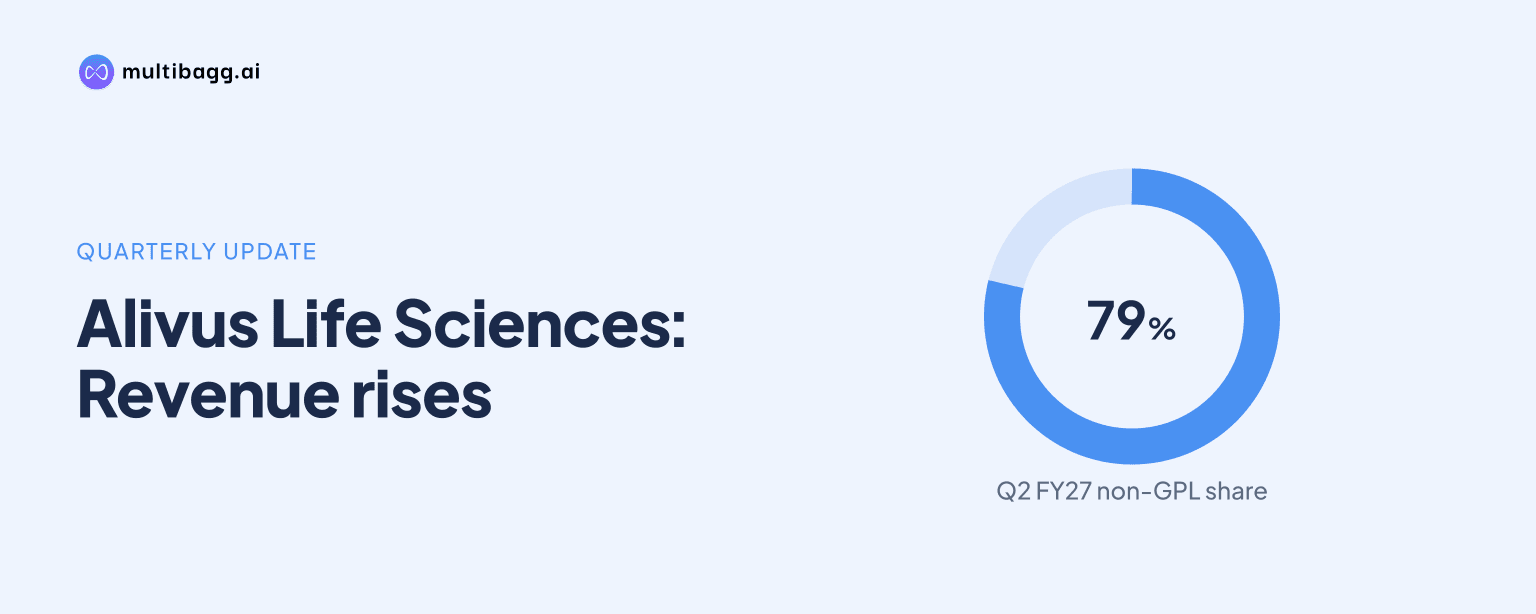
- Non-GPL business grew 20.8% year-on-year and accounted for 79% of Alivus revenue.
- CDMO revenue was ₹50 crore, up 32.3% quarter-on-quarter and nearly 80% year-on-year.
- Alivus reaffirmed FY27 revenue-growth guidance of 10% to 12% and EBITDA-margin guidance of 35% to 36%.
powered by IRIS
Alivus Life Sciences Ltd reported Q2 FY27 revenue from operations of ₹682 crore, up 16% year-on-year, and reaffirmed its FY27 revenue-growth guidance of 10% to 12% and EBITDA margin guidance of 35% to 36%. The company also made the October 30, 2026 earnings-call recording available on its website for investors.
Know Alivus Life Sciences inside out
Results, valuation, peers and who's buying, in one view.
What did Alivus Life Sciences Ltd report for Q2 FY27?
Alivus Life Sciences Ltd reported revenue from operations of ₹682 crore for the second quarter of FY27, representing year-on-year growth of 16%. The company said its non-GPL business grew 20.8% year-on-year and accounted for 79% of overall revenue, underscoring the importance of this business mix to quarterly performance.
The earnings-call highlights also indicated that adjusted EBITDA margin was about 39.5%, excluding one-time income. Management discussed that the one-off contribution had two parts: a validation supply of a complex high-margin product and a one-time income accrual from a customer. These items are relevant when assessing the reported quarter against the company’s underlying operating trend.
Alivus said it has retained its FY27 guidance, targeting revenue growth of 10% to 12% and an EBITDA margin of 35% to 36%. The reaffirmation provides the company’s stated framework for the remainder of the financial year, although quarterly results can continue to reflect product mix and specific customer-related items.
How did Alivus Life Sciences Ltd's CDMO business perform?
Alivus reported CDMO revenue of ₹50 crore in Q2 FY27, up 32.3% quarter-on-quarter and nearly 80% year-on-year. The segment was one of the faster-growing parts of the business discussed during the earnings call.
Management said it had not pursued some large-volume intermediate CDMO projects because of capacity constraints. Dr. Yasir Rawjee, Managing Director and Chief Executive Officer, said the Solapur capacity expansion is expected to allow the company to address this opportunity, including potential work that could move from intermediates to active pharmaceutical ingredients, or APIs.
Tushar Mistry, Chief Financial Officer, said Alivus is targeting a doubling of the CDMO business over three to four years. Under that stated objective, CDMO would contribute 12% to 15% of overall revenue. This is a management target rather than a reported outcome, and its execution will depend on capacity availability and project conversion.
What were the key Q2 FY27 financial and operating figures?
The quarter’s reported figures show revenue growth alongside a greater contribution from non-GPL operations and rapid CDMO expansion. The adjusted EBITDA margin figure specifically excludes the one-time income discussed by management, making that distinction important for investors comparing profitability across periods.
Management also said operating costs remained stable following a shift in boiler fuel from gas to bio-briquettes. The company cited India’s broad agricultural-waste base and said it had no supply concerns related to the change. No quantified cost saving from this shift was disclosed in the provided call highlights.
Got a follow-up? Ask IRIS
Why does the Q2 update matter for Alivus investors?
The Q2 update matters because it combines 16% revenue growth with a mix shift toward non-GPL business, which represented 79% of revenue. It also places CDMO at the centre of Alivus’s capacity-expansion discussion, with the company linking future project opportunities to the Solapur facility.
For investors, the distinction between adjusted margin and one-time income is material. Management’s disclosure that a validation supply and customer-income accrual contributed to the quarter gives context for the approximately 39.5% adjusted EBITDA margin. The company’s 35% to 36% full-year EBITDA-margin guidance remains the relevant management benchmark for FY27.
Alivus shares closed at ₹1,451 on October 30, 2026, up 3.07% for the next-day close reference provided. The available information does not establish a direct link between that movement and the earnings-call disclosure, but the release gave shareholders access to management’s detailed commentary after the Q2 result.
What information has Alivus Life Sciences Ltd made available to shareholders?
Alivus confirmed in a Regulation 30 disclosure dated October 30, 2026 that it uploaded the audio recording of its Q2 FY2027 earnings call to the company website. The call was held on the same date and covered quarterly performance, operating conditions, CDMO activity and capacity-expansion plans.
The recording allows shareholders to review management’s comments directly, including the explanation of one-time income, the stable operating-cost commentary and the CDMO revenue objective. Earnings-call transcripts, where available, are listed in the Annual Reports and Financial Documents section of the company’s resources area.
Conclusion
Alivus Life Sciences Ltd’s Q2 FY27 update showed revenue of ₹682 crore, 16% above the year-earlier period, while non-GPL operations accounted for 79% of revenue and CDMO revenue reached ₹50 crore. The quarter also included identified one-time items, so the company’s adjusted margin disclosure and full-year guidance provide important context for evaluating profitability.
Investors will next watch progress on the Solapur expansion, particularly whether it enables Alivus to pursue larger-volume intermediate CDMO projects. The other disclosed markers are delivery against FY27 revenue growth of 10% to 12%, EBITDA margin of 35% to 36%, and management’s longer-term target to double CDMO revenue over three to four years.