










Allcargo Global Limited returns to Q2 profit as EBITDA rises
Key highlights
- AGL reported a Rs 32 crore profit in Q2 FY27 after a Rs 28 crore loss in Q1 FY27.
- Revenue increased 23% QoQ to Rs 4,320 crore in Q2 FY27 from Rs 3,522 crore in Q1 FY27.
- EBITDA rose 270% QoQ to Rs 122 crore from Rs 33 crore.
- Air volumes grew 16% QoQ, while LCL and FCL volumes rose 3% and 1%, respectively.
powered by IRIS
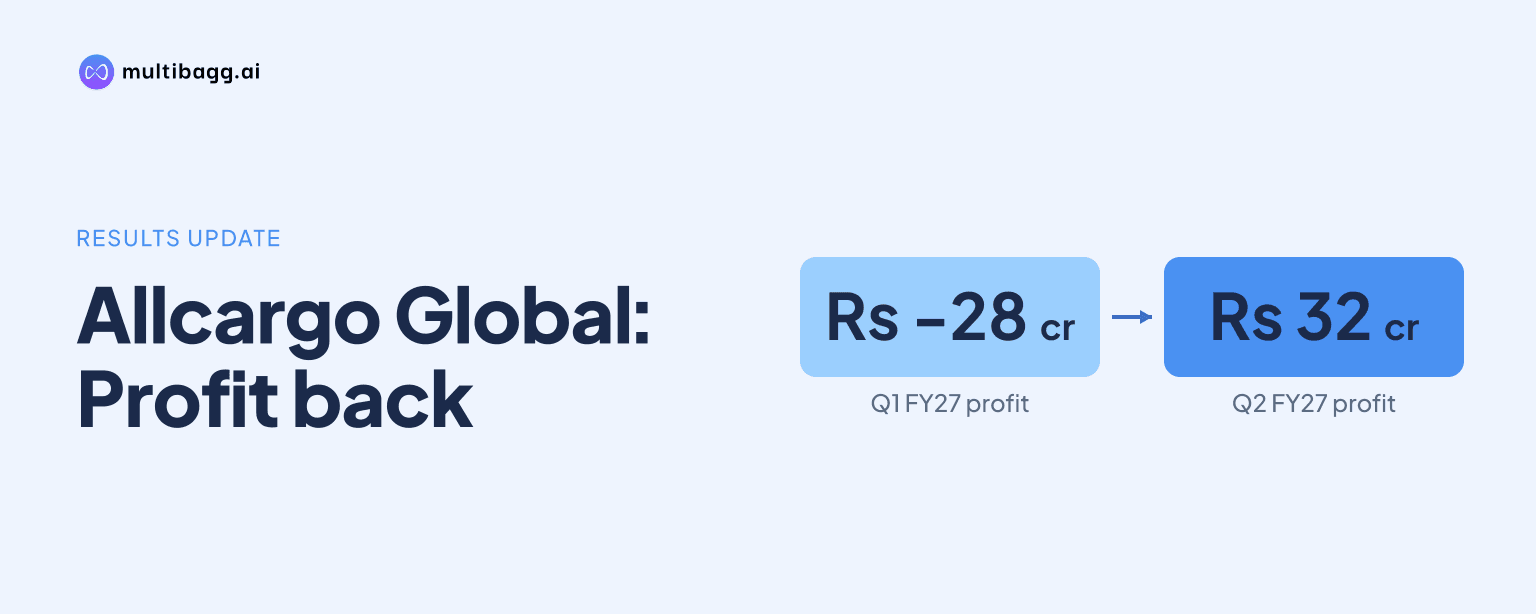
For the quarter ended September 30, 2026, Allcargo Global Limited returned to a Rs 32 crore profit and increased earnings before interest, tax, depreciation and amortisation (EBITDA) 270% quarter on quarter to Rs 122 crore. AGL reported Rs 4,320 crore of revenue, up 23% from Q1 FY27, while profit after tax reversed a Rs 28 crore loss in the preceding quarter.
Know Allcargo Global inside out
Results, valuation, peers and who's buying, in one view.
How did AGL perform in Q2 FY27?
AGL recorded a sequential improvement in revenue, profitability and earnings in Q2 FY27. Consolidated revenue increased by Rs 798 crore from Rs 3,522 crore in Q1 FY27 to Rs 4,320 crore in Q2 FY27. Gross profit rose 14% quarter on quarter to Rs 837 crore, while EBITDA grew by Rs 89 crore from Rs 33 crore to Rs 122 crore. The company described the EBITDA change as 270% growth quarter on quarter, or QoQ.
AGL also reported profit before tax (PBT) of Rs 62 crore during Q2 FY27, compared with a loss in both Q1 FY27 and Q2 FY26. The release does not provide the amount of either earlier PBT loss. The comparison shows that the Q2 FY27 shift was not limited to net profit: revenue, gross profit, EBITDA and PBT all moved higher or into profit in the quarter ended September 30, 2026.
What drove AGL's Q2 FY27 turnaround?
AGL attributed the Q2 FY27 result to business initiatives and industry tailwinds. Its stated commercial measures included expanding volumes in long-haul trade lanes, withdrawing from loss-making routes, improving container utilisation and increasing the use of 40 ft boxes, which it said are more profitable than 20 ft boxes. These actions were intended to improve gross profit, which reached Rs 837 crore in Q2 FY27.
AGL said staff and administration costs remained largely flat both QoQ and year on year, or YoY, because of cost-control efforts. It identified automation, outsourcing, and global processes and systems as tools used to contain those expenses. The company said this cost structure allowed the increase in gross profit to flow through to the bottom line, contributing to the move from a Rs 28 crore loss in Q1 FY27 to a Rs 32 crore profit in Q2 FY27.
Which AGL shipping volumes increased in Q2 FY27?
AGL reported QoQ volume growth across all three products it disclosed for Q2 FY27. Less-than-container-load, or LCL, volumes rose 3% from the previous quarter. Full-container-load, or FCL, volumes increased 1%, while air volumes rose 16%, making air the fastest-growing category among the three reported volume measures.
The product comparison matters because the disclosed operational changes focused on container economics as well as shipment volumes. AGL linked its 40 ft box mix and container-utilisation work to gross-profit improvement, whereas the disclosed air-volume increase was 16% QoQ without a corresponding air revenue or profit figure. The release therefore establishes that all reported products expanded in Q2 FY27, but it does not quantify each product's contribution to the Rs 4,320 crore consolidated revenue total.
Got a follow-up? Ask IRIS
What did AGL management say about the result?
AGL Managing Director Adarsh Hegde said the Q2 FY27 performance marked a positive turnaround after challenging preceding quarters. He said improving market conditions and freight-rate movements had provided some support, but attributed the outcome also to actions implemented over the past few quarters, including cost optimisation, pricing discipline, yield management and steps to address operational inefficiencies. EBITDA reached Rs 122 crore in Q2 FY27, versus Rs 33 crore in Q1 FY27.
Management also said it had accelerated technology and automation initiatives to improve process efficiency and productivity. AGL characterised the September 2026 quarter as an encouraging indication that these measures were producing tangible results, while saying more work remained. The company was reporting only its second quarterly result as an independently listed business following the Allcargo Group restructuring and demerger of its international supply-chain business.
How does AGL's operating footprint support its business?
AGL describes itself as the Allcargo Group's international supply-chain business and the world's largest global LCL consolidator. It said its network covers markets accounting for more than 90% of global trade and includes more than 200 owned offices in over 60 countries, supplemented by franchise operations in other geographies. Those disclosed network figures provide context for the 3% QoQ increase in its LCL volumes.
AGL also identified ECU360 as its digital freight-booking platform for shipment bookings across global trade lanes. The release does not disclose ECU360 booking volumes, revenue, cost savings or a timetable for further deployment. Its operational account instead ties technology and automation generally to staff and administration costs that remained largely flat in Q2 FY27 despite the Rs 798 crore sequential increase in consolidated revenue.
Conclusion
AGL's Q2 FY27 filing shows a sequential return to profitability supported by higher revenue, gross profit and EBITDA. Revenue rose 23% QoQ to Rs 4,320 crore, EBITDA increased 270% to Rs 122 crore, and profit after tax shifted from a Rs 28 crore loss to a Rs 32 crore profit. The operational data also showed growth across LCL, FCL and air volumes, with air increasing 16% QoQ.
The next reported periods can show whether AGL's stated initiatives continue to affect results, including yield improvement, pricing discipline, exits from loss-making routes, improved 40 ft box use, automation and cost control. Management said more work remains on these measures, while the release did not disclose a target or timetable for further product-level revenue, profitability or ECU360 data.