










Allied Blenders and Distillers reports 15.8% Q2 FY27 growth
Key highlights
- Allied Blenders and Distillers reported Q2 FY27 consolidated income from operations of ₹1,152 crore, up 15.8% year on year.
- ABD sold a record 10.0 million cases in Q2 FY27, up 11.1% from 9.0 million cases a year earlier.
- ABD reported EBITDA of ₹143 crore, up 10.0% year on year, with a 12.4% EBITDA margin.
- ABD reported gross margin of 45.3%, an expansion of 90 basis points year on year.
powered by IRIS
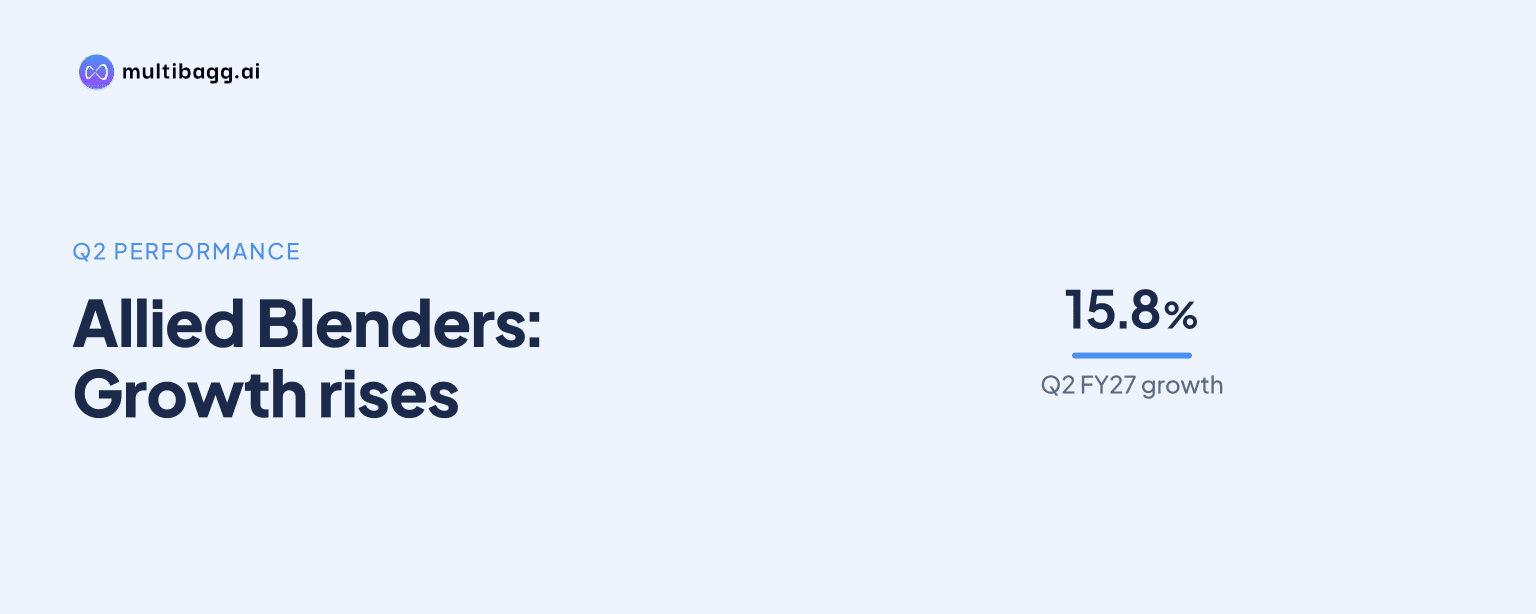
Allied Blenders and Distillers Limited reported consolidated Q2 FY27 income from operations of ₹1,152 crore, up 15.8% year on year, while quarterly sales volume crossed 10 million cases for the first time. The result matters because revenue growth, higher volumes and gross-margin expansion were recorded despite global supply-chain disruptions.
Know Allied Blenders & Distillers inside out
Results, valuation, peers and who's buying, in one view.
What did ABD report for Q2 FY27?
ABD reported consolidated income from operations of ₹1,152 crore for the quarter ended September 30, 2026, representing year-on-year growth of 15.8% and quarter-on-quarter growth of 17.1%. The company said this was supported by its highest-ever quarterly sales volume of 10.0 million cases.
The company reported profit after tax of ₹69 crore, up 9.7% year on year. Reported EBITDA was ₹143 crore, an increase of 10.0% from a year earlier and 19.2% sequentially, while the reported EBITDA margin stood at 12.4%.
Separate quarterly financial data cited revenue of ₹1,147.85 crore, operating profit of ₹139.16 crore and profit before tax of ₹97.16 crore. Those figures showed sequential improvement from revenue of ₹978.94 crore, operating profit of ₹115.48 crore and profit before tax of ₹67.84 crore in the preceding quarter.
How did ABD reach 10 million quarterly cases?
ABD reached 10.0 million cases in Q2 FY27, compared with 9.0 million cases in Q2 FY26, a year-on-year increase of 11.1%. Management described the milestone as the first time the company had exceeded 10 million cases in a single quarter.
The company said growth was registered across all four of its millionaire brands on a quarter-on-quarter basis. Management linked its operating focus to premiumisation-led growth, stronger consumer engagement, disciplined execution, backward integration and prudent capital allocation.
Higher sales volume did not fully explain the reported revenue increase. ABD also cited higher realisation per case and a more profitable brand mix as contributors to quarterly performance. The available disclosures do not provide a brand-wise sales or revenue breakdown.
Which profitability metrics changed during the quarter?
ABD said gross margin was 45.3% in Q2 FY27, expanding by 90 basis points from the year-earlier period. The company attributed the improvement to a profitable brand mix, higher realisation per case and benefits from backward integration in PET bottle manufacturing.
At the same time, reported EBITDA growth of 10.0% was lower than income-from-operations growth of 15.8%. The company reported an EBITDA margin of 12.4%, while the quarter's operating-profit data indicated operating profit of ₹139.16 crore, up 10.96% year on year.
The disclosures also highlighted global supply-chain disruptions. Management said PET bottle manufacturing benefits helped support gross margin despite these disruptions, showing that input availability and costs remained relevant factors for the alcoholic-beverages business during the quarter.
Got a follow-up? Ask IRIS
What does the result mean for investors and operations?
ABD's Q2 result shows that revenue and case-volume growth continued together in the September quarter. Income from operations rose faster than reported EBITDA, while profit after tax rose 9.7%, making the relationship between sales growth, realised pricing, product mix and operating costs important for assessing the quarter.
The record volume achievement is significant for an Indian spirits company because scale can support manufacturing and distribution efficiency. However, the company also cited supply-chain disruption, and its reported financial data show that sales growth does not automatically translate into EBITDA growth at the same rate.
For investors, the reported 90-basis-point gross-margin expansion provides context for the quarter's profitability. The business also benefited from PET bottle backward integration, according to management, but no quantified financial contribution from this initiative was disclosed.
ABD held an audio earnings call on October 28, 2026, following the results announcement dated October 27, 2026. The call covered unaudited standalone and consolidated results for the quarter and half-year ended September 30, 2026, and its recording was made available on the company's investor website.
How does Q2 FY27 compare with the preceding quarter?
The quarterly financial data showed a broad sequential increase across revenue, operating profit, profit before tax and net profit. Revenue of ₹1,147.85 crore was 17.25% higher than ₹978.94 crore in the preceding quarter, while net profit of ₹69.02 crore was 51.96% higher than ₹45.42 crore.
Profit before tax rose 43.22% quarter on quarter to ₹97.16 crore from ₹67.84 crore. PBDT increased 27.53% to ₹115.58 crore from ₹90.63 crore, and operating profit rose 20.51% from ₹115.48 crore to ₹139.16 crore.
Conclusion
ABD delivered a quarter of higher income from operations, record sales volume and improved gross margin. Consolidated income from operations rose 15.8% year on year to ₹1,152 crore, while the company crossed 10 million cases in quarterly sales for the first time and reported profit after tax of ₹69 crore.
The next disclosures will be relevant for evidence on the company's premiumisation, consumer-engagement and backward-integration priorities. Investors will also watch management's comments on global supply-chain disruptions, realisation per case and the relationship between revenue growth and reported EBITDA growth.