










Amarnath Securities review qualified over missing records
Key highlights
- Amarnath Securities’ September 30, 2026 limited review received a qualified conclusion over unavailable RBI compliance documents.
- Total liabilities were Rs 99.24 lakh at September 30, 2026, compared with Rs 79.53 lakh at March 31, 2026.
- Reported loans increased to Rs 20.89 lakh from Rs 2.50 lakh, while related agreements were unavailable to the auditor.
- Amarnath Securities reported negative total equity of Rs 72.13 lakh at September 30, 2026.
powered by IRIS
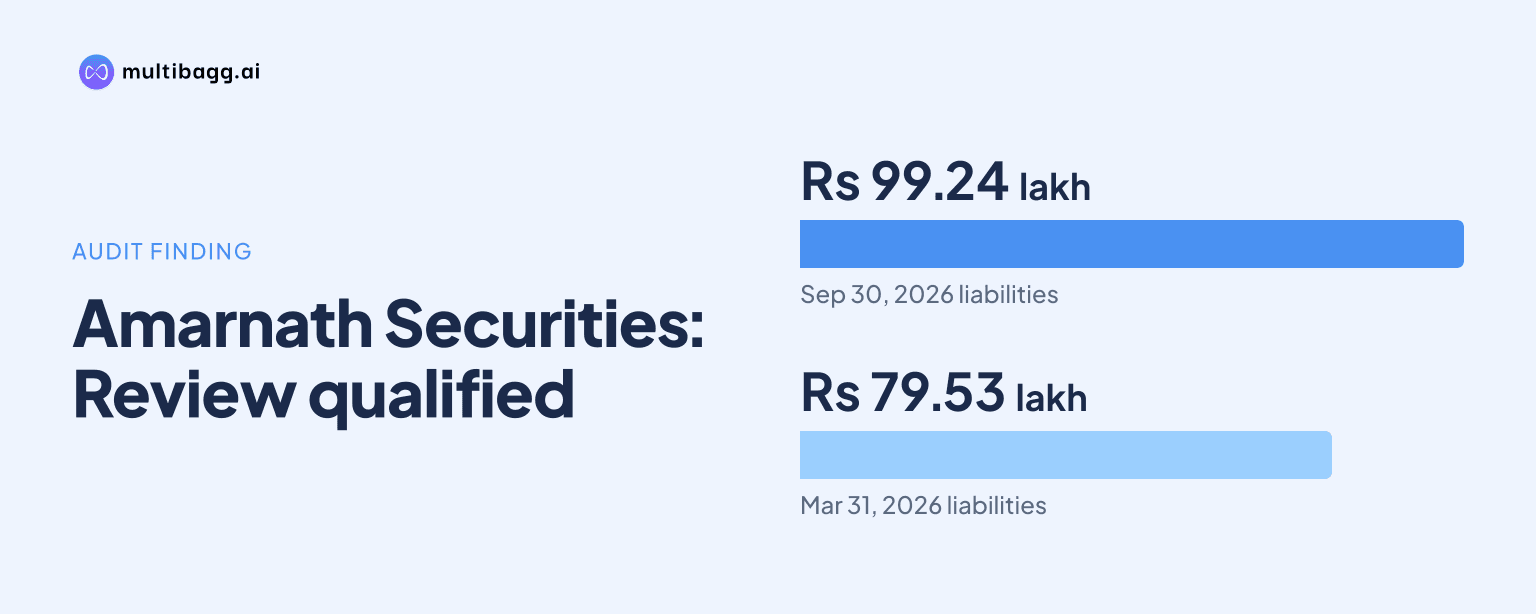
Amarnath Securities Limited received a qualified review conclusion for the quarter and half year ended September 30, 2026, after its auditor said Reserve Bank of India compliance documents were unavailable and it could not assess the possible effects; Amarnath Securities reported total liabilities of Rs 99.24 lakh at that date.
Know Amarnath Securities inside out
Results, valuation, peers and who's buying, in one view.
Why did Amarnath Securities receive a qualified review conclusion?
Amarnath Securities received the qualified conclusion because the auditor had not received documents concerning Reserve Bank of India, or RBI, compliance by the date of its November 14, 2026 report. The auditor said it was therefore unable to determine the possible effects, if any, of the missing compliance documents on the September 30, 2026 unaudited financial results.
The qualification applies to a limited review, rather than a full audit, of the quarterly and half-year results submitted under Regulation 33 of the Securities and Exchange Board of India, or SEBI, Listing Obligations and Disclosure Requirements Regulations, 2015. The auditor said its review under Standard on Review Engagements 2410 provides moderate assurance and consists primarily of inquiries and analytical procedures, rather than an audit opinion.
Amarnath Securities separately disclosed that, following a change in management, it had yet to make an application or intimation to RBI seeking approval for the changes. As of the signing date of the financial statements, November 14, 2026, the company said RBI approval remained pending, identifying the regulatory matter connected with the auditor's unavailable-document observation.
Which Amarnath Securities balances could the auditor not verify?
The auditor said it could not quantify effects on profit or loss, assets or liabilities because Amarnath Securities’ liabilities appeared to have been compromised and management had not clarified the details. The report does not specify a monetary amount for the apparently compromised liabilities, but total liabilities stood at Rs 99.24 lakh on September 30, 2026, compared with Rs 79.53 lakh on March 31, 2026.
The auditor also could not verify the existence, ownership, carrying value or presentation of the investment balance because supporting documents were not supplied. Amarnath Securities reported investments of Rs 51,000 at September 30, 2026, unchanged from Rs 51,000 at March 31, 2026, within total financial assets of Rs 27.00 lakh.
Loan and advance agreements were likewise unavailable, preventing the auditor from checking contractual terms, potential adjustments, interest income, impairment provisions and disclosures. The reported loans balance rose to Rs 20.89 lakh at September 30, 2026 from Rs 2.50 lakh at March 31, 2026, an increase of Rs 18.39 lakh that also appears in the half-year cash-flow statement as an outflow for long- and short-term loans and advances.
What do Amarnath Securities’ September 2026 financial results show?
Amarnath Securities reported total assets of Rs 27.10 lakh at September 30, 2026, versus Rs 6.49 lakh at March 31, 2026. Financial assets accounted for Rs 27.00 lakh of the September total, including Rs 20.89 lakh of loans, Rs 2.81 lakh of other financial assets, Rs 2.16 lakh of cash and cash equivalents, and Rs 62,000 of other receivables.
Financial liabilities increased to Rs 79.83 lakh from Rs 57.00 lakh over the same dates, while provisions declined to Rs 19.41 lakh from Rs 22.53 lakh. The September balance sheet recorded borrowings other than debt securities of Rs 78.55 lakh, whereas the March 2026 balance sheet showed debt securities of Rs 55.95 lakh; the filing does not provide a reconciliation between those classifications.
Total equity remained negative at Rs 72.13 lakh on September 30, 2026, compared with negative Rs 73.04 lakh on March 31, 2026. The auditor drew attention to the financial statements’ indication that Amarnath Securities’ entire net worth had been eroded; equity share capital was Rs 3.00 crore and other equity was negative Rs 3.72 crore.
For the half year from April 1 to September 30, 2026, Amarnath Securities reported profit before tax of Rs 91,000, compared with a loss before tax of Rs 5.21 crore for the year ended March 31, 2026. Operating activities used Rs 23.70 lakh of cash in the half year, principally alongside an Rs 18.39 lakh increase in loans and advances, while financing activities generated Rs 22.51 lakh through borrowings net of finance cost.
Got a follow-up? Ask IRIS
What other accounting and governance matters did the auditor report?
The auditor said Amarnath Securities had no whole-time company secretary for part of the quarter under review and that it could not determine the extent or effects of any resulting secretarial non-compliances. It also said the previous year’s secretarial audit report had not been received and that the company had neither provided for nor paid interest on share application money, without quantifying that interest amount.
Documentation was also insufficient for certain expenses, including rent of Rs 21,000 charged in the September 2026 quarter for premises whose leave-and-license agreement was in a director’s personal name. The auditor said it could not comment on Amarnath Securities’ right to use the premises or whether recording the expense in the financial results was appropriate.
The report additionally highlighted Rs 6.87 lakh of revenue recognised during the quarter from writing back a loan payable to a related party, based on management’s decision. This was presented as an emphasis-of-matter item, separate from the RBI-document qualification, and the auditor also referred readers to the scrutiniser’s report for Amarnath Securities’ 32nd annual general meeting on the BSE website.
How did related-party funding and transactions appear in the disclosure?
Amarnath Securities disclosed unsecured loans from related parties during the reporting period, including Rs 9.20 lakh from whole-time director Chetan Balubhai Patel and Rs 9.47 lakh from Prarthee Chetan Patel, a relative of a director. The related-party table recorded closing balances of Rs 95,000 and Rs 9.13 lakh respectively for those two funding arrangements.
The disclosure also recorded Rs 39.51 lakh of expense reimbursements involving Chetan Balubhai Patel during the reporting period, against an audit-committee-approved value of Rs 5.00 lakh. The filing listed a total related-party transaction value of Rs 46.99 lakh during the period and aggregate closing balances of Rs 14.50 lakh, although the auditor’s report separately said agreements for loans and advances granted by Amarnath Securities were unavailable for review.
Conclusion
The qualified review combines an RBI-document gap with unverified loans, investments, expenses and liability details at a time when Amarnath Securities reported Rs 99.24 lakh of liabilities against total assets of Rs 27.10 lakh on September 30, 2026. The reported loan balance increased by Rs 18.39 lakh from March 31, 2026, yet the underlying agreements were not available to the auditor.
The next disclosed issue to watch is Amarnath Securities’ pending RBI application or intimation following its change in management, which had not been made and had not received approval as of November 14, 2026. Subsequent disclosures may also show whether the company provides loan agreements, investment support, the prior-year secretarial audit report and clarification of the liabilities cited by the auditor.