










Ambuja Cements targets 155 MTPA with Rs 14,500 crore plan
Key highlights
- Ambuja Cements plans about Rs 14,500 crore of spending for 14 projects adding approximately 30 MTPA of cement capacity and 10.3 MTPA of clinker capacity.
- Ambuja Cements targets 149 MTPA by FY29 and 155 MTPA by FY30, compared with 113.5 MTPA cited during the Q2 FY27 call.
- The West, East and North clusters will receive 15.2 MTPA, 11.6 MTPA and 2.9 MTPA of new grinding capacity, respectively.
- Ambuja Cements reported Q2 FY27 trade-volume growth of 8.6% year on year, with trade accounting for 74% of sales.
powered by IRIS
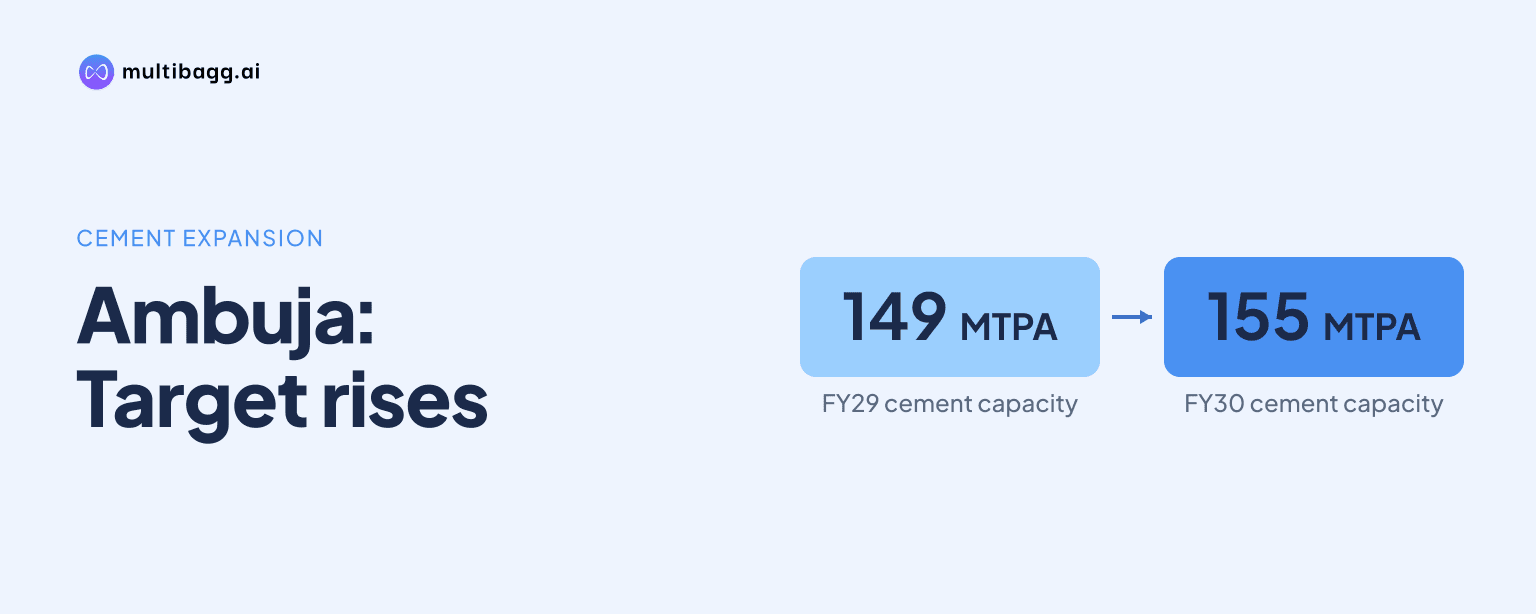
Ambuja Cements Limited plans to spend about Rs 14,500 crore on 14 projects adding approximately 30 million tonnes per annum (MTPA) of cement capacity and 10.3 MTPA of clinker capacity, with management targeting 155 MTPA by FY30. The programme is concentrated in western, eastern and northern markets and is designed to use available clinker capacity.
Know ACC inside out
Results, valuation, peers and who's buying, in one view.
What is Ambuja Cements investing in capacity?
Ambuja Cements is committing about Rs 14,500 crore to an expansion programme comprising 14 projects, 30 MTPA of cement capacity and 10.3 MTPA of clinker capacity. Management said the plan follows its previously communicated path of reaching 149 MTPA by FY29 and 155 MTPA by FY30, compared with the 113.5 MTPA capacity cited by an analyst during the October 29, 2026 call.
Management said the programme is not a response to a single quarter of demand but the next phase after its first capex wave. During Q2 FY27, Ambuja Cements commissioned 4.6 MTPA across Dahej, Salai Banwa and Kalamboli. A further 3.2 MTPA at Bathinda and Jodhpur had stabilised, while the 2.4 MTPA Warisaliganj project in Bihar was scheduled for commissioning in the second half of FY27.
Management described the Rs 14,500 crore outlay as a combination of integrated units and grinding units. It said the investment requirement would be almost Rs 7,500 crore a year and that the programme should be self-sustainable through business cash flows over three years. Management did not disclose individual project costs, including for the Assam facilities.
Where will Ambuja Cements add grinding and clinker capacity?
Ambuja Cements will add 15.2 MTPA of grinding capacity in the West cluster, 11.6 MTPA in the East cluster and 2.9 MTPA in the North cluster. The West therefore accounts for just over half of the announced grinding additions, while Dadri Line-2 in Uttar Pradesh is the sole North-cluster project.
The West plan includes 2.9 MTPA each at Mundra and Hazira in Gujarat, and 2.9 MTPA each at Raigad, Kalyan and Amravati in Maharashtra, plus a 1 MTPA bulk cement terminal at Dahanu. The East plan includes 2.9 MTPA each at Rangia and Hojai in Assam, Godda in Jharkhand and Muzaffarpur in Bihar.
The clinker programme includes 4 MTPA each at Maratha in Maharashtra and Umrangso in Assam, and 2.25 MTPA at Mundra. Management said Maratha Line-2 was in advanced stages and should be running within the next couple of quarters. It also identified surplus clinker at Sanghi and operational capacity at Penna Jodhpur as support for the expanded grinding network.
Got a follow-up? Ask IRIS
Why does Ambuja Cements say the projects support value?
Ambuja Cements says the projects are focused on markets where it has brand equity, market share and premium-cement participation, rather than on volume alone. Management identified the West, East and North as the primary expansion areas and said many additions are brownfield projects, which it expects to lower construction risk and support efficient manufacturing costs.
The capacity programme follows a trade-led sales strategy. Trade volume rose 8.6% year on year in Q2 FY27, and trade represented 74% of sales, up 6 percentage points from the prior year. Premium products made up 37% of trade sales, compared with 35% a year earlier, while the blended-cement share increased to 82% from 77%.
Management said newer plants closer to markets could allow it to recalibrate some older, high-cost or less-efficient grinding assets. It put utilisation at Penna and Sanghi at roughly 50% each at the time of the call, but said existing capacity, including those assets, should see better utilisation in Q3 and Q4 FY27.
For projects requiring longer clinker movement, management said clinker can move by rail while cement can be delivered by road over shorter distances to end markets. It also cited a long-term arrangement for 20 million tonnes of fly ash from group thermal-power plants and said the BCFC infrastructure for fly-ash movement would expand over the next two quarters.
How will Ambuja Cements fund and execute the plan?
Ambuja Cements expects business cash flows to fund the Rs 14,500 crore programme over three years, while management said any interim funding need could be temporary. The company reported Q2 FY27 net worth of Rs 72,238 crore and cash and cash equivalents of Rs 1,070 crore, and management said it remained debt-free.
Management said it had revised project scheduling after challenges with a contractor in an earlier expansion phase. It gave indicative completion periods of about 14 months for grinding units and 18 months for integrated units, and said it would discuss the more detailed execution approach in subsequent quarters.
The expansion plan sits beside a FY28 operating-cost target of Rs 4,000 per tonne for the combined existing and new capacity base. For FY27, management retained its Rs 4,250-per-tonne cost target after reporting Q2 total cost of Rs 4,410 per tonne, or about Rs 4,182 per tonne excluding the cited geopolitical-conflict effect.
Management linked cost reduction to renewable power, logistics and domestic coal. Green power represented 61% in Q2 FY27, while net power cost was Rs 4.8 per unit, versus Rs 6 per unit in Q2 FY26. The primary logistics lead declined to 254 kilometres from 265 kilometres, partly offsetting higher diesel costs.
Conclusion
Ambuja Cements has attached a defined Rs 14,500 crore capital plan to its FY30 capacity target, combining approximately 30 MTPA of cement additions with 10.3 MTPA of clinker additions. The programme is weighted toward the West and East, where management expects available clinker, closer market access, trade growth and blended-cement sales to support its value-focused approach.
The next disclosed milestones are the second-half FY27 commissioning of the 2.4 MTPA Warisaliganj plant and the expected start-up of Maratha Line-2 within the next couple of quarters. Management also targets capacity utilisation closer to 75% by the end of FY27, versus about 61% to 62% in Q2 FY27, and operating cost of Rs 4,000 per tonne by FY28.