










Andhra Cements can file NCLT merger petition after BSE letter
Key highlights
- Andhra Cements received BSE’s no-adverse-observation letter on November 5, 2026.
- The scheme must be submitted to the NCLT within six months of November 5, 2026.
- The merger is conditional on NOCs from lending scheduled commercial banks and financial institutions.
- Shareholders must receive three years of revenue, PAT and EBIDTA data for both companies.
powered by IRIS
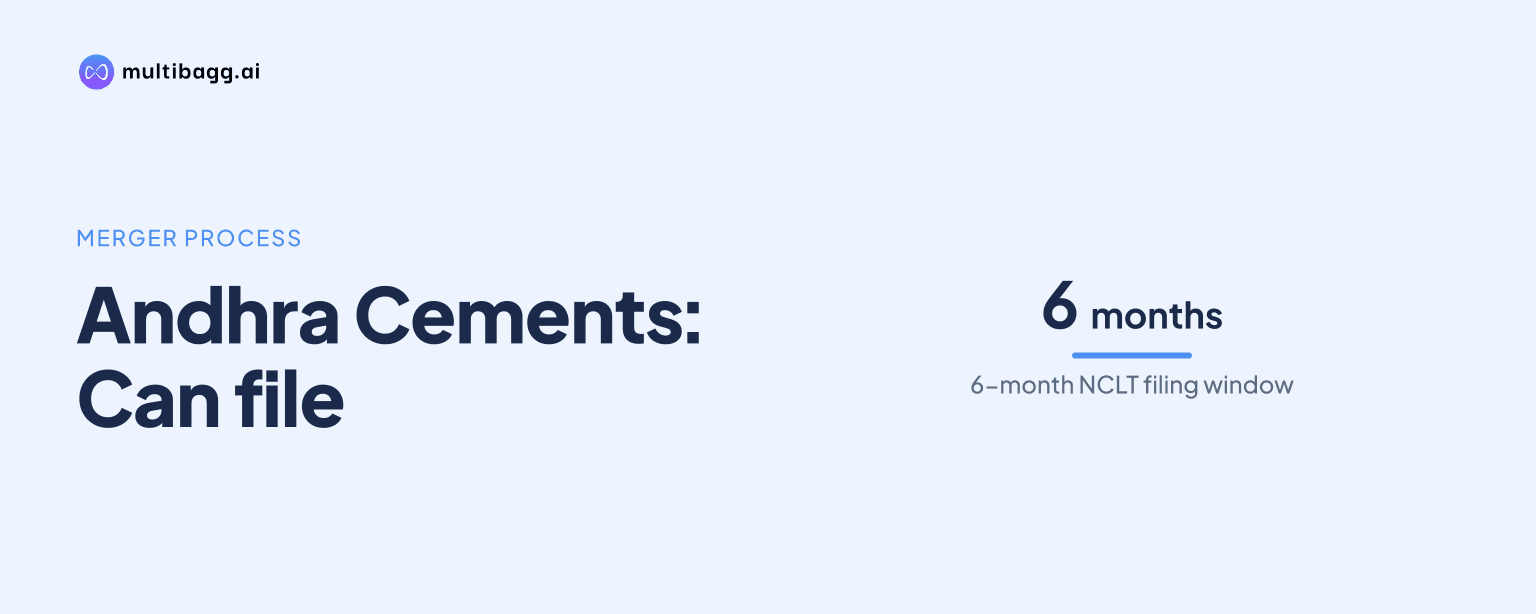
Andhra Cements Limited can submit its proposed amalgamation with Sagar Cements Limited to the National Company Law Tribunal, or NCLT, after BSE’s November 5, 2026 no-adverse-observation letter, but the scheme must be filed within six months and remains conditional on lender, creditor, shareholder and tribunal requirements.
Know Andhra Cements inside out
Results, valuation, peers and who's buying, in one view.
What did BSE allow Andhra Cements to do?
BSE allowed Andhra Cements to file its proposed scheme of amalgamation with the NCLT after issuing its observation letter on November 5, 2026. The letter states that BSE has no adverse observations, with limited reference to matters bearing on listing, delisting and continuous-listing requirements, enabling the company to take the draft scheme to the tribunal stage.
Andhra Cements disclosed the receipt of the letter on November 6, 2026 under Regulation 30 of the Securities and Exchange Board of India, or SEBI, Listing Obligations and Disclosure Requirements Regulations, 2015. The scheme describes Andhra Cements as the transferor company and Sagar Cements as the transferee company under Sections 230 to 232 of the Companies Act, 2013.
Does BSE’s letter approve the Andhra Cements merger?
No, BSE’s November 5, 2026 letter does not approve or complete the amalgamation of Andhra Cements with Sagar Cements. Andhra Cements said in its November 6 disclosure that the scheme remains subject to statutory and regulatory approvals under applicable law, including NCLT approval.
BSE said submissions of documents or information to SEBI or the exchange must not be treated as clearance or approval of the scheme. It also said neither SEBI nor BSE accepts responsibility for the financial soundness of the scheme or for the accuracy of statements and opinions in the submitted documents.
What lender and creditor conditions must Andhra Cements meet?
Andhra Cements must make the scheme expressly subject to no-objection certificates, or NOCs, from lending scheduled commercial banks and financial institutions. BSE linked that requirement to paragraph A(2)(k) of Part I of SEBI’s master circular dated June 20, 2023; the filing does not identify lenders or say whether any NOCs have been received.
Andhra Cements and Sagar Cements must also comply with the Companies Act, 2013 and related rules, including obtaining creditor consent where applicable. BSE required all liabilities of Andhra Cements to transfer to and vest in Sagar Cements, placing the transfer of obligations alongside the assets covered by the proposed amalgamation.
What must Andhra Cements disclose before shareholders vote?
Andhra Cements must provide shareholders and the NCLT details of any ongoing adjudication, recovery proceedings, prosecutions and other enforcement action involving the companies, their promoters and directors, if applicable. The BSE letter does not state that any such action exists; it sets a disclosure requirement for the approval process.
The shareholder explanatory statement must cover the merger’s need, rationale, business synergies, shareholder impact and cost-benefit analysis. It must also identify the registered valuer and merchant banker, explain the methods used for the share-swap ratio, and disclose revenue, profit after tax, or PAT, and earnings before interest, depreciation, tax and amortisation, or EBIDTA, for both companies for the last three years.
Andhra Cements must additionally disclose the transferor’s assets and liabilities to be moved to Sagar Cements, plus Sagar Cements’ post-merger balance sheet. The notice must show pre- and post-scheme shareholding as of the shareholder-meeting notice date and explain changes from the draft-scheme filing, if any.
Got a follow-up? Ask IRIS
What shareholder-process requirements remain for Andhra Cements?
Andhra Cements must receive a report on complaints, examine that report and take necessary measures before the shareholder process advances. This requirement arises under paragraph A(6) of Part I of SEBI’s June 20, 2023 master circular, although the November 5 letter gives no complaint count or shareholder-meeting date.
The company must display on its website and the stock exchanges’ websites any additional information submitted after the exchange filing from the receipt of the November 5 letter. The proposed scheme’s details must be prominently presented in the shareholder notice, and any equity shares issued under the scheme must be in dematerialised form only.
Where an unlisted company is involved in the scheme, Andhra Cements must include information in the prescribed abridged-prospectus format in the shareholder communication. BSE also required the financial information in the scheme, including information considered for the valuation report, not to be more than six months old.
What happens after Andhra Cements files with NCLT?
After filing, Andhra Cements must incorporate SEBI and stock-exchange observations in its NCLT petition and bring those observations to the tribunal’s notice. BSE stated that a petition is filed with the NCLT after SEBI and stock-exchange comments or observations on the draft scheme have been processed and communicated.
The companies cannot change the draft scheme without SEBI’s specific written consent unless changes are mandated by regulators, authorities or tribunals. Under Section 230(5) of the Companies Act, 2013 and Rule 8 of the Companies (Compromises, Arrangements and Amalgamations) Rules, 2016, an NCLT-ordered scheme notice may need to be served on BSE for representations or objections through the BSE Listing Centre.
BSE may withdraw its no-adverse-observation position at any stage if information submitted is incomplete, incorrect, misleading or false, or if relevant rules, bye-laws, regulations or listing requirements are contravened. Compared with the October 30, 2026 SEBI comments and the earlier draft-scheme submission, the November 5 letter advances Andhra Cements to the NCLT-filing stage but does not remove lender, creditor, shareholder or tribunal conditions.
Conclusion
Andhra Cements has crossed a defined regulatory step because BSE’s November 5, 2026 letter permits an NCLT filing for its amalgamation with Sagar Cements. The letter is limited to listing-related observations, however, and the transaction remains subject to bank NOCs, creditor compliance where applicable, complaint handling, shareholder disclosures and NCLT approval.
The next disclosed milestone is submission of the scheme to the NCLT within six months of November 5, 2026. Readers should watch for confirmation of the NCLT filing, the lender-NOC position, the shareholder notice containing valuation and share-swap disclosures, and any changes to the draft scheme requiring SEBI’s written consent.