










Anondita Medicare own-brand sales lift H1 margin profile
Key highlights
- Anondita Medicare reported ₹52.72 crore of own-brand sales in H1 FY27.
- Own-brand margins were approximately 60% to 65%, versus 50% to 52% for government sales.
- Anondita Medicare reported ₹8.77 crore of export turnover in H1 FY27 and had approximately ₹40 crore of export orders for H2.
- Anondita Medicare said it offers distributors and retailers 60 to 70 days of credit.
powered by IRIS
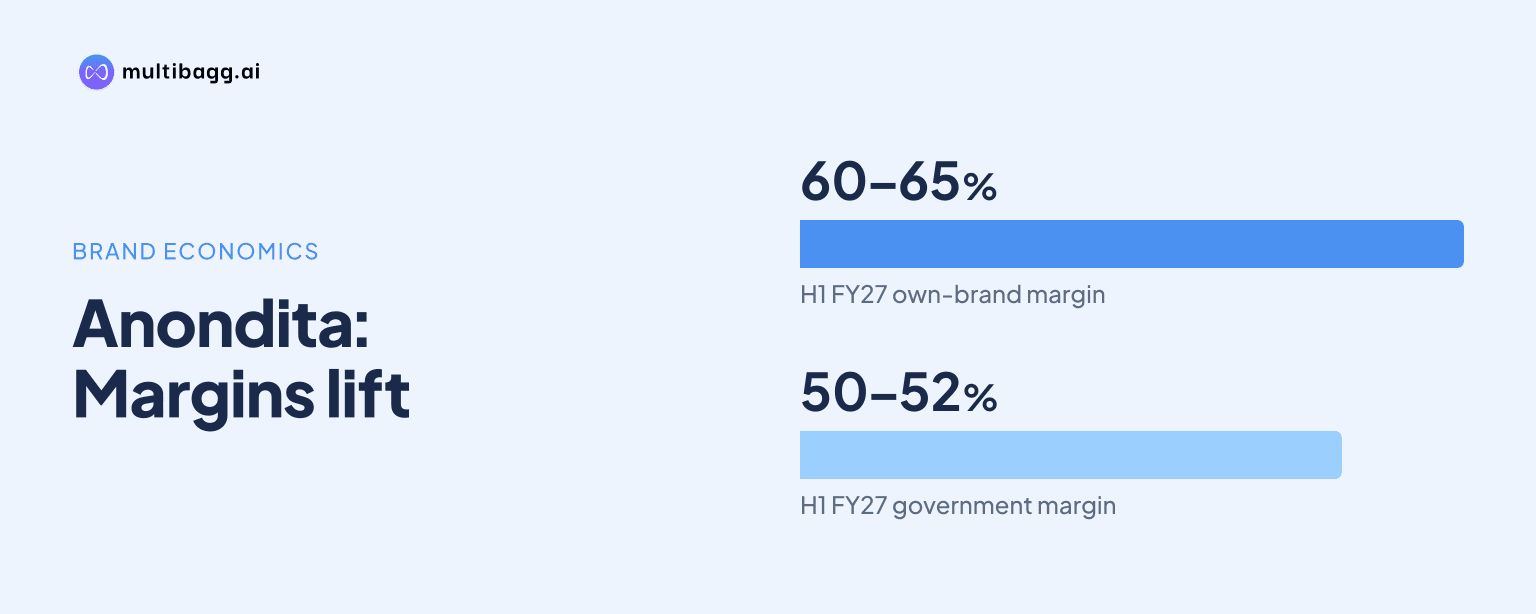
Anondita Medicare Limited reported ₹52.72 crore of own-brand sales in H1 FY27, and management said the channel delivered margins of about 60% to 65%, the highest range among its three disclosed sales buckets. Government turnover was about ₹12 crore at 50% to 52% margins, while exports contributed ₹8.77 crore at 55% to 60% margins.
Know Anondita Medicare inside out
Results, valuation, peers and who's buying, in one view.
How much did Anondita Medicare earn from own-brand sales in H1 FY27?
Anondita Medicare generated ₹52.72 crore from own-brand sales in H1 FY27, exceeding the two other revenue buckets management quantified on the call. Government turnover was approximately ₹12 crore and exports were ₹8.77 crore, putting the disclosed own-brand amount above the combined ₹20.77 crore from those institutional and export channels.
Management did not disclose total H1 FY27 turnover, contract-manufacturing revenue or the exact percentage contribution of each channel to total sales. It did, however, attribute the period's profitability in part to own-brand sales, which carried the highest reported margin range among own brand, government and export turnover.
The disclosed mix shows a clear difference by channel in H1 FY27. Own-brand margins of 60% to 65% were 8 to 15 percentage points above the 50% to 52% government range, while export margins of 55% to 60% sat between the two. The company did not provide a product-level or cost-level reconciliation of these ranges.
Why did Anondita Medicare report higher own-brand margins?
Anondita Medicare said own-brand sales earned margins of about 60% to 65% in H1 FY27, compared with about 50% to 52% for government sales and 55% to 60% for exports. Management did not give a detailed explanation for the own-brand premium, such as the effects of product mix, trade spending, advertising, freight or distributor commissions.
Exports were another contributor to profitability, according to management, because export realisations were almost 20% higher than supplies to the Government of India and manufacturers received export incentives. Government business operates through tenders that management described as one- or two-year contracts, where prices cannot be changed during the contract period.
In response to an analyst who cited an H1 margin of around 31%, management said it expected margins to remain between 26% and 29% rather than decline to 20% to 25%. Management linked that expectation to rising exports, higher export prices and incentives, but did not define the margin measure in that response or provide formal guidance.
Latex is the main raw material, and management said advance buying limited the effect of seasonal price movements on latex purchases to no more than 2% to 5%. It said manufacturers procure ahead of the rainy season, when tapping stops and latex prices increase, because government tender prices cannot be revised during the contract.
Is Anondita Medicare extending credit to grow own-brand sales?
Yes. Anondita Medicare said it now offers 60 to 70 days of credit to super distributors, distributors and retailers as it expands own-brand distribution. Management said the earlier model used advance payment or payment on delivery, but it began matching credit offered by competing brands.
The change adds to working-capital use because cash is collected after the sale rather than on delivery. Management said this distributor credit affected the consolidated working-capital position, although the call did not disclose the amount of receivables specifically related to own-brand distributors or the consolidated working-capital balance.
An analyst said working-capital days had risen from 170 days in FY26 to 200 days in H1 FY27. Management attributed the increase both to distributor credit and to inventory built for government orders expected in August, which were delayed after a change in the director general.
Management also said debtors increased after high sales in the preceding quarter, while latex procurement requires advance payment. These factors show the trade-off in the own-brand strategy: the channel produced ₹52.72 crore in H1 FY27 at a 60% to 65% margin range, but its wider distribution model requires credit and more working capital.
Got a follow-up? Ask IRIS
How is Anondita Medicare widening its consumer distribution?
Anondita Medicare said it had recently listed products on Flipkart and planned listings on Amazon and Blinkit. Management expected its products to be available across e-commerce and quick-commerce platforms by December, making this a stated rollout target rather than a completed distribution expansion.
Management said its immediate six-month focus was on female condoms, which it described as a business without competition for the company. It also said sexual toys were due to be introduced within a couple of days and that surgical products were the next manufacturing category, but did not disclose expected sales, margins, launch costs or timing for commercial contribution.
For its ₹1,000 crore FY29 target, management said female condoms, expanded male-condom production, government orders and domestic own-brand sales had already been included in its strategy. Management also said non-latex products had ready orders from Brazil and other countries, though it did not quantify those orders or specify their execution dates.
The company had completed ₹8.77 crore of exports in H1 FY27 and said it held about ₹40 crore of export orders and about ₹70 crore of Government of India orders for H2 execution. These institutional orders are separate from the e-commerce plan, but their delivery will affect the mix between government, export and own-brand turnover.
What capacity supports Anondita Medicare’s product plans?
Anondita Medicare said it was adding four male-condom lines, with trial production completed and commercial production expected within two weeks. Management said the resulting annual male-contraceptive capacity would be about 1.1 billion units, though it did not provide production utilisation or the revenue potential from that capacity.
Management also described four female-product lines under development. Two female-latex lines, whose trials were completed, were expected to be ready by the end of December, while trials for two female non-latex lines were expected to commence by December and commercial production was targeted within the financial year.
Management stated annual capacity of 60 million for female latex and around 120 million each for the two female non-latex lines. It also reported an electronic-test pass rate of about 98% to 99%, without disclosing the test volumes, rejection costs or whether that rate applied equally across existing and new lines.
Conclusion
Anondita Medicare’s H1 FY27 disclosures show that own-brand sales were the largest specifically quantified channel at ₹52.72 crore and carried the highest disclosed margin range of 60% to 65%. Exports provided a 55% to 60% range and higher realisations than Government of India supplies, while government turnover had the lowest stated range at 50% to 52%.
The next items to watch are execution of the approximately ₹40 crore export and ₹70 crore government H2 orders, the planned e-commerce and quick-commerce rollout by December, and the effect of 60-to-70-day distributor credit on receivables and working capital. Management also plans commercial production on additional male and female product lines during the stated timelines.