










Antony Waste capex reaches Rs 105.85 crore as cash falls
Key highlights
- Antony Waste spent Rs 105.85 crore on capital assets in the half year ended 30 September 2026, compared with Rs 23.92 crore a year earlier.
- Cash and cash equivalents fell by Rs 54.08 crore to Rs 55.48 crore during the half year ended 30 September 2026.
- Net cash generated from operating activities increased to Rs 39.60 crore from Rs 35.46 crore year on year.
- Current trade receivables rose to Rs 386.94 crore at 30 September 2026 from Rs 322.10 crore at 31 March 2026.
powered by IRIS
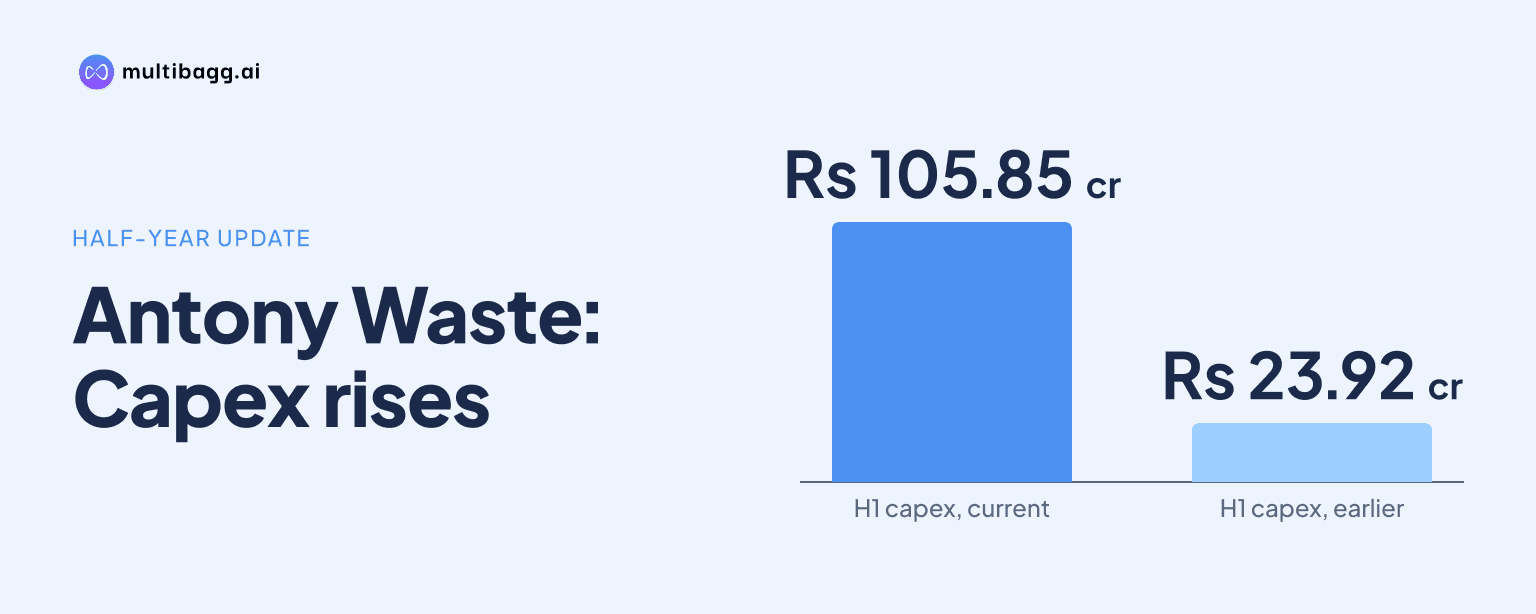
Antony Waste Handling Cell Limited spent Rs 105.85 crore on capital assets in the half year ended 30 September 2026, compared with Rs 23.92 crore a year earlier, while cash and cash equivalents fell by Rs 54.08 crore to Rs 55.48 crore. Net investing outflow of Rs 94.81 crore exceeded cash generated from operations and financing activities.
Know Antony Waste Handling Cell inside out
Results, valuation, peers and who's buying, in one view.
Why did Antony Waste’s cash and cash equivalents fall?
Antony Waste’s cash and cash equivalents fell because its Rs 94.81 crore net investing outflow was larger than the Rs 39.60 crore operating cash inflow and Rs 1.13 crore financing cash inflow in the half year ended 30 September 2026. The resulting net decrease was Rs 54.08 crore, taking closing cash and cash equivalents to Rs 55.48 crore from an opening cash-flow balance of Rs 109.57 crore.
The cash-flow statement reported closing balances comprising Rs 33.53 crore in bank current accounts, Rs 25.49 crore in deposits with original maturities below three months and Rs 4.78 lakh in cash on hand. These were offset by an overdraft facility of Rs 3.58 crore. Antony Waste said there were no restricted balances in cash and cash equivalents at 30 September 2026.
The consolidated balance sheet separately recorded Rs 59.06 crore of cash and cash equivalents at 30 September 2026, compared with Rs 109.94 crore at 31 March 2026, as well as Rs 4.36 crore of bank balances other than cash and cash equivalents. The cash-flow statement’s closing measure includes the overdraft and is the directly comparable measure against its opening balance.
How much did Antony Waste spend on capital assets?
Antony Waste spent Rs 105.85 crore on purchases of property, plant and equipment in the half year ended 30 September 2026, including intangible assets, movement in capital creditors, capital advances and capital work-in-progress. This was Rs 81.93 crore more than the Rs 23.92 crore reported in the corresponding half of 2025.
Investing activities included Rs 8.94 crore from net liquidation of short-term bank deposits, Rs 2.43 crore of interest received and Rs 27.62 lakh of asset-sale proceeds. After Rs 61.16 lakh of tax related to investing activities, net cash used in investing was Rs 94.81 crore, against Rs 22.98 crore in the prior-year period.
The balance sheet showed higher asset balances at 30 September 2026. Property, plant and equipment rose to Rs 434.05 crore from Rs 408.96 crore at 31 March 2026, capital work-in-progress increased to Rs 29.97 crore from Rs 28.77 crore, and intangible assets under development grew to Rs 29.01 crore from Rs 10.03 crore. Completed intangible assets declined to Rs 280.34 crore from Rs 295.08 crore.
Did Antony Waste generate more operating cash?
Antony Waste generated Rs 39.60 crore of net operating cash in the half year ended 30 September 2026, up Rs 4.13 crore from Rs 35.46 crore a year earlier. The increase occurred even as profit before tax declined to Rs 14.82 lakh from Rs 45.80 crore because the indirect cash-flow calculation included non-cash charges and movements in working capital.
Operating profit before working-capital changes was Rs 107.61 crore, compared with Rs 119.18 crore in the prior-year half. The 2026 figure included Rs 45.97 crore of depreciation and amortisation, Rs 28.29 crore of impairment loss on financial assets, Rs 28.49 crore of interest on borrowings and Rs 8.87 crore of impairment of property, plant and equipment, intangible assets under development and intangible assets.
Trade receivables, net of revenue received in advance, used Rs 96.35 crore of cash, compared with Rs 68.41 crore in the half year ended 30 September 2025. Financial and other assets contributed Rs 31.76 crore, while provisions, financial and other liabilities added Rs 9.20 crore. Cash generated from operations was Rs 53.49 crore before Rs 13.89 crore of net income-tax payments.
Got a follow-up? Ask IRIS
What changed in Antony Waste’s receivables and borrowings?
Antony Waste’s current trade receivables increased to Rs 386.94 crore at 30 September 2026 from Rs 322.10 crore at 31 March 2026, while non-current trade receivables increased to Rs 87.45 crore from Rs 80.36 crore. The rise in receivables was consistent with the Rs 96.35 crore working-capital outflow recorded in the cash-flow statement.
The filing disclosed Rs 15 crore within current receivables due from a municipal corporation that had been outstanding for a significant period. The Supreme Court dismissed the municipal corporation’s special leave petition on 5 May 2026 and directed payment within a stipulated period. As that period had lapsed by the reporting date, Antony Waste had issued a reminder and filed a contempt petition and a miscellaneous application.
A separate overdue receivable of Rs 19.47 crore from another municipal corporation was also included in current trade receivables. The corporation repaid Rs 5.02 crore in the quarter ended 30 June 2026, and Antony Waste said it had received a balance confirmation dated 30 September 2026 and communication that state approval for remittance had been obtained. Management considered both disclosed receivables good and recoverable.
Non-current borrowings rose to Rs 298.57 crore at 30 September 2026 from Rs 270.16 crore at 31 March 2026, while current borrowings declined to Rs 150.38 crore from Rs 155.35 crore. Financing activities generated Rs 1.13 crore of cash, compared with a Rs 60.47 crore outflow a year earlier, partly reflecting Rs 14.79 crore received from issuing shares to non-controlling shareholders.
How did financing and exceptional costs affect Antony Waste?
Antony Waste’s financing inflow of Rs 1.13 crore reflected Rs 87.55 crore of proceeds from non-current borrowings and Rs 58.25 crore of repayments, alongside other financing movements. It also received Rs 14.79 crore from issuing shares to non-controlling shareholders and Rs 7.50 lakh from employee stock-option exercises.
Cash payments included Rs 28.49 crore of interest excluding lease interest, Rs 2 crore of interest on lease liabilities, Rs 1.85 crore of other borrowing-cost payments and Rs 1.42 crore of dividends. In the corresponding 2025 half, financing activities used Rs 60.47 crore, including Rs 168.84 crore of non-current borrowing repayments.
The period also included an exceptional loss of Rs 19.93 crore following the 8 July 2026 force majeure event at the Pimpri Chinchwad waste-to-energy facility of Antony Lara Renewable Energy Private Limited. Management said the core waste-processing and power-generation infrastructure was not affected. Material-recovery-facility and composting operations resumed on 28 July 2026, while waste-to-energy operations were to resume after inspections and certification by original equipment manufacturers and Hitachi Zosen (Kanadevia).
Conclusion
Antony Waste’s first-half cash flow reflected a substantial increase in capital-asset purchases, which rose by Rs 81.93 crore year on year to Rs 105.85 crore. Operating cash generation increased to Rs 39.60 crore, but higher investment outflows and a Rs 96.35 crore receivables-related working-capital use reduced cash and cash equivalents to Rs 55.48 crore.
Next, readers can watch capital-spending levels, progress in collecting the Rs 15 crore municipal-corporation receivable subject to Supreme Court-related proceedings, and the restart of waste-to-energy operations at Pimpri Chinchwad after required inspections and certification. The filing also said the next Kanjurmarg compliance review was scheduled for November 2026, while the next hearing date was awaited.