










Antony Waste seeks Rs 15 crore as Rs 19.4688 crore overdue
Key highlights
- The Supreme Court's 5 May 2026 order directed discharge of Rs 15 crore in municipal dues within a stipulated period.
- A separate Rs 19.4688 crore municipal receivable was overdue at 30 September 2026.
- The Municipal Corporation repaid Rs 5.0212 crore during the quarter ended 30 June 2026.
- Current trade receivables rose to Rs 386.9381 crore at 30 September 2026 from Rs 322.1006 crore at 31 March 2026.
powered by IRIS
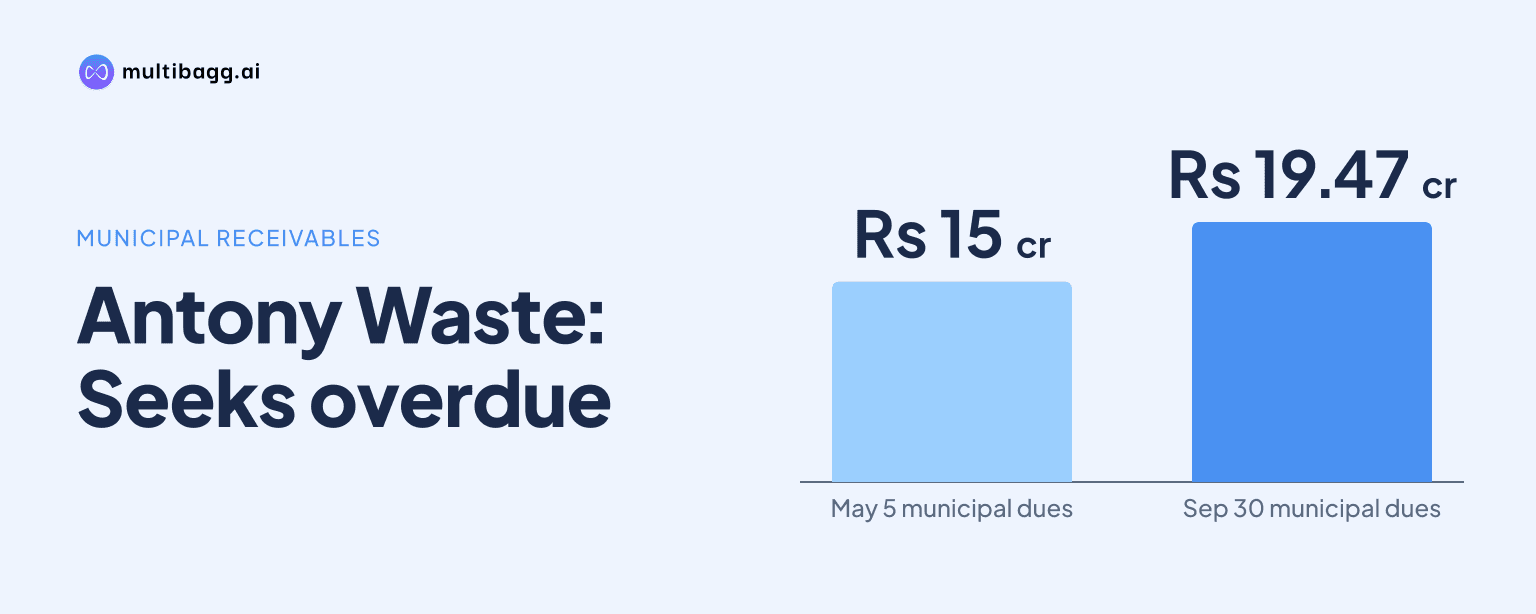
Antony Waste Handling Cell Limited is seeking enforcement of a Rs 15 crore Supreme Court-directed municipal payment after the stipulated period lapsed, while a separate Rs 19.4688 crore municipal receivable remained overdue at 30 September 2026. Management considers both amounts recoverable, but the auditor flagged uncertainty over the timing of the latter balance.
Know Antony Waste Handling Cell inside out
Results, valuation, peers and who's buying, in one view.
What did the Supreme Court order on Antony Waste's municipal dues?
The Supreme Court upheld a conciliation arrangement and directed the Municipal Corporation to discharge Antony Waste's Rs 15 crore outstanding dues within a stipulated period. In its 5 May 2026 order, the Supreme Court dismissed the Municipal Corporation's Special Leave Petition, which had challenged the High Court ruling in Antony Waste's favour.
The Rs 15 crore balance relates to contractual dues reviewed and approved by the Municipal Corporation's standing committee before the parties executed the conciliation agreement. The Municipal Corporation later challenged that standing committee decision before the High Court, but the High Court ruled for Antony Waste before the appeal reached the Supreme Court.
The period specified in the 5 May 2026 order had expired by 30 September 2026, according to Antony Waste's financial-results note. The order provides for applicable interest consequences in the event of delay, although the filing does not quantify the interest amount or report a payment received after the order.
What has Antony Waste done to enforce the Rs 15 crore order?
Antony Waste has issued a formal reminder to the Municipal Corporation, filed a contempt petition and submitted a miscellaneous application to the Supreme Court. These steps followed the lapse of the payment period set in the 5 May 2026 order.
Management continues to classify the Rs 15 crore balance as good and recoverable at 30 September 2026 because of the favourable judicial outcome and the enforceability it says follows from that outcome. The filing does not disclose a hearing date, a revised payment deadline or a collection schedule for the contempt petition and miscellaneous application.
The Rs 15 crore court-directed amount is included within current trade receivables, rather than reported as an additional balance. Current trade receivables were Rs 386.9381 crore at 30 September 2026, compared with Rs 322.1006 crore at 31 March 2026, an increase of Rs 64.8375 crore.
Why is Antony Waste's Rs 19.4688 crore municipal balance overdue?
A separate Rs 19.4688 crore receivable from another Municipal Corporation was overdue for a considerable period at 30 September 2026. Antony Waste said it had received a balance confirmation from that customer as of the reporting date, along with communication that State Government approval for remittance had been obtained.
The Municipal Corporation had been making repayments, including Rs 5.0212 crore during the quarter ended 30 June 2026. It told Antony Waste that arrangements were under way to settle the remaining dues, and management said these developments supported its view that the balance was good and recoverable.
Walker Chandiok & Co LLP drew attention to uncertainty about the timing of recovery of the Rs 19.4688 crore amount in its limited-review report dated 5 November 2026. The auditor did not modify its conclusion on the consolidated unaudited results, while recording management's expectation that the amount would be collected in due course.
The filing identifies both municipal amounts as current trade receivables but does not name either Municipal Corporation. It also does not disclose whether either counterparty made a payment after 30 September 2026, so the reported evidence of repayment ends with the Rs 5.0212 crore received in the quarter ended 30 June 2026.
Got a follow-up? Ask IRIS
How did receivables affect Antony Waste's cash flow?
Trade receivables, net of revenue received in advance, used Rs 96.3467 crore of cash during the half year ended 30 September 2026, compared with an outflow of Rs 68.4063 crore in the corresponding half year of 2025. The working-capital outflow therefore increased by Rs 27.9404 crore year on year.
Net cash generated from operating activities nevertheless rose to Rs 39.5952 crore in the six months ended 30 September 2026 from Rs 35.4634 crore a year earlier. The filing does not attribute the movement in operating cash flow to either municipal balance, but separately identifies the receivables movement as a use of working capital.
Antony Waste recorded impairment loss on financial assets of Rs 28.2877 crore in the half year ended 30 September 2026, up from Rs 8.9835 crore in the corresponding 2025 period. The results classify this expense under the expected-credit-loss model in Indian Accounting Standard 109, but do not state whether any portion relates to the Rs 15 crore or Rs 19.4688 crore municipal balances.
What did the auditor say about Antony Waste's recovery risk?
The auditor said there was uncertainty relating to the timing of recoverability of the Rs 19.4688 crore municipal receivable, which had been overdue for a substantial period at 30 September 2026. Walker Chandiok & Co LLP stated that its limited-review conclusion was not modified in respect of this matter.
That emphasis concerns collection timing rather than an auditor conclusion that the receivable is irrecoverable. Management's assessment rests on the municipal customer's balance confirmation, stated State Government approval for remittance and ongoing settlement arrangements disclosed as of 30 September 2026.
The review report, issued on 5 November 2026, also notes that a review is substantially narrower in scope than an audit and does not provide audit assurance on all significant matters. Antony Waste's board approved the unaudited consolidated results for the quarter and half year ended 30 September 2026 on the same date.
Conclusion
Antony Waste has disclosed two separate municipal collection matters: a Rs 15 crore balance backed by the Supreme Court's 5 May 2026 order, and a Rs 19.4688 crore overdue balance supported by repayments, a balance confirmation and stated remittance arrangements. Both remain recorded as recoverable, while the expired court payment period and auditor's emphasis show that collection timing remains unresolved.
The next disclosed matters to watch are progress in Antony Waste's contempt petition and miscellaneous application for the Rs 15 crore order, and completion of the other Municipal Corporation's remittance arrangements after its stated State Government approval. Any payment after 30 September 2026 or court update would provide new evidence on the timing of recovery.