










Apis EBITDA rises 55% as H1FY27 margin reaches 10% level
Key highlights
- Apis reported H1FY27 EBITDA of Rs 18.31 crore, up 55% year on year.
- H1FY27 EBITDA margin increased to 10% from 7%, a 300-basis-point expansion.
- Income from operations rose 1% to Rs 179.86 crore in H1FY27.
- Honey represented 64% of H1FY27 sales, while dates represented 32%.
powered by IRIS
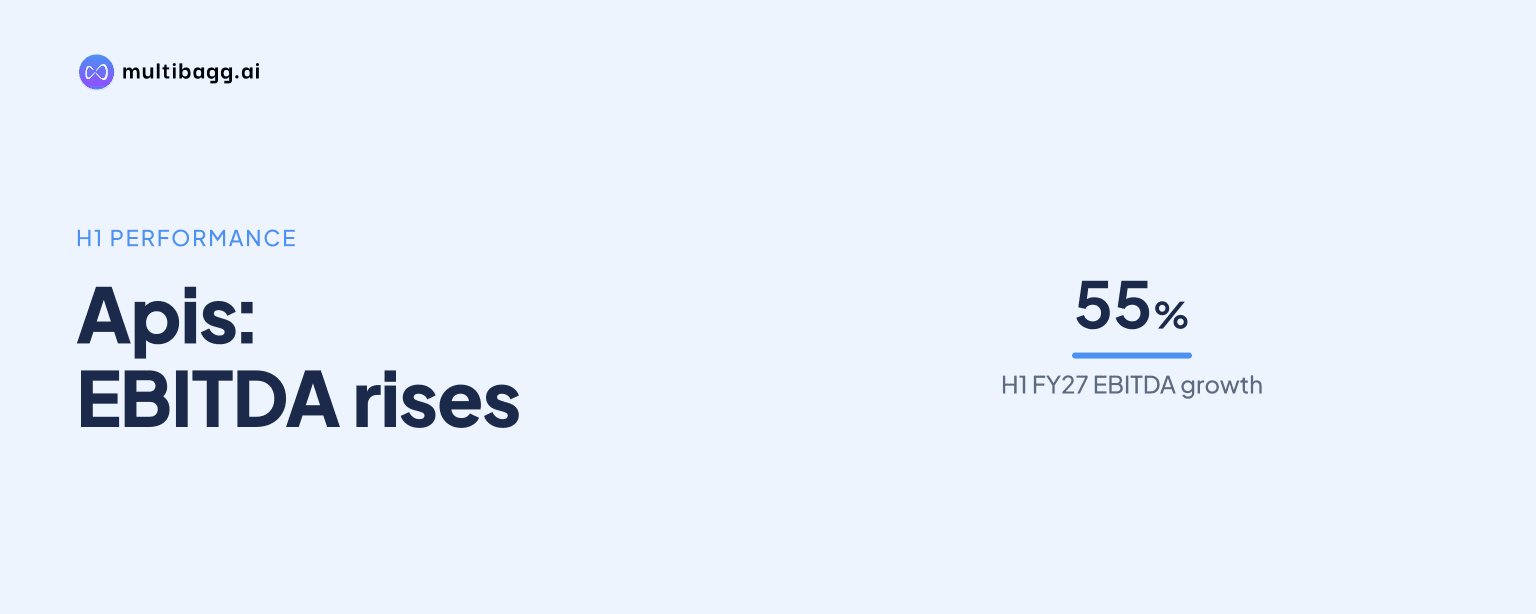
APIS India Limited reported H1FY27 EBITDA of Rs 18.31 crore, up 55% year on year, as its EBITDA margin rose to 10% from 7% despite income from operations increasing only 1% to Rs 179.86 crore. Management attributed the margin expansion to calibrated pricing and operational efficiencies amid higher raw-material and packaging costs.
Know Apis India inside out
Results, valuation, peers and who's buying, in one view.
How did Apis perform in H1FY27?
Apis delivered higher operating and net profit in the half year ended September 2026 despite limited revenue growth. Standalone income from operations increased to Rs 179.86 crore in H1FY27 from Rs 178.80 crore in H1FY26, an increase of Rs 1.06 crore. EBITDA rose by Rs 6.50 crore to Rs 18.31 crore from Rs 11.81 crore, while profit after tax increased 11% to Rs 12.35 crore from Rs 11.15 crore.
The difference between revenue and EBITDA growth is central to the result. Income from operations grew 1%, whereas EBITDA grew 55%, raising the EBITDA margin by 300 basis points, or bps, to 10% from 7%. Profit after tax margin also increased to 7% in H1FY27 from 6% a year earlier, although the reported profit-after-tax increase was lower than the EBITDA increase.
The second quarter supplied a substantial part of the half-year improvement. Q2FY27 income from operations was Rs 113.90 crore, up 23% from Rs 92.25 crore in Q2FY26, and EBITDA reached Rs 12.09 crore, up 161% from Rs 4.63 crore. The quarterly EBITDA margin was 11%, compared with 5% in the prior-year quarter, exceeding the 10% margin reported for the full first half.
Why did Apis expand its EBITDA margin?
Apis said calibrated pricing actions and operational efficiencies mitigated elevated raw-material and packaging costs in H1FY27. Management specifically linked the 55% EBITDA increase and 10% margin to those actions, while stating that demand remained resilient during the six months ended September 2026. The release does not quantify the price changes, input-cost increase, or savings from individual efficiency initiatives.
The revenue outcome indicates that margin expansion, rather than broad top-line acceleration, accounted for most of the earnings gain. H1FY27 income from operations increased Rs 1.06 crore year on year, but EBITDA increased Rs 6.50 crore. This comparison is consistent with management’s explanation that pricing and cost management offset cost pressures, rather than with a conclusion that sales growth alone produced the EBITDA increase.
Management also cited sustained demand and a healthy performance from General Trade in H1FY27. The company said its distribution network continued to gain market traction, but did not provide General Trade sales, outlet growth, or channel-wise revenue. Apis stated that it distributes products across more than 200,000 retail counters nationwide, although the release does not provide a comparable counter count for H1FY26.
Which products and markets drove Apis sales?
Apis remained primarily dependent on honey in H1FY27, with honey accounting for 64% of sales and dates accounting for 32%. Together, those two categories represented 96% of first-half sales. Management said dates recorded healthy growth, but it did not disclose category revenue in rupees or a prior-period growth rate.
Domestic sales supplied 69% of H1FY27 sales and exports supplied 31%. Within exports, the United Arab Emirates, or UAE, accounted for 41% of export revenue during the period. Exports were therefore lower than domestic sales, while the UAE was the largest disclosed export contributor; the release does not provide total export revenue in rupees or sales from other overseas markets.
Apis also described the role of its overseas associate, Apis Arabia Foods LLC, Dubai. According to management, the associate supports trade operations in the Middle East for honey, tea, coffee, and bread and bakery products. Management said it remained optimistic on the associate’s contribution, but the H1FY27 release provides no revenue, profit, ownership, or financial contribution figures for that entity.
Got a follow-up? Ask IRIS
What does bringing jam production in-house mean for Apis?
Apis moved jam manufacturing and packaging from a third-party arrangement into its own operations during H1FY27. Management said the change is expected to increase control over the manufacturing process, improve cost efficiency, and strengthen pricing competitiveness. The release does not disclose the investment amount, installed capacity, timing of full ramp-up, or the share of jam production previously outsourced.
Management said the investment is likely to produce 10 times growth in jam sales over the coming period. That is a forward-looking expectation rather than a reported H1FY27 outcome, and no base-year jam sales figure or timeframe accompanies it. Honey and dates accounted for 96% of H1FY27 sales, but the release does not disclose jam’s standalone share within the remainder.
The operational move may matter to future margins because management explicitly connected in-house processing with cost and pricing advantages. However, the reported first-half 10% EBITDA margin cannot be allocated between pricing actions, distribution performance, product mix, and the manufacturing transition. The disclosed evidence supports an expected operational benefit, but not a quantified contribution to the Rs 18.31 crore H1FY27 EBITDA result.
What should readers monitor after Apis's H1FY27 results?
The immediate operating measure is whether Apis can sustain a margin above the 7% recorded in H1FY26 while raw-material and packaging costs remain elevated. Q2FY27 EBITDA margin was 11%, above the H1FY27 level of 10%, while H1FY27 revenue growth was only 1%. Future results can show whether the second-quarter margin and pricing actions persist across a longer period.
Readers can also monitor the disclosed composition of sales. Honey represented 64% and dates 32% of H1FY27 sales, domestic business represented 69%, and the UAE represented 41% of exports. Changes in these percentages, together with any disclosure of category or export revenue in rupees, would provide clearer evidence of where future growth is occurring.
Conclusion
Apis’s H1FY27 results show an earnings improvement led chiefly by margin expansion: EBITDA rose 55% to Rs 18.31 crore and margin reached 10%, even as income from operations rose 1% to Rs 179.86 crore. Management attributed this outcome to calibrated pricing and operational efficiencies that offset elevated raw-material and packaging costs, while dates, General Trade, and sustained demand supported sales.
Next, management plans to use in-house jam manufacturing and packaging to improve cost efficiency and pricing competitiveness, with an expectation of 10 times jam-sales growth over the coming period. Apis has also applied for National Stock Exchange, or NSE, listing and said it is completing formalities; the release gives no timeline for either the jam-sales target or the proposed listing process.