










EaseMyTrip.com targets 2,000 electric buses nationwide by FY2028
Key highlights
- EaseMyTrip.com plans Rs 200 crore of EV-bus investment over two to three years.
- EaseMyTrip.com targets operation of more than 2,000 electric buses nationwide by FY2028.
- YoloBus covers more than 250 routes across India, according to EaseMyTrip.com's EV-mobility presentation.
- EaseMyTrip.com cites a 24% CAGR for India's EV-bus market from 2024 to 2030.
powered by IRIS
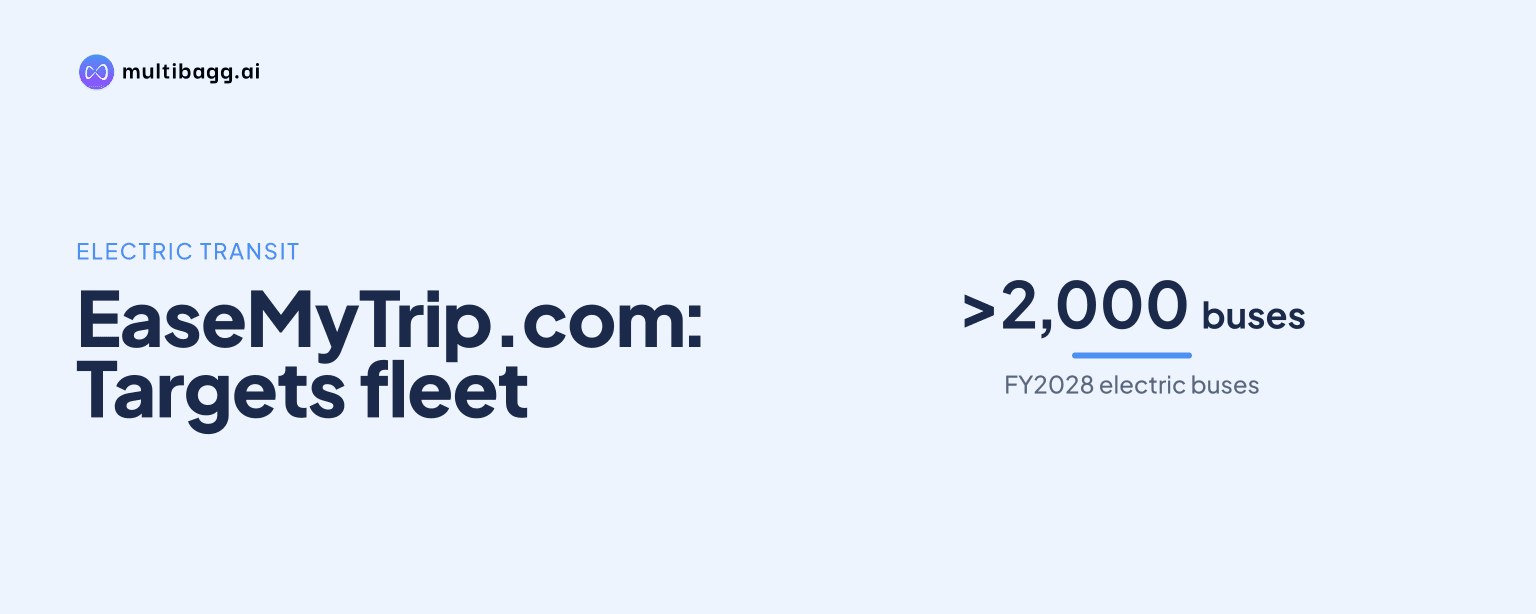
EaseMyTrip.com plans to invest Rs 200 crore over two to three years in electric vehicle, or EV, bus research, development and manufacturing, while targeting operation of more than 2,000 electric buses across India by FY2028 through YoloBus. The plan places Easy Green Mobility in manufacturing and YoloBus in operations.
Know Easy Trip Planners inside out
Results, valuation, peers and who's buying, in one view.
What is EaseMyTrip.com's electric-bus plan?
EaseMyTrip.com has announced its entry into EV-bus manufacturing through its new subsidiary, Easy Green Mobility. The company has allocated Rs 200 crore over two to three years for research and development, or R&D, and the establishment of a manufacturing plant. Its presentation describes the expansion as a new revenue stream within its effort to expand its non-air travel business.
EaseMyTrip.com targets operation of more than 2,000 electric buses by FY2028 through YoloBus. The same presentation describes the goal as operating 2,000-plus electric buses across the country by 2027-28. Easy Green Mobility is intended to manufacture the vehicles, while YoloBus will act as the operating arm.
The proposed buses are expected to feature advanced technology, long-range batteries and energy-efficiency features, according to the presentation. EaseMyTrip.com does not disclose a factory location, manufacturing capacity, vehicle cost, production start date or a year-by-year schedule for reaching the 2,000-plus-bus operating target.
How will EaseMyTrip.com split manufacturing and operating roles?
EaseMyTrip.com assigns bus manufacturing to Easy Green Mobility and fleet operations to YoloBus. The presentation identifies YoloBus as another EaseMyTrip.com subsidiary and its operating arm for the EV-bus initiative. This structure links a planned manufacturing plant with an existing intercity mobility platform.
YoloBus's operating template covers bus scheduling, ticketing, customer service and network planning. EaseMyTrip.com says the platform connects major Tier I and Tier II cities, while the EV-mobility presentation says YoloBus has a network of more than 250 routes across India. The company intends to use YoloBus's technology-enabled platform, team and data expertise to support the expansion.
The presentation identifies a network-planning algorithm, a dynamic-pricing engine and an in-house global distribution system, or GDS, as YoloBus tools. EaseMyTrip.com says these systems support route optimisation, yield management and booking efficiency, although it does not provide route-level economics or planned electric-bus deployment by corridor.
What operating base does YoloBus bring to the plan?
YoloBus brings an intercity platform that EaseMyTrip.com describes as operating on an asset-light model in partnership with bus aggregators. The acquisition presentation reports annual occupancy of more than 88% and says Internet of Things, or IoT, enabled systems are used for passenger safety and revenue integrity.
EaseMyTrip.com reports two different passenger totals for YoloBus. The acquisition presentation says YoloBus has served more than 2 million passengers to date, while the Easy Green Mobility presentation says it has served more than 300,000 travellers. The company does not explain whether the difference reflects different reporting dates, definitions or business scope.
The acquisition presentation also displays a 67% Net Promoter Score, or NPS, 97% on-time departure, 87% on-time arrival and 100% trackable trips for YoloBus. It does not provide dates, calculation methods or comparable prior-period data for those measures, limiting assessment of how they may translate to a larger electric-bus fleet.
Got a follow-up? Ask IRIS
What market opportunity does EaseMyTrip.com cite for EV buses?
EaseMyTrip.com cites a projected 24% compound annual growth rate, or CAGR, for India's EV-bus market from 2024 to 2030. It also cites projected annual demand of 125,000 to 150,000 EV buses within a decade. These figures are market projections presented by the company, rather than EaseMyTrip.com revenue, production or sales guidance.
The company links its EV-bus plan to the Faster Adoption and Manufacturing of Electric Vehicles, or FAME, programme, the Production Linked Incentive, or PLI, framework, and state EV policies. EaseMyTrip.com says the initiative aligns with India's EV mission and aims to accelerate the nationwide transition toward net-zero carbon mobility in buses.
EaseMyTrip.com does not quantify expected policy support, incentives, emissions reductions or customer purchase commitments. It also does not state whether the Rs 200 crore programme includes working capital, charging infrastructure, battery procurement or financing arrangements for the planned fleet.
How does the EV-bus plan fit EaseMyTrip.com's wider travel strategy?
EaseMyTrip.com describes the YoloBus acquisition as a new revenue stream and part of its non-air expansion. Its presentation says 53 million people travel intercity by train and bus each day, with this market growing at a 10% CAGR. The EV-bus initiative extends the company's bus-travel presence beyond an asset-light operating model toward manufacturing and operation.
The presentation projects an 8% CAGR for intercity bus travel from FY24 to FY27, compared with 14% for air travel, 11% for hotels and 9% for rail. The comparison indicates that the intercity-bus segment is expected to grow more slowly than the other three travel categories shown during the FY24-27 period.
EaseMyTrip.com also shows intercity bus travel as 32% online and 68% offline, compared with 73% online for domestic air and 87% online for rail. The company presents YoloBus's ticketing, dynamic pricing and distribution systems as mechanisms to address the intercity segment while building its non-air offerings.
What remains undisclosed about EaseMyTrip.com's rollout?
EaseMyTrip.com has disclosed a Rs 200 crore investment envelope, a two-to-three-year period for R&D and plant setup, and a more-than-2,000-bus target by FY2028. It has not disclosed annual capital spending, funding sources, manufacturing partners, battery suppliers, charging arrangements or electric-bus delivery milestones.
The company has also not provided projected revenue, operating cost, margin or utilisation assumptions for Easy Green Mobility or the planned YoloBus fleet. Its reported YoloBus operating measures, including occupancy above 88% and coverage of more than 250 routes, provide an existing operating reference but not a financial forecast for the EV initiative.
The presentation's two passenger figures, more than 2 million served to date and more than 300,000 travellers, are another unresolved disclosure point. Clarification of the measurement periods and definitions would help establish the operating base from which EaseMyTrip.com intends to scale to more than 2,000 electric buses.
Conclusion
EaseMyTrip.com's EV-bus strategy combines Rs 200 crore of proposed R&D and manufacturing investment with a target to operate more than 2,000 electric buses nationwide by FY2028. Easy Green Mobility is intended to manufacture the buses, while YoloBus is intended to operate them using its network, scheduling, ticketing and pricing capabilities.
The next developments to watch are the two-to-three-year R&D and plant-setup programme and progress toward the FY2028 fleet target. EaseMyTrip.com has cited more than 250 YoloBus routes and a 24% projected EV-bus market CAGR for 2024-2030, but has not disclosed plant capacity, rollout stages, funding details or fleet economics.