










EaseMyTrip makes no provision for Rs 67.407 crore penalty
Key highlights
- EaseMyTrip disclosed a Rs 67.407 crore DGGI penalty notice for alleged GST TCS non-collection.
- The notice covers October 2018 to December 2025 and was received in the September 2026 quarter.
- EaseMyTrip recognised no provision, citing independent legal opinions and judicial precedents.
- Revenue from operations was Rs 292.698 crore in the six months ended September 30, 2026, versus Rs 232.130 crore a year earlier.
powered by IRIS
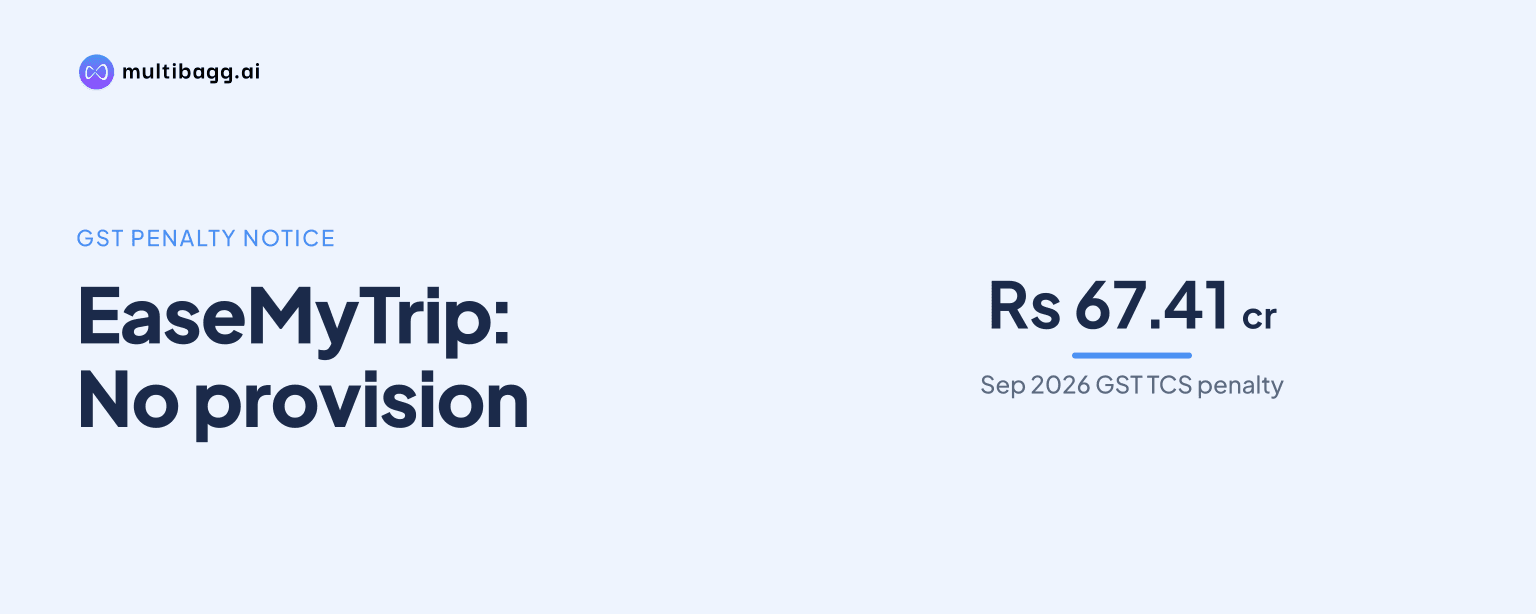
Easy Trip Planners Limited, referred to as EaseMyTrip, received a Rs 67.407 crore penalty notice for alleged failure to collect Goods and Services Tax Tax Collected at Source from October 2018 to December 2025, but recognised no provision in results for the quarter and six months ended September 30, 2026. Management said it does not expect a material financial outflow.
Know Easy Trip Planners inside out
Results, valuation, peers and who's buying, in one view.
What is the Rs 67.407 crore TCS penalty against EaseMyTrip?
EaseMyTrip received a Show-Cause cum Demand Notice during the quarter ended September 30, 2026 from the Mumbai Zonal Unit of the Directorate General of Goods and Services Tax Intelligence, or DGGI. The notice imposes a Rs 67.407 crore penalty under Section 52 of the Central Goods and Services Tax Act, 2017, over alleged non-collection of Tax Collected at Source, or TCS.
The notice concerns TCS provisions applicable to electronic commerce operators and covers October 2018 to December 2025. The department’s stated prima facie view is that EaseMyTrip was liable to collect TCS. EaseMyTrip is contesting that view, so the disclosed Rs 67.407 crore is a disputed regulatory demand rather than an amount the company has accepted as payable.
The disclosure appeared in consolidated unaudited financial results approved by the board on November 14, 2026. The results cover the September 2026 quarter and the six months beginning April 1, 2026, whereas the tax dispute spans more than seven years through December 2025.
Why has EaseMyTrip not recognised a provision for the penalty?
EaseMyTrip has not recognised a provision for the Rs 67.407 crore matter because management said independent legal opinions and judicial precedents support its case on merits. Management also said it does not expect a material financial outflow, which is the disclosed basis for recording no provision in the September 30, 2026 consolidated results.
This accounting treatment does not settle the dispute. EaseMyTrip said the ultimate outcome depends on future proceedings with tax authorities, while the notice records the department’s prima facie position. The November 14, 2026 filing gives no timetable for an appeal, adjudication, payment, settlement or another procedural step.
The company’s approach means the reported profit and loss statement contains no Rs 67.407 crore charge for the six months ended September 30, 2026. The filing does not quantify possible interest, any further penalty, legal expense or other exposure beyond the DGGI penalty, so such amounts cannot be calculated from the disclosure.
Got a follow-up? Ask IRIS
How does the disputed demand compare with EaseMyTrip's reported figures?
The Rs 67.407 crore disputed penalty was below EaseMyTrip’s Rs 292.698 crore revenue from operations for the six months ended September 30, 2026, but exceeded its Rs 13.540 crore combined current and non-current provisions at that date. It was also below the Rs 168.020 crore total income reported for the September 2026 quarter.
EaseMyTrip’s revenue from operations increased to Rs 292.698 crore in the six months ended September 30, 2026 from Rs 232.130 crore in the comparable 2025 period. The group reported a net loss after tax of Rs 12.253 crore in the 2026 half year, compared with a Rs 35.600 crore net loss in the prior-year half year; neither result includes a provision for the TCS matter.
For the September 2026 quarter, EaseMyTrip reported a net loss after tax of Rs 56.5 lakh, compared with a Rs 11.688 crore loss in the preceding June 2026 quarter and a Rs 36.043 crore loss in the September 2025 quarter. The filing states that no TCS provision was recognised, so the quarter-to-quarter change should not be attributed to the disputed demand.
The September 30, 2026 balance sheet showed total assets of Rs 1,478.689 crore, total equity of Rs 1,050.994 crore and cash and cash equivalents of Rs 107.673 crore. Current tax liabilities were Rs 6.389 crore and total provisions were Rs 13.540 crore, while the filing separately states that the Rs 67.407 crore TCS demand has no provision.
What did the auditor say about the TCS demand?
Walker Chandiok & Co LLP drew attention to the TCS disclosure in its review report dated November 14, 2026. The auditor noted the Rs 67.407 crore penalty, management’s reliance on independent legal opinions and judicial precedents, and the absence of a provision in the consolidated unaudited financial results.
The auditor did not modify its review conclusion in respect of the matter. The report states that a limited review does not provide the assurance of an audit. Its unmodified conclusion therefore addresses the financial-results disclosure, rather than deciding how the tax proceedings for October 2018 to December 2025 will end.
The same review report covered financial information from 18 subsidiaries with total assets of Rs 560.911 crore at September 30, 2026, as well as three associates and four joint ventures. The TCS notice was received by EaseMyTrip as the holding company and was not described as a claim against those subsidiaries, associates or joint ventures.
Conclusion
The DGGI notice creates a disclosed Rs 67.407 crore contingent tax dispute alongside a half-year net loss of Rs 12.253 crore and no accounting provision. Management’s expectation of no material outflow rests on independent legal opinions and judicial precedents, while the auditor highlighted the matter without modifying its limited-review conclusion.
The next development to watch is the tax-authority process because EaseMyTrip says the final outcome depends on future proceedings and provided no hearing or adjudication date as of November 14, 2026. Subsequent financial results will show whether management’s assessment, including the decision not to recognise a provision, changes.