








APL builds regulated specialty access through key approvals
MAX Plan at ₹4,999/yr

Find your next multibaggerBe a Pro Investor
Research stocks and track your picks on the go. Download the app.
Key highlights
- APL disclosed an approximately Rs 90 lakh Indian Army order for defence-grade lubricants.
- APL says its DRDO technology transfer for URF and low-temperature coolants is valid for 5 years and extendable to 10 years.
- APL secured BIS certification for transformer oil, supporting eligibility for high-volume tenders and top-tier OEM procurement.
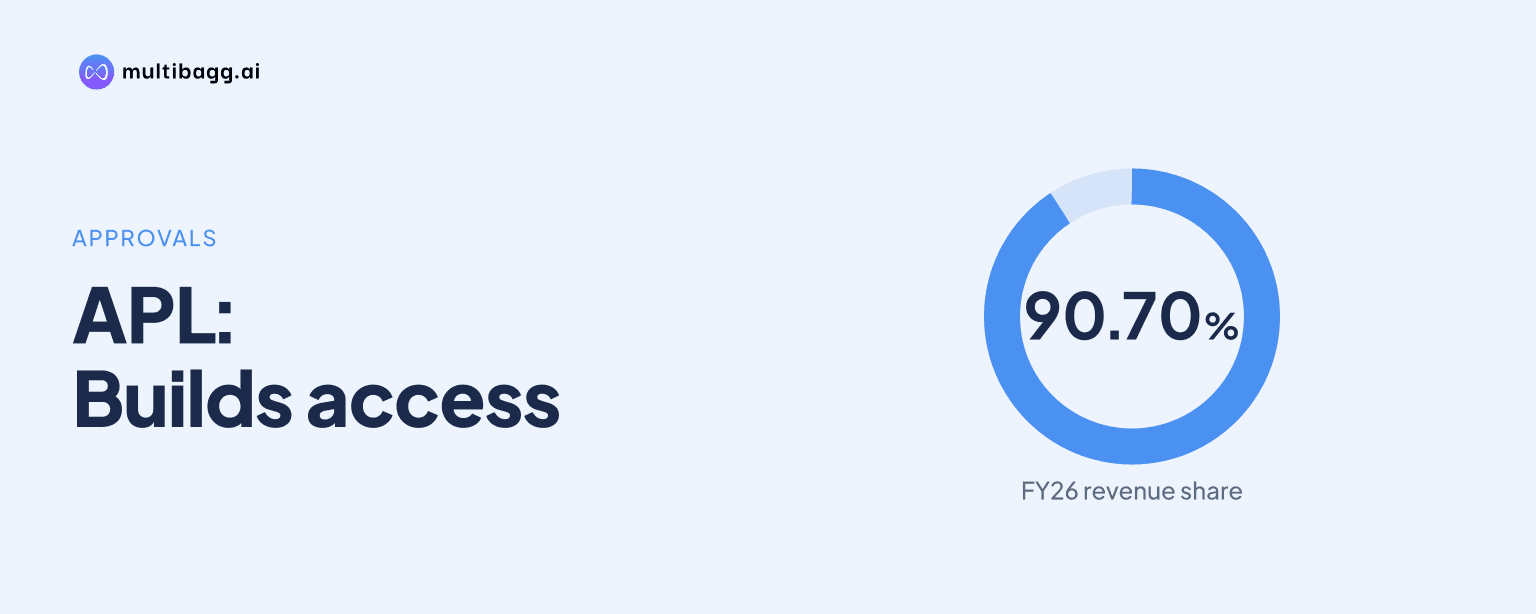
- APL contributed Rs 375.42 crore, or 90.70%, of consolidated FY26 revenue of Rs 413.27 crore.
powered by IRIS
Arabian Petroleum Ltd. is building regulated specialty-lubricants access in FY26 through NSF / US-FDA food-grade approval, a DRDO technology transfer valid for five years and BIS transformer-oil certification, while an approximately Rs 90 lakh Indian Army order is its disclosed monetary defence opportunity. APL has not quantified sales from these new access routes.
Know Arabian Petroleum inside out
Results, valuation, peers and who's buying, in one view.
How is APL entering food-grade lubricants?
APL is entering food-grade lubricants through formal NSF / US-FDA approval covering white mineral oils, light liquid paraffins, hydraulic oils and gear oils. The FY26 presentation says this range unlocks the pharma sector and provides food-safe lubrication access, extending the product focus beyond the defence and transformer-oil categories.
Management characterises the approval as a food-grade entry and cites first-mover advantage in food-safe lubrication. However, the FY26 presentation does not disclose food-grade revenue, production volume, customer names, order value or an order pipeline, so the current commercial contribution of this certification cannot be measured from the disclosed information.
APL supports its specialty formulation work with a National Accreditation Board for Testing and Calibration Laboratories, or NABL, accredited laboratory certified to ISO 17025 and equipped with more than 30 testing instruments. The company also added inductively coupled plasma optical emission spectrometry, or ICP-OES, and Nicolet Summit Fourier-transform infrared spectroscopy, or FTIR, equipment as part of its research and development infrastructure.
What defence access has APL disclosed?
APL has disclosed an Indian Army order worth approximately Rs 90 lakh for defence-grade lubricants, its only separately valued defence opportunity in the FY26 presentation. It also lists the Indian Space Research Organisation, or ISRO, and Oil and Natural Gas Corporation, or ONGC, in its active order book, but does not provide values, delivery periods or revenue recognition details for those opportunities.
APL says it has absorbed a Defence Research and Development Organisation, or DRDO, technology transfer for Universal Recoil Fluids, or URF, and low-temperature coolants. The approval is valid for five years and extendable to 10 years, according to the presentation, and the products can be supplied to the Army, Navy, Air Force, Ordnance and Munitions India.
The defence programme also includes PX-2 and PX-6 anti-corrosion coatings for arms and ammunition. Separately, APL developed and supplied a water-soluble forming fluid to ISRO, although the presentation does not disclose the supply value or say whether either coating has converted into an order.
How does BIS certification expand APL’s transformer-oil access?
APL has secured Bureau of Indian Standards, or BIS, certification for transformer oil, which management says meets regulatory prerequisites for high-volume tenders and procurement by top-tier original equipment manufacturers, or OEMs. The credential gives APL stated eligibility for a procurement channel that differs from its food-grade product approval and DRDO-derived defence fluids.
The transformer-oil certification sits within APL’s dedicated Process & Specialty Oils vertical for industrial markets. Unlike the approximately Rs 90 lakh Army order, the FY26 presentation does not disclose a transformer-oil tender award, customer, volume, revenue target or booked sales, making the BIS approval an access credential rather than a reported commercial award.
APL also reports a two-year Bharat Heavy Electricals Limited, or BHEL, rate contract in execution, alongside new Manganese Ore India Limited, or MOIL, and Bharat Earth Movers Limited, or BEML, contracts in H2 FY26. These disclosed contracts add government and public-sector channels, although the presentation does not identify the products or contract values.
Got a follow-up? Ask IRIS
What operating work supports APL’s specialty-products plan?
APL has signed a memorandum of understanding for interim expansion and is resolving a small-pack stock-keeping unit, or SKU, filling bottleneck. Management says de-bottlenecking will create headroom for the next phase of volume growth, while larger production batches are planned to improve per-unit operating margins; no capacity addition, completion date or memorandum counterparty is disclosed.
Backward integration advanced in December 2025, when APL commenced Fatty Acid Amides production. The company says the output can be used in-house and sold in the open market, providing two revenue routes while reducing import dependence on key raw materials; it also reports esterification capability for lubricant formulations and external sale without giving capacity or sales figures.
The group’s FY26 revenue remains concentrated in APL, which contributed Rs 375.42 crore, or 90.70%, of consolidated revenue from operations of Rs 413.27 crore. Arzol Petroleum Trading FZE contributed Rs 37.69 crore, or 9.10%, while Lavisa Technologies contributed Rs 0.81 crore and was in a start-up phase after commencing operations in H2 FY26.
The contrast between APL’s 90.70% revenue share and the subsidiaries’ combined 9.30% shows that the specialty and institutional initiatives remain centred on APL’s operating business. Both subsidiaries began revenue generation in H2 FY26, and FY26 was the first year of subsidiary consolidation, according to the presentation.
Conclusion
APL’s FY26 strategy combines product approvals, institutional access and manufacturing actions across food-grade lubricants, defence fluids and transformer oil. The NSF / US-FDA approval covers four disclosed product categories, the DRDO transfer for URF and low-temperature coolants has a five-year validity, and the approximately Rs 90 lakh Army order is the clearest disclosed value attached to the strategy.
The next disclosed milestones are execution of the two-year BHEL rate contract, the H2 FY26 MOIL and BEML contracts, and resolution of the small-pack SKU filling bottleneck under the interim-expansion memorandum. Management also plans larger production batches, while the revenue scale from food-grade, transformer-oil, DRDO-derived and Fatty Acid Amides products remains undisclosed.

