










Ardee Industries Q2 profit declines 9.3% to ₹18.1 crore
Key highlights
- Ardee Industries reported Q2 FY27 total income of ₹325.83 crore and profit after tax of ₹18.06 crore.
- Q2 FY27 revenue declined 4.1% sequentially to ₹324.8 crore from ₹338.8 crore.
- Operating margin narrowed by about 130 basis points to 8.6% in Q2 FY27.
- H1 FY27 profit after tax was ₹37.96 crore on total income of ₹664.87 crore.
powered by IRIS
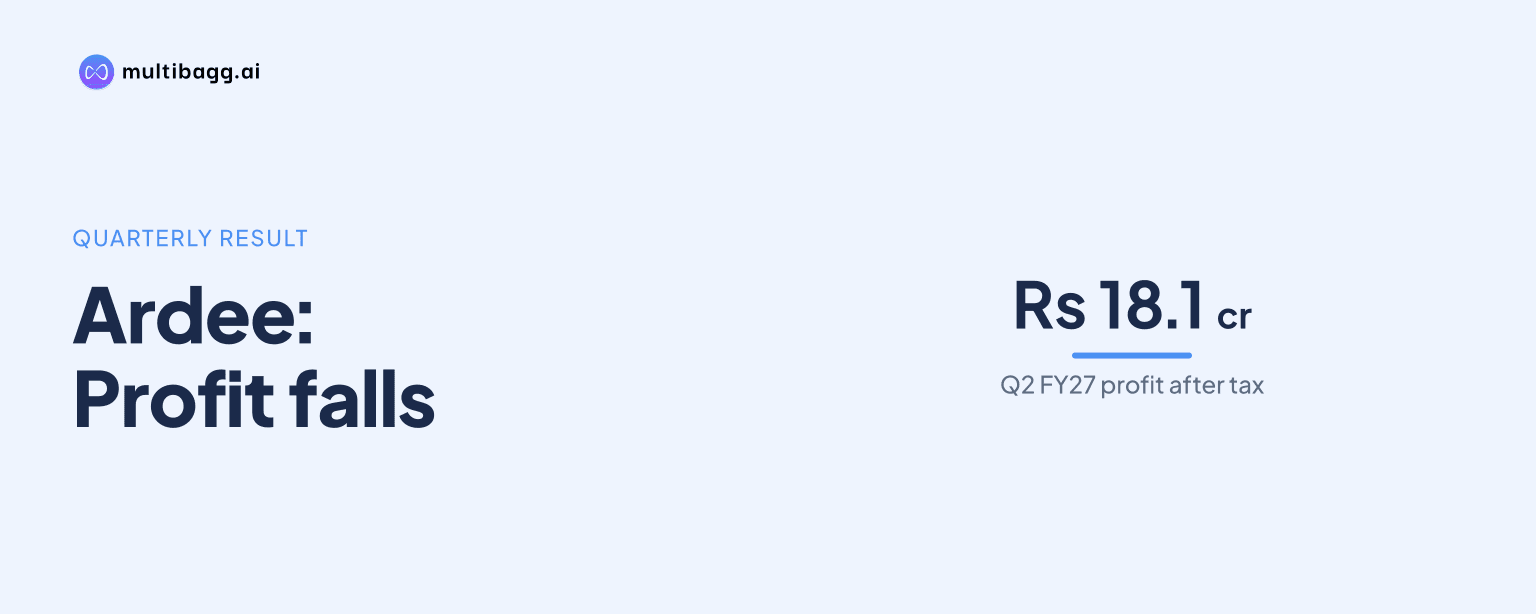
Ardee Industries Limited reported a Q2 FY27 profit after tax of ₹18.06 crore for the quarter ended September 30, 2026, down 9.3% sequentially from ₹19.9 crore. Total income was ₹325.83 crore, while operating margin narrowed to 8.6% from 9.9% in the preceding quarter.
Know Arcee Industries inside out
Results, valuation, peers and who's buying, in one view.
What did Ardee Industries report for Q2 FY27?
Ardee Industries reported standalone total income of ₹325.83 crore, profit before tax of ₹24.02 crore and profit after tax of ₹18.06 crore for the September 2026 quarter. Total comprehensive income for the period was ₹18.08 crore, while basic and diluted earnings per share stood at ₹0.57.
The Board of Directors approved the unaudited standalone results for the quarter and half year ended September 30, 2026. The approved set included the financial results, cash flow statement and statement of assets and liabilities. Nangia & Co LLP conducted a limited review of the results under Indian Accounting Standard 34 on interim financial reporting.
The statutory auditors stated that, based on their review, nothing had come to their attention that indicated the accompanying statement was not fairly presented in accordance with the applicable accounting standard. The company made the results and limited review report available through its website and stock exchange platforms.
How did Ardee Industries perform against the June quarter?
Ardee Industries' revenue was ₹324.8 crore in Q2 FY27, compared with ₹338.8 crore in Q1 FY27, a sequential decline of 4.1%. Total income was higher at ₹325.83 crore because it included other income of about ₹1 crore during the quarter.
Operating profit declined 16.6% sequentially to ₹28 crore from ₹33.5 crore. Profit before tax fell 10% from ₹26.7 crore to ₹24 crore, while net profit fell 9.3% from ₹19.9 crore to ₹18.1 crore. The source data did not provide comparable year-on-year figures for the September 2025 quarter.
The half-year result remained larger in absolute terms, reflecting performance over the first six months of FY27. For the half year ended September 30, 2026, Ardee Industries reported total income of ₹664.87 crore, profit before tax of ₹50.69 crore and profit after tax of ₹37.96 crore. Total comprehensive income for the half year was ₹38.01 crore.
Why did Ardee Industries' operating margin narrow?
Ardee Industries' operating margin narrowed by about 130 basis points to 8.6% in Q2 FY27 from 9.9% in Q1 FY27. The reported figures point to lower revenue and higher cost intensity as the main factors behind the reduction in operating profit.
Materials and purchases were ₹270 crore, equivalent to about 83% of quarterly revenue. Employee cost was ₹7.9 crore, or 2.4% of revenue, while other expenses were ₹19.3 crore, or 5.9% of revenue. Materials and employee costs fell sequentially, but other expenses increased marginally from ₹19.2 crore despite the decline in revenue.
Lower finance cost provided some support to earnings. Finance cost fell to ₹2.2 crore from ₹4.3 crore in the June quarter, a decrease of 49.5%. However, this reduction was not sufficient to offset the fall in operating profit. Other income rose to ₹1 crore from ₹0.2 crore and represented 4.4% of profit before tax.
Got a follow-up? Ask IRIS
What are the key financial figures for the first half of FY27?
Ardee Industries earned ₹37.96 crore in profit after tax during the first half of FY27 on total income of ₹664.87 crore. Profit before tax was ₹50.69 crore, and total comprehensive income was ₹38.01 crore for the six months ended September 30, 2026.
The company's paid-up equity share capital was ₹63.04 crore as of September 30, 2026. Half-year basic and diluted EPS was ₹1.20. These figures are based on the standalone financial statements reviewed by the statutory auditors, rather than consolidated accounts.
Tax expense for the September quarter was ₹6 crore, compared with ₹6.8 crore in Q1 FY27. The effective tax rate eased to 24.8% from 25.4% in the preceding quarter. The lower tax charge followed the decline in profit before tax and supported the reported post-tax profit.
What does the Q2 result mean for investors and operations?
Ardee Industries' Q2 result shows that revenue, operating profit, margin and net profit all declined sequentially during the September quarter. The 4.1% fall in revenue was accompanied by a steeper 16.6% reduction in operating profit, indicating that operating costs did not decrease in line with sales.
For investors, the reported EPS of ₹0.57 was below the ₹0.78 recorded in Q1 FY27. The data does not include a share-price movement, management earnings commentary, order-book update or forward guidance. Therefore, the disclosed results establish the quarter's financial performance but do not provide a stated outlook for future revenue or margins.
The results also show the importance of finance costs in the quarter. While the reduction in finance cost helped cushion profit before tax, the lower operating margin remained the larger driver of the sequential earnings decline. Any assessment of subsequent performance will depend on later disclosures on revenue, input costs, expenses and profitability.
Conclusion
Ardee Industries reported a profitable Q2 FY27, with profit after tax of ₹18.06 crore and total income of ₹325.83 crore. However, the quarter was weaker than Q1 FY27 on revenue, operating profit, operating margin, net profit and EPS, while lower finance costs partly moderated the impact on earnings.
The next disclosed reference point is the company's subsequent quarterly financial filing. Investors will watch whether revenue recovers from ₹324.8 crore, whether the 8.6% operating margin stabilises, and whether finance-cost savings continue to support profitability.