










Arshiya auditor disclaims FY26 opinion over evidence gaps
Key highlights
- Arshiya’s auditor disclaimed an opinion on standalone FY26 results for the year ended March 31, 2026.
- Arshiya’s current liabilities exceeded current assets by Rs 2,542.63 crore at March 31, 2026.
- The auditor could not verify Rs 575.39 crore of investments and loans linked to Arshiya Northern FTWZ Limited.
- Arshiya recognised Rs 18.06 crore of FY26 revenue from Ascendas Panvel FTWZ Limited without an executed contract available to the auditor.
powered by IRIS
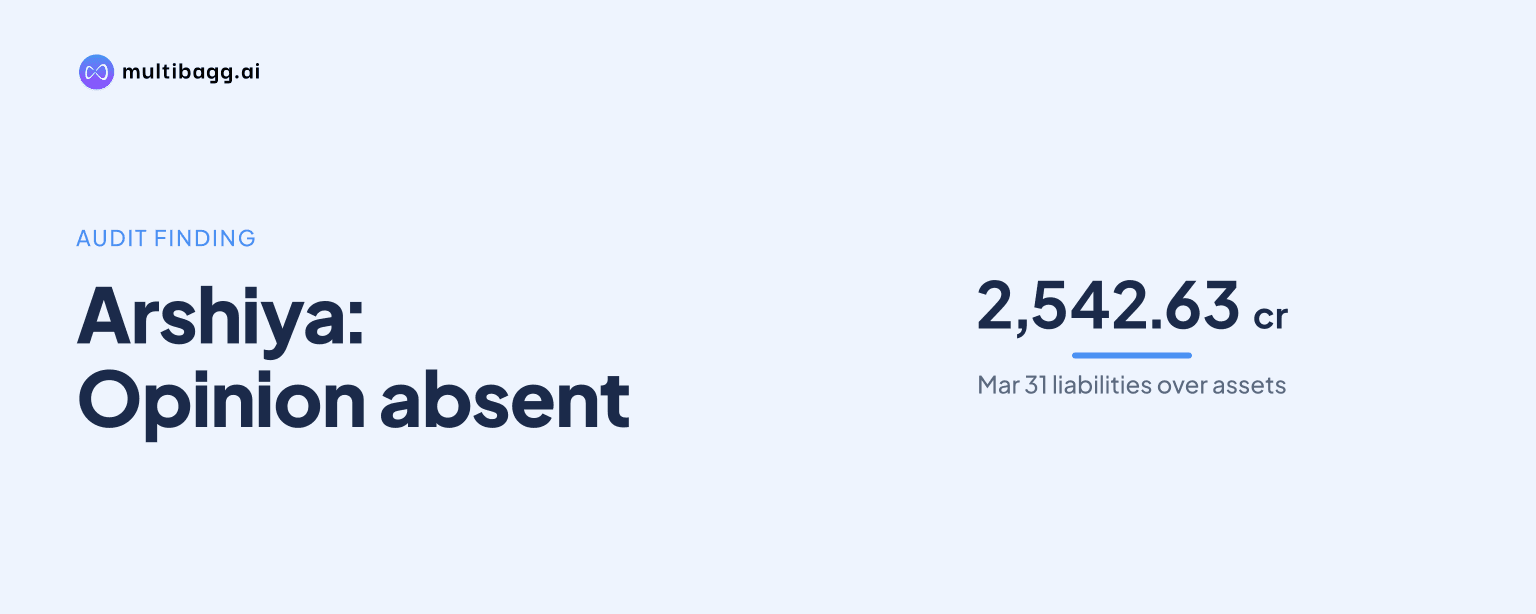
Arshiya Limited’s auditor disclaimed an opinion on its standalone FY26 results for the year ended March 31, 2026, after being unable to obtain sufficient appropriate evidence across several accounting areas. The report also disclosed that current liabilities exceeded current assets by Rs 2,542.63 crore and that the company recorded a Rs 91.15 crore net loss.
Know Arshiya inside out
Results, valuation, peers and who's buying, in one view.
Why did Arshiya’s auditor disclaim an opinion on FY26 accounts?
Arshiya’s statutory auditor, Artha & Associates, disclaimed an opinion because the nature and significance of unresolved matters meant it could not obtain sufficient appropriate audit evidence on the March 31, 2026 standalone results. The auditor therefore did not form an opinion on whether the results complied with Regulation 33 of the Securities and Exchange Board of India listing regulations or gave a true and fair view.
The limitations arose while Arshiya was in the Corporate Insolvency Resolution Process, or CIRP, initiated under a National Company Law Tribunal, Mumbai Bench order dated April 23, 2024. The board’s powers are suspended and vested in Resolution Professional Pankaj Mahajan, who took the FY26 results on record on September 25, 2026 based on information and representations received from the accounting teams, without independent verification.
The suspended directors did not sign the FY26 financial statements, and an erstwhile director raised concerns about the correctness and collectability of an identified receivable of Rs 30.11 crore. The auditor said these circumstances restricted its ability to assess the preparation, approval and completeness of the accounts. Arshiya also did not prepare consolidated FY26 results because certain subsidiaries in CIRP had not finalised their financial statements.
Which revenue and receivables did Arshiya’s auditor question?
Arshiya recognised Rs 18.06 crore of FY26 revenue and raised invoices on Ascendas Panvel FTWZ Limited, up from Rs 14.97 crore in FY25, without an executed customer contract available to the auditor. The auditor also cited no evidence of customer acceptance or other persuasive evidence establishing enforceable rights and obligations, which it said could conflict with Indian Accounting Standard 115, or Ind AS 115, on revenue from customer contracts.
No amount had been realised from Ascendas Panvel FTWZ Limited during FY26 or up to the audit report date, according to management’s representation cited by the auditor. Arshiya had not recorded an expected credit loss, or ECL, allowance against this receivable. The auditor said revenue and trade receivables may therefore be overstated, while impairment expense and the FY26 loss may be understated, but it could not quantify the adjustment.
A separate matter concerned loans advanced to subsidiary Arshiya Lifestyle Limited under a sub-lease agreement dated February 3, 2018. The lessor forfeited Rs 32.50 crore of security deposit in FY24 after promoter shareholding fell below 40%, while the subsidiary wrote off the remaining payable balance after the sub-lease was terminated in FY25 following Arshiya’s CIRP. Arshiya’s Resolution Professional did not recognise that write-off, leaving the auditor unable to verify the outstanding loan’s recoverability at March 31, 2026.
Got a follow-up? Ask IRIS
Which Arshiya asset values and guarantee liabilities remain unverified?
The auditor could not comment on recoverability of Arshiya’s Rs 575.39 crore exposure to wholly owned subsidiary Arshiya Northern FTWZ Limited, or ANFTWZ. The exposure comprised a Rs 446.25 crore non-current investment and Rs 129.14 crore of loans. ANFTWZ had incurred losses, had fully eroded net worth and was itself in CIRP, making recovery dependent on a resolution plan that had not been finalised.
Management had not completed a specific impairment assessment of the ANFTWZ investment or a credit-impairment assessment of its loans as at March 31, 2026. The auditor said an earlier asset-monetisation proposal involving a long lease may no longer be valid because of ANFTWZ’s CIRP. It consequently could not assess compliance with Ind AS 36 on impairment of assets and Ind AS 109 on financial instruments.
Arshiya had also not tested property, plant and equipment, or PPE, subsidiary investments and inventory for impairment or net realisable value, or NRV, at March 31, 2026. The reported balances included PPE with a Rs 490.18 crore gross block and Rs 573.84 crore written-down value, Rs 448.06 crore of subsidiary investments and Rs 165.06 crore of inventory. The auditor cited continuing losses and lower capacity utilisation as indicators requiring testing.
The auditor also questioned the absence of fair valuation for corporate guarantees supporting Rs 469.50 crore of principal debt, excluding interest and penal interest. Lenders had invoked guarantees linked to ANFTWZ and erstwhile subsidiary Mira Supply Chain Management Pvt Ltd. Without valuation of the guarantees or the borrowers’ secured assets, the auditor could not determine the liability that may devolve on Arshiya.
How do Arshiya’s liquidity and other accounting issues affect the results?
Arshiya reported a Rs 91.15 crore net loss for FY26, compared with a Rs 1,094.46 crore net loss in FY25, while its current liabilities exceeded current assets by Rs 2,542.63 crore at March 31, 2026. The auditor also cited defaults to financial and operational creditors, recovery proceedings, recalled loans, invoked guarantees, non-performing asset classifications and notices under the Securitisation and Reconstruction of Financial Assets and Enforcement of Security Interest Act.
The standalone accounts continue to use the going-concern basis because the Insolvency and Bankruptcy Code requires Arshiya to be managed as a going concern during CIRP. However, the auditor identified a material uncertainty and said Arshiya’s ability to continue as a going concern depends on successful completion of CIRP. It also said Arshiya did not accrue interest on certain financial liabilities during FY26, though Ind AS 109 generally requires effective-interest accounting unless liabilities are modified or derecognised.
Arshiya did not receive confirmations for a significant number of trade receivable and payable balances at March 31, 2026, despite requests under Standard on Auditing 505. It also did not obtain a current-year actuarial valuation or recognise gratuity and leave-encashment obligations after significant employee attrition in the previous year. The auditor could not verify the completeness and measurement of these balances or related contingencies.
Pending accounting effects from NCR Rail Infrastructure Limited’s resolution plan were another unresolved issue. The National Company Law Tribunal approved that plan on January 22, 2026, but the final reconciliation of merger or demerger-related adjustments remained incomplete at March 31, 2026. Arshiya had recorded identified effects, including write-offs of receivables and investments, but the auditor could not establish whether further adjustments were required.
Conclusion
Arshiya’s FY26 audit disclaimer reflects the auditor’s inability to obtain adequate evidence over revenue, receivables, subsidiary exposures, guarantees, interest costs, employee obligations and asset values. The Rs 2,542.63 crore current-liability deficit, Rs 575.39 crore ANFTWZ exposure and Rs 469.50 crore guarantee exposure make the unresolved accounting matters material to the standalone results.
The next disclosed milestones are successful completion of Arshiya’s CIRP, finalisation of ANFTWZ’s resolution plan and completion of accounting reconciliations connected with NCR Rail Infrastructure Limited. These outcomes are relevant to asset recoverability, guarantee obligations, lender settlements and the company’s ability to continue on a going-concern basis.