










Jupiter Wagons holds 80% in Woojin's metro rail venture
Key highlights
- JWL will hold 80% and Woojin will hold 20% of the rail manufacturing joint venture.
- The venture will manufacture complete metro coaches, propulsion systems, TCMS, doors, bogies and aluminium car body shells in India.
- Woojin has been entrusted with more than 2,200 metro and commuter cars in South Korea since 2019.
- The propulsion systems are intended for metro, EMU, Vande Bharat, semi-high-speed and high-speed trains.
powered by IRIS
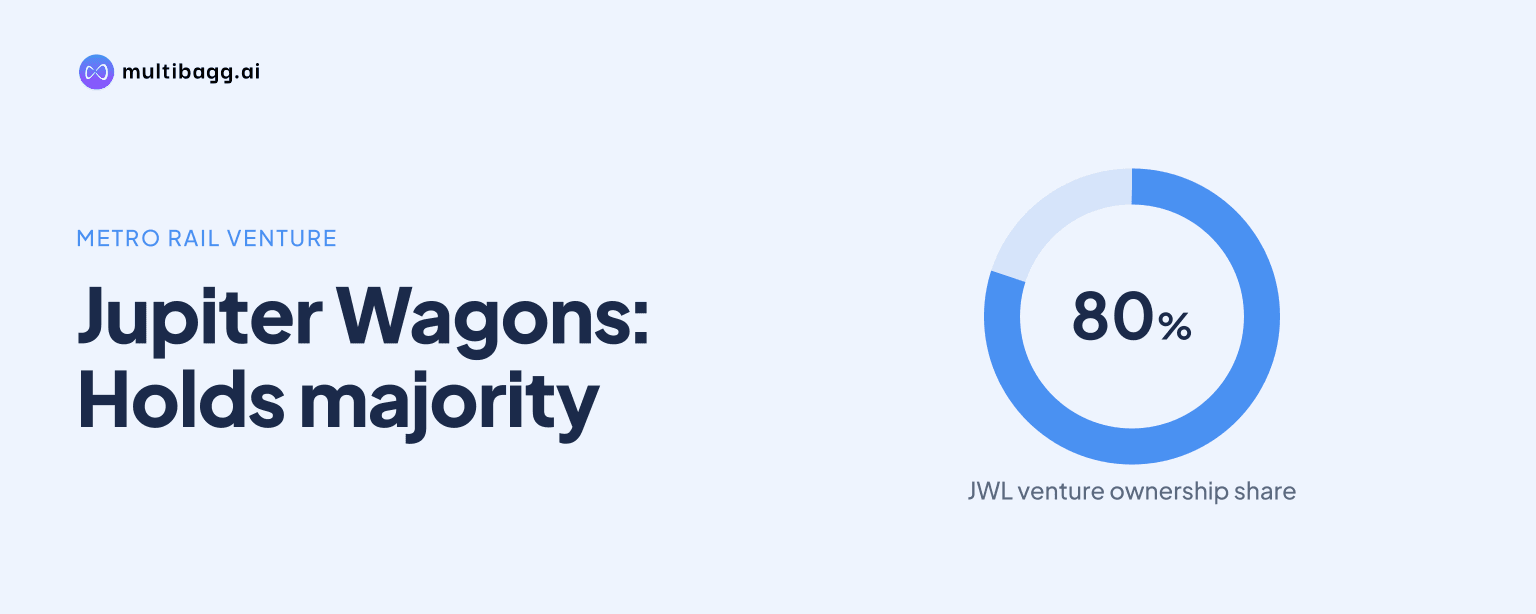
Jupiter Wagons Limited will hold 80% of a joint venture with South Korea’s Woojin Industrial Systems Co., Ltd., announced on November 23, 2026, to manufacture complete metro coaches and propulsion systems in India. The venture adds train control, doors, bogies and aluminium car-body capabilities to JWL’s existing rail-products portfolio.
Know Jupiter Wagons inside out
Results, valuation, peers and who's buying, in one view.
What does the 80:20 Woojin venture make?
The 80:20 venture will manufacture complete metro coaches in India, with JWL holding 80% and Woojin holding 20%. Its stated product scope includes propulsion systems, Train Control and Management Systems (TCMS), automatic door systems, bogies and aluminium car body shells, alongside the complete metro coaches themselves.
Propulsion is the electrical system that powers, controls and regeneratively brakes an electric train, according to the November 23, 2026 release. Beyond metro rolling stock, the venture plans to provide propulsion systems for Vande Bharat trainsets, Electric Multiple Units (EMUs), semi-high-speed trains and high-speed trains, extending the intended applications beyond urban rail.
The scope changes JWL’s stated rail offering from supplying individual components and freight-oriented products to including complete metro trainsets and core electrical equipment. JWL already lists freight wagons, bogies, couplers, brake systems, brake discs, railway wheels, axles, wheelsets and weldable cast manganese steel crossings among its rail products; the venture adds metro coaches, propulsion and train control.
How will Woojin transfer railway technology to JWL?
Woojin will undertake a complete transfer of technology to the joint venture, under which the India-based operation is intended to design, engineer, manufacture, test, commission and maintain the systems. JWL said the arrangement is under the Make in India framework and includes technology for metro coaches as well as propulsion and train-control equipment.
A dedicated manufacturing facility, including capacity for aluminium car bodies, will support the programme. Aluminium car bodies are identified in the release as part of the venture’s plan for lighter and more energy-efficient trains, while the same facility will support the manufacture of metro coaches and their critical systems in India.
The company describes the technology as available to JWL on an exclusive basis through the venture. Managing Director Vivek Lohia said Indian engineers would build on Woojin’s metro, propulsion and train-control technology, but the filing does not disclose a capital-investment amount, the facility location, production capacity, launch date or a confirmed customer order.
What experience does Woojin bring to Indian rail manufacturing?
Woojin brings more than five decades of engineering heritage in railway propulsion, train control and metro rolling stock, according to JWL’s release. Since 2019, Woojin has been entrusted with more than 2,200 metro and commuter cars in South Korea for Seoul Metro, Korea Railroad Corporation, also called KORAIL, and Busan Transportation Corporation.
That record is relevant across two distinct segments: metro and commuter cars already supplied in South Korea, and the propulsion systems proposed for Indian metro, EMU, Vande Bharat and higher-speed services. Woojin’s propulsion technology has also powered South Korea’s KTX high-speed trains and intercity fleets, which JWL cites as a foundation for its planned high-speed and semi-high-speed applications.
JWL links the venture’s wider train scope to India’s first high-speed corridor and to new high-speed lines announced in the Union Budget 2026-27. This is a stated pathway rather than a disclosed contract: the announcement identifies the train categories the venture intends to serve but gives no revenue forecast, tender award, order value or delivery schedule.
Got a follow-up? Ask IRIS
How does the venture change JWL’s rail portfolio?
The venture adds the propulsion system and complete metro coach to JWL’s stated portfolio, creating a proposed offering that runs from wheels and bogies through train controls to complete metro trainsets. Before this announcement, JWL’s disclosed rail products included freight wagons, couplers, bogies, brake systems, brake discs and cast manganese steel crossings, rather than complete metro rolling stock.
JWL produces railway wheels, axles and wheelsets through Jupiter Tatravagonka Railwheel Factory, in which Italy’s Lucchini RS and SIMEST are shareholders. It is also building passenger-rail capability through a collaboration with Poland’s PESA Bydgoszcz, while its group manufacturing sites are located in Kolkata, Jamshedpur, Indore, Jabalpur, Bangalore and Aurangabad.
The difference between the earlier component portfolio and the announced venture lies in control over additional train subsystems. The newly named TCMS, propulsion equipment, doors and aluminium shells sit alongside JWL’s existing mechanical products, while the release says the venture will also design, test, commission and maintain the critical systems in India.
Which rail markets will JWL target through the venture?
JWL will target metro rolling stock first while also positioning the venture’s propulsion systems for EMUs, Vande Bharat, semi-high-speed and high-speed trains. JWL said metro networks are expanding from a limited number of cities into state capitals and fast-growing cities, but the announcement gives no market-size estimate or planned share of those programmes.
For the metro segment, the venture is designed to manufacture complete rakes in India by combining Woojin’s metro and train-control technology with JWL’s manufacturing operations and rail-ecosystem relationships. For the broader mainline segment, the same propulsion product is intended for several train classes, distinguishing it from the metro-coach programme.
The announcement also places the venture within JWL’s wider mobility business, which includes locomotives, commercial vehicles and ISO marine containers in addition to rail equipment. Its stated customer base includes Indian Railways, BEML, Alstom, Tata Motors, GE and Volvo Eicher Motors, although the filing does not identify any of them as a customer of the new venture.
Conclusion
The November 23, 2026 announcement gives JWL an 80% position in a joint venture designed to manufacture complete metro coaches and critical electrical-control equipment in India. The principal disclosed change is the addition of propulsion, TCMS, automatic doors and aluminium car bodies to JWL’s existing mechanical rail-product range, supported by Woojin’s commitment to a complete technology transfer.
What to watch next is the execution detail not included in the filing: the location and capacity of the dedicated aluminium-body facility, the timing of commissioning, and any metro or mainline order awards. JWL has set out a plan to serve metro, EMU, Vande Bharat, semi-high-speed and high-speed applications, while Woojin’s record of more than 2,200 South Korean metro and commuter cars provides the disclosed operating reference point.