










Jupiter Wagons targets high-speed wheelsets via Lucchini
Key highlights
- Lucchini RS and SIMEST were allotted a combined 25% stake in Jupiter Wagons’ railwheel venture for approximately Rs 290 crore.
- Jupiter Wagons targets axle-line commissioning at its Odisha facility in the middle of next year.
- Jupiter Wagons expects its wheel line to be operational by the end of the next financial year.
- Jupiter Wagons reported Q2 FY27 revenue of Rs 772 crore, compared with Rs 671 crore in Q1 FY27.
powered by IRIS
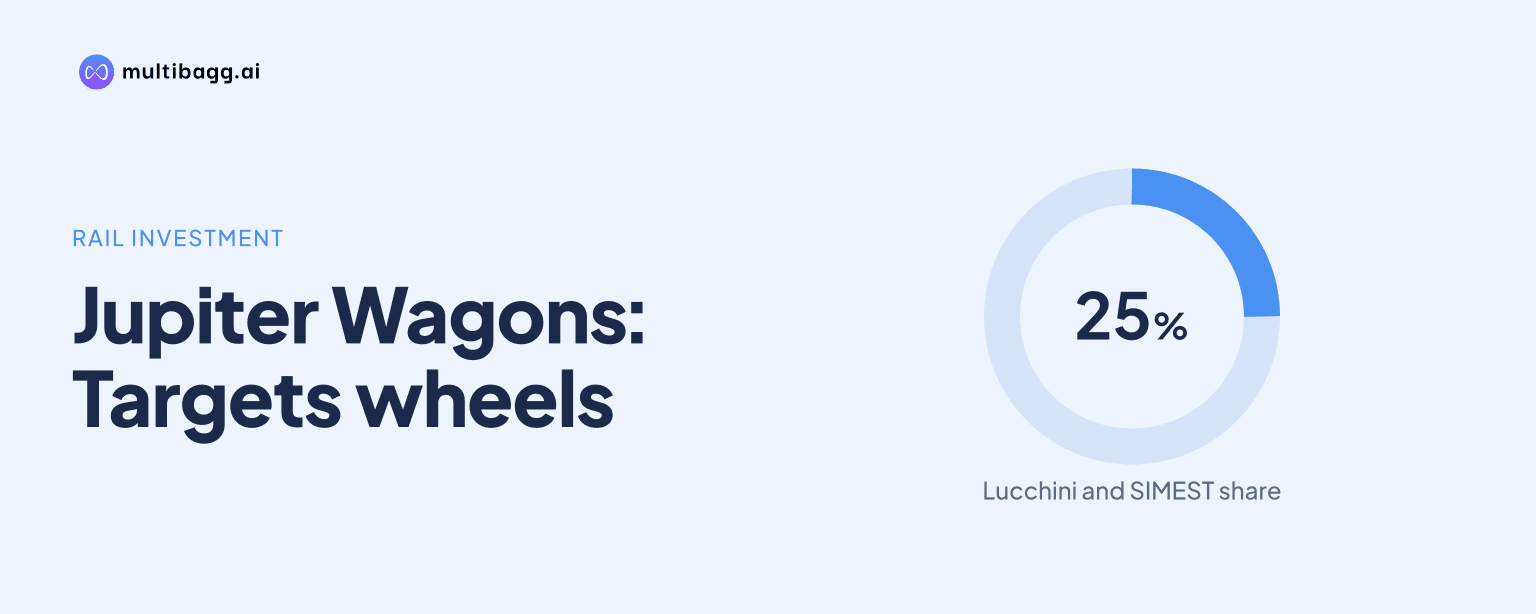
On November 16, 2026, Jupiter Wagons Limited said Lucchini RS and SIMEST’s combined 25% stake, against investment of about Rs 290 crore, supports its planned high-speed wheelset platform in India. Management said Lucchini RS’s designs, certifications and technology can support domestic import substitution and exports, with the axle line expected by the middle of next year.
Know Jupiter Wagons inside out
Results, valuation, peers and who's buying, in one view.
How does Lucchini RS change Jupiter Wagons’ wheelset plan?
Jupiter Wagons says Lucchini RS provides the designs, product range, homologations and manufacturing practices needed to move from machining into an integrated wheelset platform. The partnership is housed in Jupiter Tatravagonka Railwheel Factory Limited, or JTRWF, which management described as spanning forging, machining and finished wheelsets. Lucchini RS is Italy-based and brings experience in railwheels, axles and forged components, according to management.
The ownership arrangement gives Lucchini RS and SIMEST, an Italian government financial institution, a combined 25% stake in JTRWF against investment of approximately Rs 290 crore. Jupiter Wagons said the value of the arrangement lies not only in technology but also in certifications and established product designs, which management said are necessary for access to international wheelset markets.
Why is Jupiter Wagons pursuing high-speed wheelsets in India?
Jupiter Wagons is pursuing high-speed wheelsets because management said complete wheelsets for India’s semi-high-speed and high-speed trains are currently imported. Management also said India lacks the capability and capacity to produce these complete wheelsets, creating a potential import-substitution opportunity if the planned platform reaches production as intended.
Lucchini RS’s designs and homologations are intended to serve both domestic and export customers rather than a domestic-only product line. Management said Lucchini RS is a global leader in the high-speed segment and argued that its technology could allow Jupiter Wagons to supply high-speed wheelsets in India. That is a management expectation, not a disclosed customer order or production-volume target.
The immediate business remains affected by broader rail-industry production. Management said wheelset manufacturing numbers had been subdued as overall industry production declined, but expected wheelset revenue to increase as railway order books improve. Jupiter Wagons did not give a specific wheelset revenue forecast for FY28, citing the difficulty of providing guidance for the existing machining operation.
When will Jupiter Wagons’ axle and wheel lines start?
Jupiter Wagons said its axle line at the Odisha facility is on track for commissioning in the middle of next year, with Schuler already erecting the line. An analyst referred to the facility as slated for Q4 2027, while management later described the expected commissioning as the middle of next year; the call did not reconcile those two timing references.
The wheel line is expected to be operational by the end of the next financial year, according to management. Jupiter Wagons linked the wheel line’s start-up to the larger railwheel strategy, distinguishing it from the current smaller machining facility. The company said the axle and wheel lines, rather than machining alone, are where it expects the more substantial domestic and export opportunity to emerge.
Jupiter Wagons discussed a total railwheel-project capital expenditure of Rs 2,500 crore. Management said Rs 900 crore of required equity had been infused, while a Rs 1,600 crore bank limit had been arranged and Rs 1,100 crore of that limit had been utilised. These figures describe financing progress, not a revised commissioning schedule or confirmed plant capacity.
Got a follow-up? Ask IRIS
How does the new platform differ from Jupiter Wagons’ current operations?
Jupiter Wagons describes its current wheelset activity as a small machining facility, whereas the JTRWF plan covers forging, axle manufacturing, wheel production, machining and finished wheelsets. This distinction matters because the planned platform is intended to manufacture forged wheelsets, while management said there is currently no operational forged-wheelset capacity in India.
Management said the partnership is designed to deliver quality products at the required time and price using Lucchini RS’s established processes and technology. Jupiter Wagons also said the Lucchini RS relationship supplies international designs and product references that it believes will differentiate its offering in semi-high-speed and high-speed applications. The company did not disclose a production-capacity figure for the Odisha axle or wheel lines.
The railwheel plan also fits Jupiter Wagons’ broader move into passenger rail. In October, the company signed a memorandum of understanding with PESA, Poland’s largest train and metro manufacturer, to explore passenger-rail development, manufacturing and deployment. That PESA arrangement covers metro, regional, intercity, semi-high-speed and high-speed segments, while the Lucchini RS partnership is focused on railwheels, axles and forged components.
What financial effects does Jupiter Wagons expect from wheelsets?
Jupiter Wagons expects the wheel line to contribute to improved earnings in FY28, but management gave no stand-alone revenue or margin target for the wheelset platform. It said the company should return to “very strong” earnings before interest, taxes, depreciation and amortisation, or EBITDA, margins in FY28 as wheel-line production commences and larger order-book volumes arrive.
The company reported consolidated revenue of Rs 772 crore in Q2 FY27, up from Rs 671 crore in Q1 FY27, while EBITDA was Rs 94 crore, equal to a 12% margin, and profit after tax was Rs 46 crore. Management said it expects margins over the next few quarters to move back toward FY26 levels, with a larger effect anticipated in FY28 from order execution and new manufacturing capability.
Railway demand is a second condition for the plan. Jupiter Wagons said its wagon order book was approximately Rs 3,600 crore, or close to 10,000 wagons, within an overall order book of about Rs 5,850 crore. Management expects wagon production to return to a range of 600 to 800 wagons a month, compared with the analyst’s reference to roughly 400 wagons a month, which it said should support revenue, execution and associated wheelset demand.
Conclusion
Jupiter Wagons’ Lucchini RS partnership is central to its attempt to build a domestic forged-wheelset business rather than remain limited to machining. The combined 25% JTRWF stake held by Lucchini RS and SIMEST for approximately Rs 290 crore brings technology, designs and homologations that management says are needed for high-speed wheelsets, import substitution and exports.
The next disclosed milestones are Schuler’s axle-line erection and commissioning targeted for the middle of next year, followed by wheel-line operations by the end of the next financial year. Evidence of progress will include rail-industry production, wheelset revenue alongside wagon demand, and whether FY28 shows the margin improvement management associates with the new line.