










Jupiter Wagons Limited Q2 Revenue Hits ₹772 Crore, Order Book Grows
Key highlights
- Jupiter Wagons reported Q2 FY27 revenue of ₹772 crore, compared with ₹671 crore in Q1 FY27.
- Q2 FY27 EBITDA was ₹94 crore at a 12% margin, while profit after tax was ₹46 crore.
- Jupiter Wagons' total order book reached about ₹5,850 crore, including a wagon order book of about ₹3,600 crore.
- The company targets a wagon production run rate of 600-800 units a month and expects full margin recovery in FY28.
powered by IRIS
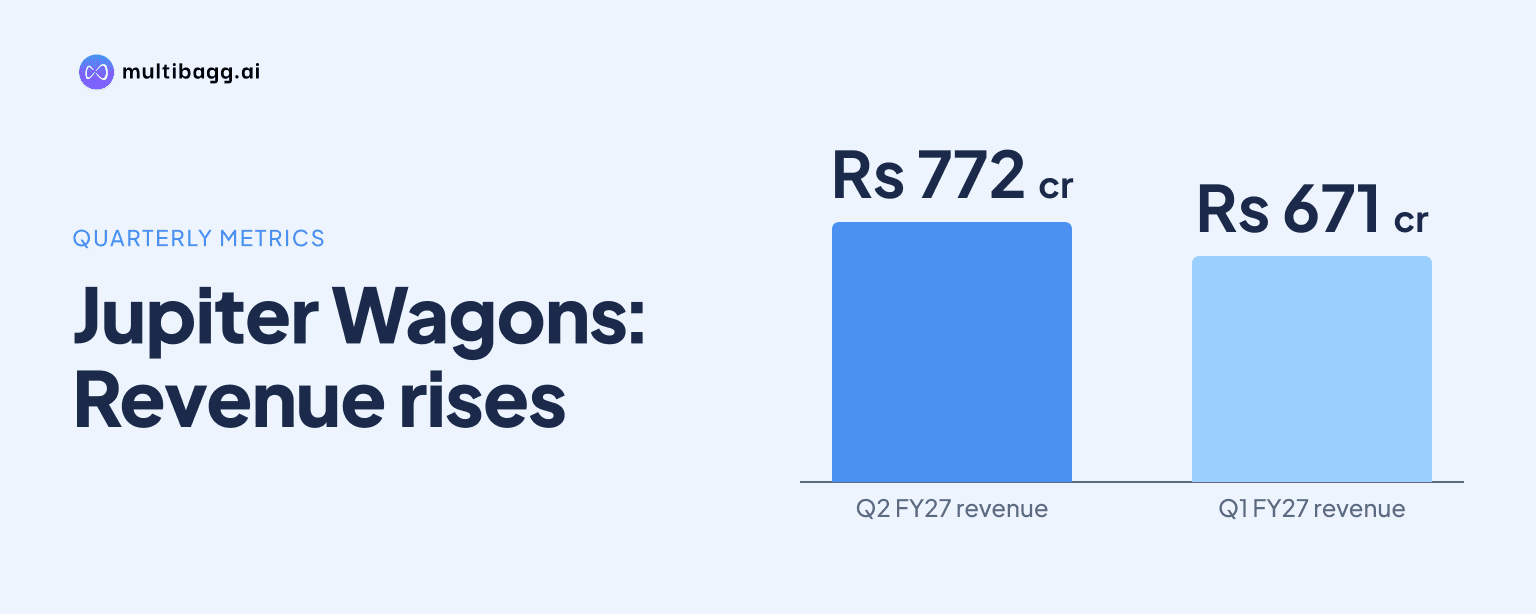
Jupiter Wagons Limited reported Q2 FY27 consolidated revenue of ₹772 crore, up from ₹671 crore in Q1 FY27, as its total order book rose to about ₹5,850 crore following new railway and private-sector orders. The quarter showed stronger sequential revenue, although EBITDA margin stood at 12% and management expects full margin recovery only in FY28.
Know Jupiter Wagons inside out
Results, valuation, peers and who's buying, in one view.
How did Jupiter Wagons perform in Q2 FY27?
Jupiter Wagons delivered a sequential improvement in operating revenue during Q2 FY27. Consolidated revenue increased by ₹101 crore from the preceding quarter to ₹772 crore. EBITDA was ₹94 crore, translating into a 12% margin, while profit after tax stood at ₹46 crore.
The results were discussed during the company's Q2 and H1 FY27 earnings call on November 16, 2026. Managing Director Vivek Lohia said the company had seen momentum return in its wagon business and order bookings. Management also pointed to its integrated manufacturing capabilities and presence across multiple end-use industries as factors supporting operations during a difficult macroeconomic environment.
The reported 12% EBITDA margin remained below Jupiter Wagons' historical guidance range of 14-15%. Management said margins should improve over the coming quarters as execution increases, but indicated that a full return to historical levels is expected in FY28 rather than immediately.
What new orders lifted Jupiter Wagons' order book?
Jupiter Wagons' order book increased to approximately ₹5,850 crore after it secured significant orders from government and private-sector customers. The company received orders worth ₹1,140 crore from the Ministry of Railways and ₹450 crore from private-sector customers.
The company said its wagon order book was about ₹3,600 crore, representing close to 10,000 wagons. This provides the largest identified component of the wider order book and is central to the expected increase in production activity over the next few quarters.
Management clarified that the total order book includes the new Indian Railways wagon orders. Private-sector business is included only partly because such orders continue to flow in over time. This distinction is relevant because the stated order book may not capture every private order expected to be received or executed.
During the call, management declined to comment on reports regarding a ₹33,000 crore Indian Railways tender for one lakh wagons, describing the reports as speculative. It nevertheless said it expects substantial order inflows in the coming year, supported by an improvement in market demand across the sector.
Got a follow-up? Ask IRIS
Why did Jupiter Wagons' EBITDA margin fall to 12%?
Jupiter Wagons' EBITDA margin declined to 12% in Q2 FY27 because wagon execution was subdued during the quarter. Management attributed the earlier caution in execution to uncertainty over future order inflows, which affected the pace of production and revenue conversion.
Mr. Lohia said confidence had since returned following the recent improvement in order bookings. He expects wagon execution to rise sharply from Q3 FY27, with a targeted run rate of 600-800 wagons a month. Management expects revenue, execution and EBITDA margin to improve as this production ramp-up progresses.
The recovery timeline remains important for investors because management does not expect margins to immediately return to the earlier 14-15% guidance range. It said margins should move toward FY26 levels over the next few quarters, with full recovery expected in FY28 as larger order books are executed and the wheel line starts production.
The company also said its axle line is on track, with the Schuler team having started installation. Management indicated that the axle line is expected to be commissioned in the middle of the next year, adding manufacturing capacity that could support the planned operational expansion.
What are Jupiter Wagons' revised growth plans and operating targets?
Jupiter Wagons has shifted its target of reaching ₹8,000-10,000 crore in revenue from FY29 to FY30, indicating a one-year delay in achieving the planned scale. The revision reflects the current pace of execution and the time required for new production lines and order inflows to translate into revenue.
Management is also pursuing growth outside the core wagon business. It is targeting a battery energy storage systems, or BESS, order book of approximately ₹1,000 crore by the end of FY27. Jupiter Electric Mobility is expected by management to turn EBITDA positive in Q3 FY27 and become profitable by FY28.
For the rail-equipment business, the order book and planned wagon run rate are the main near-term indicators. A higher production rate would support revenue growth, while the timing of the wheel and axle facilities will matter for management's stated margin recovery path.
The Q2 numbers also underline that stronger revenue alone has not yet restored profitability to historical guidance levels. The movement from a ₹671 crore Q1 revenue base to ₹772 crore in Q2 shows sequential progress, but the 12% margin and delayed FY30 revenue target set clear benchmarks for future quarterly updates.
Conclusion
Jupiter Wagons reported higher sequential Q2 FY27 revenue and a larger order book, supported by ₹1,140 crore of Ministry of Railways orders and ₹450 crore of private-sector orders. However, the company's ₹94 crore EBITDA represented a 12% margin, below its historical 14-15% guidance range, reflecting subdued wagon execution during the quarter.
Investors will watch whether Jupiter Wagons reaches its targeted 600-800 monthly wagon run rate from Q3 FY27, how quickly the ₹3,600 crore wagon order book is executed, and whether the axle and wheel-line plans support the margin recovery management has targeted for FY28.