










Jupiter Wagons broadens with passenger rail and energy storage
Key highlights
- Jupiter Wagons reported a Rs 5,841 crore order book in Q2 FY27.
- Jupiter Wagons’ BESS order book crossed 500 MWh and exceeded Rs 500 crore in value.
- Jupiter Wagons secured a Rs 1,140 crore order for 2,583 BOXNHL and BOXNS wagons.
- Lucchini RS and SIMEST invested approximately Rs 290 crore for a combined 25% stake in the railwheel subsidiary.
powered by IRIS
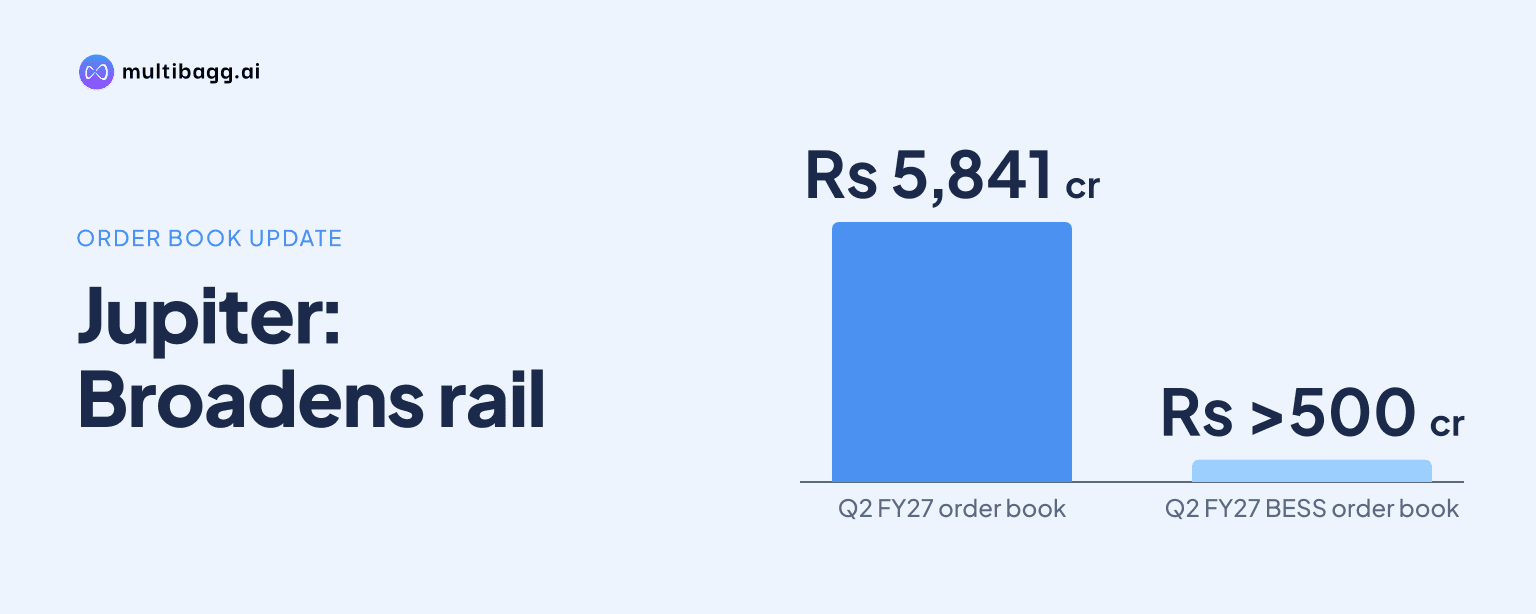
Jupiter Wagons Limited broadened beyond freight wagons in Q2 FY27 by incorporating subsidiaries for passenger rail and energy, while its battery energy storage system order book crossed 500 megawatt-hours (MWh) and exceeded Rs 500 crore in value. The expansion also includes railwheel investment and freight-brake production.
Know Jupiter Wagons inside out
Results, valuation, peers and who's buying, in one view.
What is Jupiter Wagons doing in passenger rail?
Jupiter Wagons has incorporated Jupiter Rail Mobility Private Limited to enter rail passenger transport and engineering. The new subsidiary marks a move into passenger rolling stock alongside the freight-wagon operation, which produced 1,212 railway wagons in Q2 FY27 and 2,353 units in the first half of FY27.
Jupiter Wagons has signed a memorandum of understanding (MoU) with Poland-based PESA to explore passenger rolling-stock opportunities in metro, regional, intercity, semi-high-speed and high-speed rail. The presentation gives no order value, delivery timetable, manufacturing plan or production target for the PESA arrangement as of Q2 FY27.
The passenger initiative sits alongside existing group component operations. The Jabalpur unit makes brake discs for high-speed passenger coaches through a joint venture with Kovis, while Kolkata has a joint venture with DAKO-CZ for brake systems for high-speed passenger trains and metro coaches. Jupiter Rail Mobility is, however, the newly incorporated subsidiary for passenger transport and engineering.
How is Jupiter Wagons entering battery energy storage?
Jupiter Wagons has incorporated Jupiter Green Power Solutions Private Limited in the energy and power sector for deployment of a 100 megawatt (MW), 400 MWh battery energy storage system (BESS) under a recently won order from West Bengal State Electricity Distribution Company Limited. The presentation does not state the value of that 100 MW and 400 MWh project.
The group also won a 41 MW and 102.5 MWh BESS project in Uttarakhand worth about Rs 100 crore. Separately, Jupiter Electric Mobility secured 110 MWh of FY27 BESS orders through MoUs with Chalukya Power and Pickrenew Energy across utility-scale and commercial and industrial segments.
Managing Director Vivek Lohia said the BESS order book had crossed 500 MWh and was valued at more than Rs 500 crore by Q2 FY27. He also said management remained focused on achieving a Rs 1,000 crore target for the energy-storage business by FY27, but the presentation does not specify the measure underlying that target.
What railwheel and braking capabilities is Jupiter Wagons adding?
Jupiter Wagons is expanding railwheel manufacturing through Jupiter Tatravagonka Railwheel Factory, which has partnered with Italy-based Lucchini RS. The company describes the planned operation as India’s first fully integrated private-sector railwheel manufacturing platform, combining Jupiter Wagons’ manufacturing capabilities with Lucchini RS technology and engineering.
Lucchini RS and SIMEST, an Italian government financial institution, infused approximately Rs 290 crore of fresh equity for a combined 25% stake in Jupiter Tatravagonka Railwheel Factory. Jupiter Wagons said the partnership is intended to create an export-oriented railwheel manufacturing platform, without disclosing output capacity or export targets.
Stone India, a Jupiter Wagons subsidiary, received approval for its Freight Brake System and began commercial production in July 2026. The start of production enables supply of freight brake systems to the railway sector and extends the group’s component range beyond the 5,032 brake discs produced in Q2 FY27, compared with 7,183 in Q2 FY26.
Got a follow-up? Ask IRIS
How do new businesses compare with Jupiter Wagons’ core operations?
Jupiter Wagons’ established freight-wagon business remains the larger disclosed order source. It secured a Rs 1,140 crore Ministry of Railways order for 2,583 BOXNHL and BOXNS wagons, as well as orders exceeding Rs 450 crore from GATX India, Chetak International and Balmer Lawrie & Company for ACT2 automobile-carrier and BFNS 22.9T wagons.
Production data show a year-on-year decline in railway wagons but higher output in several other lines. Railway-wagon output fell by 416 units from Q2 FY26, whereas commercial-vehicle bodies and components rose by 859 units and container output increased by 153 units over the same period.
Q2 FY27 revenue was Rs 672.9 crore, up 8.8% from Rs 618.7 crore in Q1 FY27 but down 4.9% from Rs 707.2 crore in Q2 FY26. Earnings before interest, tax, depreciation and amortisation (EBITDA), excluding other income, rose sequentially to Rs 88.1 crore from Rs 65.7 crore, and the EBITDA margin increased by 250 basis points to 13.1%.
For the first half of FY27, revenue increased 15.5% to Rs 1,291.6 crore from Rs 1,118.1 crore in the first half of FY26. EBITDA rose 10.9% to Rs 153.9 crore, but the EBITDA margin declined by 50 basis points to 11.9% from 12.4%, showing that the half-year margin trend differed from the sequential Q2 improvement.
What order pipeline supports Jupiter Wagons’ expansion?
Jupiter Wagons reported an order book of Rs 5,841 crore in Q2 FY27. The quantified freight-wagon awards include the Rs 1,140 crore Ministry of Railways order and more than Rs 450 crore of private-customer orders, while BESS orders exceeding 500 MWh were valued above Rs 500 crore.
Mr. Lohia said order inflows had revived in recent weeks and months and identified an upcoming tender for 5,800 BOBRN wagons as a possible source of further momentum. The tender was not an awarded contract at Q2 FY27, and management said its focus was on converting the opportunity pipeline into quality orders, expanding manufacturing and component capabilities, and scaling passenger mobility.
The balance sheet showed capital work in progress of Rs 94.9 crore at September 2026, compared with Rs 67.8 crore at FY26. Total borrowings were Rs 606.4 crore at September 2026, comprising Rs 50.4 crore of non-current borrowings and Rs 556 crore of current borrowings, compared with Rs 582.7 crore at FY26.
Conclusion
Jupiter Wagons is building businesses in passenger rolling stock, energy storage, railwheels and freight braking while freight wagons remain its largest specifically quantified order stream. The Q2 FY27 disclosures combine a Rs 5,841 crore total order book, BESS orders above 500 MWh valued at more than Rs 500 crore, and new manufacturing and technology arrangements across rail components.
Next, investors can watch progress toward management’s Rs 1,000 crore FY27 energy-storage target, deployment of the 100 MW and 400 MWh West Bengal BESS order, and conversion of the PESA passenger-rail MoU into disclosed work. The outcome of the 5,800-wagon BOBRN tender and commercial supply from Stone India’s freight-brake system, in production since July 2026, are further disclosed execution markers.