










Jupiter Wagons Q2 FY27 Consolidated Income Reaches ₹796 Crore
Key highlights
- Jupiter Wagons reported Q2 FY27 consolidated total income of ₹796.10 crore.
- Jupiter Wagons' Q2 FY27 consolidated profit after tax was ₹46.15 crore.
- H1 FY27 consolidated total income stood at ₹1,462.14 crore, with profit after tax of ₹72.34 crore.
- The Board approved the unaudited Q2 and H1 FY27 results on November 13, 2026.
powered by IRIS
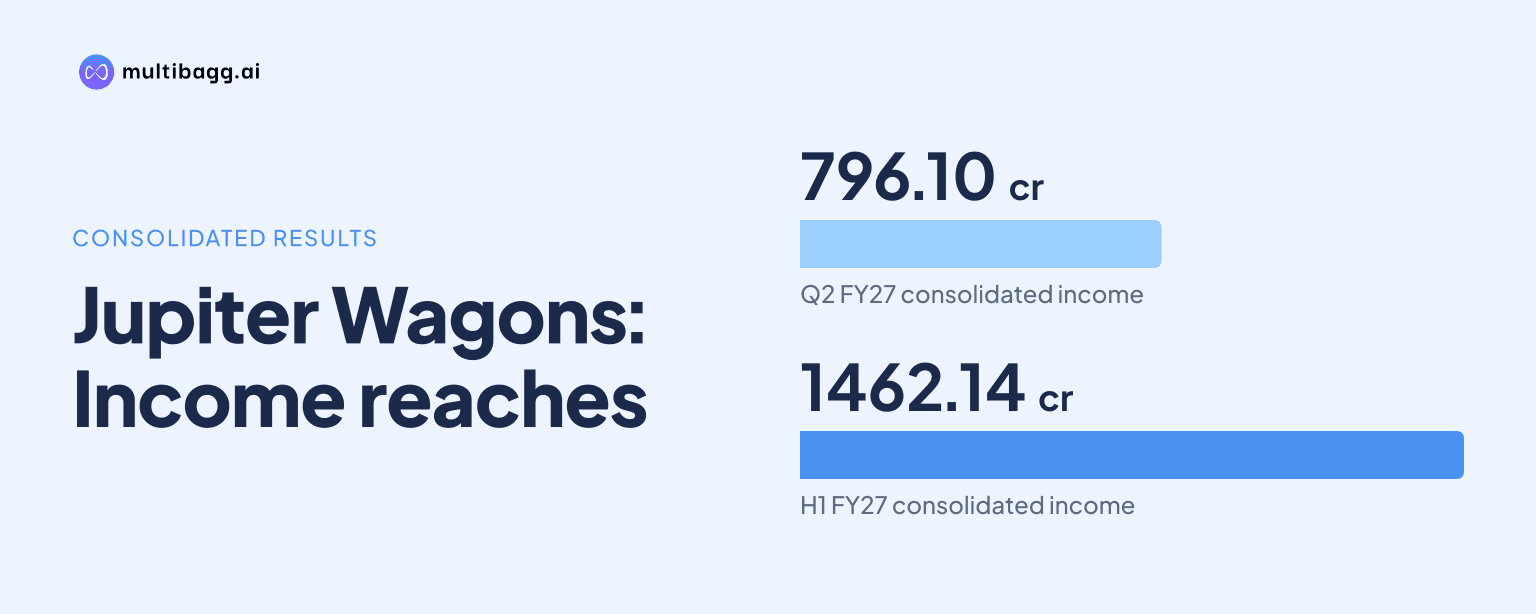
Jupiter Wagons Limited reported consolidated total income of ₹796.10 crore for the quarter ended September 30, 2026, while consolidated profit after tax was ₹46.15 crore. The Board approved the unaudited Q2 FY27 and first-half FY27 financial results on November 13, 2026, providing the latest financial update for shareholders and the railway-equipment market.
Know Jupiter Wagons inside out
Results, valuation, peers and who's buying, in one view.
What did Jupiter Wagons report for Q2 FY27?
Jupiter Wagons reported consolidated total income of ₹796.10 crore and profit after tax of ₹46.15 crore for Q2 FY27. On a standalone basis, total income was ₹681.78 crore and profit after tax was ₹53.50 crore for the July-September 2026 quarter.
The company also released results for the six months ended September 30, 2026. Consolidated total income for the first half stood at ₹1,462.14 crore, with profit after tax of ₹72.34 crore. Standalone total income was ₹1,308.75 crore, while standalone profit after tax was ₹91.53 crore.
These figures were prepared under Indian Accounting Standards, or Ind AS. Jupiter Wagons said its Board of Directors approved both the standalone and consolidated unaudited financial statements at its meeting held on November 13.
How was the Q2 FY27 results process completed?
Jupiter Wagons had informed BSE that its Board meeting would be held on November 13, 2026, to consider the unaudited standalone and consolidated results for the quarter and half year ended September 30. The company subsequently announced that the Board had approved the results.
The results and the auditors' report were submitted to the stock exchanges and made available on the company website, according to the disclosure. The announcement did not provide a detailed management explanation for the difference between standalone and consolidated profit after tax.
The reporting process is relevant because listed companies are required to disclose periodic financial performance to exchanges. The Q2 announcement follows the company’s Q1 FY27 results, which had been released on August 14, 2026.
How do the Q2 figures compare with the first quarter?
The disclosed Q1 FY27 data showed revenue from operations of ₹670.74 crore, up 46.02% year on year and down 14.02% quarter on quarter. Consolidated profit after tax in that quarter was ₹26.19 crore, while total income was ₹679.88 crore.
Q2 consolidated total income of ₹796.10 crore was therefore higher than the Q1 consolidated total income reported in the supplied financial data. Consolidated profit after tax of ₹46.15 crore was also above the Q1 figure of ₹26.19 crore. These are sequential comparisons based on the reported quarterly numbers.
The supplied data separately describes Q1 revenue from operations and total income. Investors should distinguish between these measures, as total income can include items beyond revenue from operations. The Q2 announcement specifically provides total income figures in the disclosed summary.
Got a follow-up? Ask IRIS
Why do the standalone and consolidated results matter?
Standalone results represent the reporting entity’s own financial performance, while consolidated results include the financial performance of subsidiaries and other entities required to be consolidated under applicable accounting standards. Both sets of figures are useful, but they measure different reporting scopes.
For Q2 FY27, standalone profit after tax of ₹53.50 crore was above consolidated profit after tax of ₹46.15 crore. The company’s announcement does not specify the underlying reasons for this difference. It would therefore be inappropriate to attribute it to any particular subsidiary, expense, or accounting item without further disclosures.
The six-month figures show the same distinction. Standalone profit after tax was ₹91.53 crore for H1 FY27, compared with ₹72.34 crore on a consolidated basis. For investors, reviewing both statements helps assess the performance presented at the company level and across the consolidated group.
What is the context for investors and the railway-equipment sector?
Jupiter Wagons operates in the commercial vehicles and railway-equipment space, placing its financial disclosures within the broader capital-goods and rail manufacturing market. The supplied Q1 data showed that revenue growth did not translate into higher year-on-year profit, with Q1 profit after tax down 15.73% from the comparable prior-year quarter.
For Q2, the reported consolidated total income of ₹796.10 crore and profit after tax of ₹46.15 crore provide a more current reference point than the Q1 result. However, the release does not disclose segment-level performance, order-book movements, margins, or detailed cost drivers in the supplied information.
Market participants will likely focus on the relationship between income growth and profitability across future disclosures. The available data also notes that FY27 revenue forecasts had been reduced from ₹3,650 crore to ₹3,450 crore, while the EPS estimate was lowered from ₹6.83 to ₹5.80. These forecasts are external estimates cited in the supplied material, not company guidance.
Conclusion
Jupiter Wagons delivered Q2 FY27 consolidated total income of ₹796.10 crore and profit after tax of ₹46.15 crore, alongside H1 consolidated income of ₹1,462.14 crore. The Board-approved results provide the company’s latest reported financial position following a Q1 period in which revenue rose year on year but profit declined.
The next point to watch is the company’s subsequent earnings disclosure and any management commentary on revenue from operations, margins, costs, and group-level performance. The current announcement confirms the Q2 and H1 financial outcomes but does not disclose operational targets, segment details, or a revised company forecast.