










Jupiter Wagons targets 600-800 monthly output as orders revive
Key highlights
- Jupiter Wagons targets peak production of 600-800 wagons a month, compared with roughly 400 wagons monthly cited on the call.
- Jupiter Wagons’ wagon order book was about Rs 3,600 crore and represented close to 10,000 wagons.
- Q2 FY27 consolidated revenue rose to Rs 772 crore from Rs 671 crore in Q1 FY27.
- Jupiter Wagons secured a Rs 1,140 crore Ministry of Railways order for 2,583 wagons.
powered by IRIS
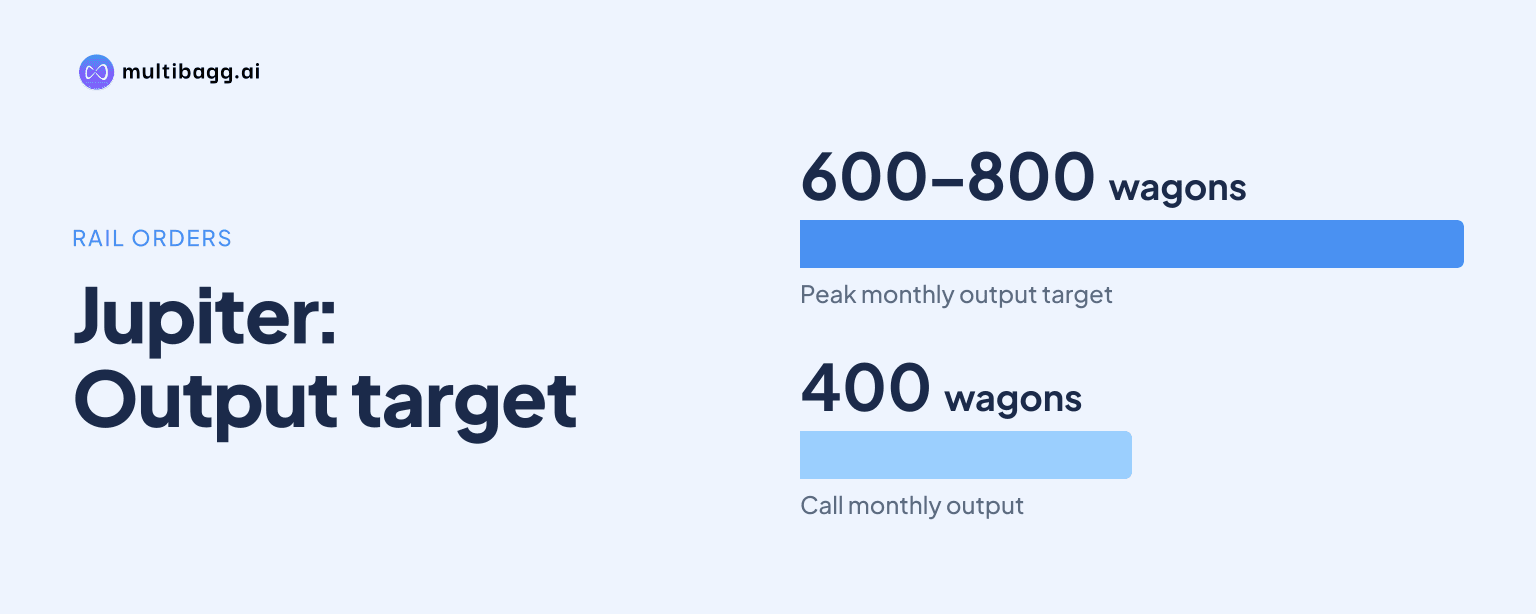
In the Q2 and H1 FY27 call on November 16, 2026, Jupiter Wagons Limited said it is targeting peak production of 600-800 wagons a month, up from roughly 400 cited on the call, after its wagon order book reached about Rs 3,600 crore, or close to 10,000 wagons.
Know Jupiter Wagons inside out
Results, valuation, peers and who's buying, in one view.
What monthly wagon output is Jupiter Wagons targeting?
Jupiter Wagons is targeting production of 600-800 wagons a month, which management described as the company’s earlier peak production range. Managing Director Vivek Lohia gave the range in response to a question about second-half FY27 and FY28 execution, but did not provide a month or quarter by which the rate would be achieved.
The target compares with roughly 400 wagons a month cited by an analyst during the call. Lohia said execution would exceed 400 wagons a month and that a sharp rise would start from the current quarter, with sector momentum expected over the next two quarters. Management had previously been cautious on execution because it lacked confidence in future order inflows, according to Lohia.
The 600-800 range is an intended peak production rate rather than reported Q2 FY27 output or formal volume guidance for a defined period. Management said higher execution should lift revenue and bring earnings before interest, tax, depreciation and amortisation, or EBITDA, margins closer to prior peak levels over the next few quarters.
Why is Jupiter Wagons planning to raise wagon production?
Jupiter Wagons is planning to raise production after recent railway and private-sector wins expanded the wagon pipeline. The company secured a Rs 1,140 crore Ministry of Railways order for 2,583 BOXNHL and BOXNS wagons, as well as Rs 450 crore of private orders from GATX India, Chetak International, and Balmer Lawrie and Company.
The private orders cover ACT2 automotive-carrier wagons and BFNS wagons with a 22.9-tonne payload. Jupiter Wagons said its overall order book had reached about Rs 5,850 crore, while the wagon order book was about Rs 3,600 crore and represented close to 10,000 wagons. The overall figure includes the new Indian Railways order, while management said some, but potentially not all, private-sector orders had been captured.
Jupiter Wagons also cited a newly announced tender for 5,800 BOBRN wagons as supporting the industry opportunity. It did not state that it had won any portion of that tender. When asked about reports of a larger possible rail tender, Lohia declined to comment on speculation but said management expected substantial order inflows in the coming year.
How did Jupiter Wagons perform in Q2 FY27?
Jupiter Wagons reported consolidated revenue of Rs 772 crore in Q2 FY27, up from Rs 671 crore in Q1 FY27. The Rs 101 crore sequential increase came as management said wagon-sector production had been subdued and had affected industry activity in wheelsets and related operations.
Q2 FY27 EBITDA was Rs 94 crore, equal to a 12% margin, and profit after tax was Rs 46 crore. Lohia said larger order-book conversion should become more visible in FY28 and that the wheel line commencing production could support a return to higher EBITDA margins. He also said margins should move toward FY26 levels over the next few quarters, without providing quarter-specific targets.
Got a follow-up? Ask IRIS
What manufacturing projects could support Jupiter Wagons’ execution?
Jupiter Wagons is building an integrated railwheel platform through Jupiter Tatravagonka Railwheel Factory Limited, which has partnered with Italy-based Lucchini RS. Lucchini RS and SIMEST, an Italian government financial institution, received a combined 25% stake in the venture against an investment of about Rs 290 crore.
Management said the arrangement adds technology and experience in railwheels, axles, forged components, forging, machining and finished wheelsets. Lohia said wheelsets for semi-high-speed and high-speed trains are currently imported into India, and that Lucchini RS brings global designs and certifications relevant to domestic and international markets. Jupiter Wagons did not disclose a revenue or production forecast for the venture.
Jupiter Wagons also said the Schuler team had begun erecting the axle line and that management remained on track for its stated Q4 2027 facility milestone. The railwheel project has total capital expenditure of Rs 2,500 crore, including about Rs 900 crore of equity already infused. Management said Rs 1,100 crore had been utilised from a Rs 1,600 crore bank limit.
Which non-wagon businesses could affect FY28 results?
Jupiter Wagons expects energy storage, electric mobility, brakes and passenger rail initiatives to develop alongside wagon execution. During Q2 FY27, it secured 100 megawatts of standalone battery energy storage system, or BESS, projects in West Bengal, estimated at about Rs 400 crore under a 15-year build-own-operate model.
JEM Energy’s order book exceeded 500 megawatts and was valued at more than Rs 500 crore. Management is targeting a BESS order book of about Rs 1,000 crore by the end of FY27, while Jupiter Electric Mobility is expected by management to become EBITDA-positive in Q3 FY27 and profitable by FY28. These are management targets, not reported financial results.
In October, Jupiter Wagons signed a memorandum of understanding with PESA to explore passenger rail vehicles for regional, intercity and urban transport. Management said Jupiter Wagons plans to participate in railway and metro tenders from this year through joint ventures in which it would be the majority shareholder, using technology transfer and partner references.
Jupiter Wagons said it will establish a new passenger-segment manufacturing facility, but did not disclose capital expenditure or a commissioning date. Management said further announcements would provide the business-plan figures. Separately, it expects brake-business revenue in FY28 to double from FY27 and said Stone India could produce about 700-800 freight brake systems a month from the beginning of next year.
Conclusion
Jupiter Wagons’ planned move from roughly 400 wagons a month to a 600-800 monthly peak range reflects management’s increased confidence after order inflows. The company entered the period with a wagon order book of about Rs 3,600 crore, close to 10,000 wagons, while consolidated revenue rose sequentially by Rs 101 crore to Rs 772 crore in Q2 FY27.
The next disclosed milestones are whether execution rises over the next two quarters, progress on the stated Q4 2027 axle-facility milestone, and the planned start of wheel-line production by the end of the next financial year. Management’s FY27 BESS order-book target of about Rs 1,000 crore and forthcoming passenger-rail facility details are also unresolved items to watch.