










Jupiter Wagons Limited Plans Majority-Owned Passenger JVs
Key highlights
- Jupiter Wagons said it will pursue passenger rail through majority-owned joint ventures from FY27.
- Jupiter Wagons signed a memorandum with PESA in October 2026 to explore metro, intercity and high-speed passenger rail opportunities.
- Jupiter Wagons disclosed an order book of about Rs 5,850 crore, including about Rs 3,600 crore of wagon orders.
- Jupiter Wagons has not disclosed capital expenditure, capacity or timing for its planned passenger-coach facility.
powered by IRIS
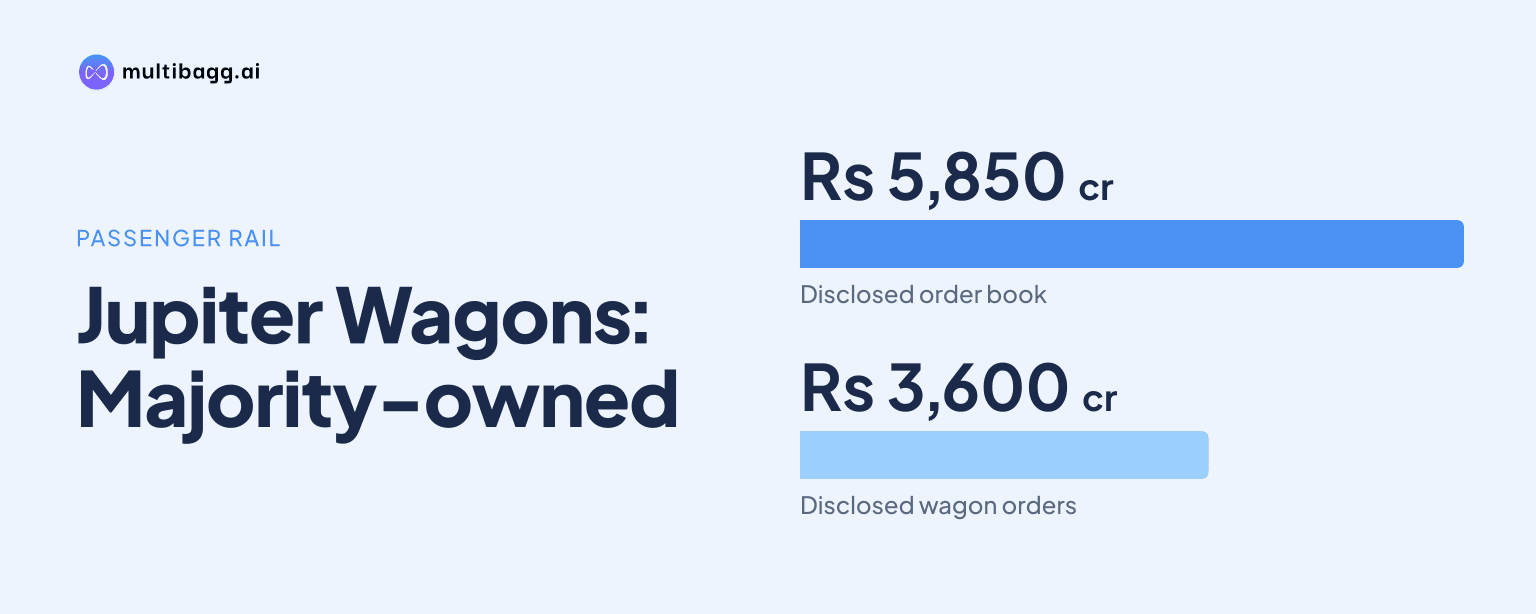
On November 16, 2026, Jupiter Wagons Limited said it would pursue passenger rail through majority-owned joint ventures, using partner technology transfer and prior-project references to bid for railway and metro work. The plan follows its October 2026 memorandum of understanding with PESA, while Jupiter Wagons’ disclosed order book of about Rs 5,850 crore remains principally freight related.
Know Jupiter Wagons inside out
Results, valuation, peers and who's buying, in one view.
How will Jupiter Wagons enter passenger rail?
Jupiter Wagons plans to seek passenger-rail contracts through joint ventures in which it will be the majority shareholder. Managing Director Vivek Lohia said partners would provide technology transfer and prior project references, allowing the ventures to bid for projects where passenger-coach pre-qualification requirements can limit a new entrant. Management said Jupiter Wagons would become an active participant in railway and metro tenders from FY27.
The strategy takes Jupiter Wagons beyond freight wagons and rail components into complete passenger-mobility offerings. Management identified regional intercity, urban transport, metro, semi-high-speed and high-speed rail as potential markets under the October 2026 PESA memorandum. It said its capabilities in rolling-stock components, castings and wheelsets would be combined with partner technology rather than relying solely on its own passenger-coach operating history.
Jupiter Wagons’ current order book remains weighted towards freight, showing the scale of the proposed transition. Its wagon order book was about Rs 3,600 crore, or close to 10,000 wagons, within a total order book of about Rs 5,850 crore discussed on the November 16 call. Passenger rail was presented as a new participation area, not as a disclosed booked-order contributor.
What does the PESA agreement cover for Jupiter Wagons?
Jupiter Wagons signed a memorandum of understanding with PESA in October 2026 to explore passenger rail vehicle development, manufacturing and deployment. PESA was described by management as Poland’s largest train and metro manufacturer. The memorandum is a framework to examine opportunities, rather than a disclosed final manufacturing joint venture, contract award or committed passenger-coach production programme.
The prospective arrangement combines PESA’s passenger-rail technology and European experience with Jupiter Wagons’ Indian manufacturing scale and Indian Railways relationships. Management said the scope includes component localisation in India and other markets, with an aim to move from individual parts to end-to-end passenger-mobility offerings. No localisation percentage, production volume or passenger-coach order was disclosed on November 16.
High-speed rail is an explicit part of the rationale. Management said PESA is at the forefront of high-speed rail mobility in Europe and characterised the relationship as focused on future passenger rolling stock as well as the current Indian market. Jupiter Wagons separately partnered with Italy-based Lucchini RS for railwheels, axles and forged components, where management said complete wheelsets for semi-high-speed and high-speed trains are imported into India.
Why are joint ventures central to Jupiter Wagons’ passenger strategy?
Joint ventures are central because Jupiter Wagons said partner references and technology transfer would be used to qualify and bid for passenger projects. Responding to an analyst’s question on whether bids would be submitted through a new venture or a partner entity, Lohia said the route would be through the joint venture, with Jupiter Wagons as majority shareholder. The stated structure addresses the prior-experience criterion raised by the analyst for entry into passenger coaches.
Jupiter Wagons did not identify the number of proposed passenger joint ventures, name all intended partners or confirm that PESA will be a counterparty to a final joint venture. Management instead said that further announcements over the next few months would provide a clearer framework for its position in the segment. The distinction matters because the October 2026 PESA document is an agreement to explore cooperation, while the joint-venture bidding model was described as the intended route.
The wider rail investment programme provides industrial context but not a budget for the passenger plan. Jupiter Wagons’ railwheel project has total capital expenditure of Rs 2,500 crore, including about Rs 900 crore of equity already infused. Management said bank limits of Rs 1,600 crore had been arranged and Rs 1,100 crore utilised as of the November 16 call, but those sums relate to the railwheel project rather than the proposed passenger facility.
Got a follow-up? Ask IRIS
When will Jupiter Wagons build a passenger coach plant?
Jupiter Wagons said it will establish a new facility for the passenger segment, but it did not disclose a location, commissioning date, capacity or capital-expenditure figure on November 16, 2026. Asked for a tentative investment estimate, management said its business plans were firm and that figures would be announced shortly. The facility is therefore a stated plan rather than a costed project in the disclosed call.
The timing stated for commercial participation is earlier than the disclosed plant timetable. Management said Jupiter Wagons would participate in railway and metro tenders from FY27 using joint-venture technology and references. The transcript does not establish whether future bids would depend on a completed facility, a partner’s manufacturing base or another manufacturing arrangement.
The existing railwheel expansion provides a separate execution milestone. Management said the axle line at its Odisha facility was expected to be commissioned in the middle of the following year, while the wheel line was expected by the end of the following financial year. The Schuler team had already started erecting the axle line, whereas the passenger facility’s construction schedule remained undisclosed.
How does the railwheel project support Jupiter Wagons’ passenger ambitions?
Jupiter Wagons said its partnership with Lucchini RS is intended to provide global technology, designs and homologation, or certification, for domestic and international wheelset markets. Management said this is relevant to semi-high-speed and high-speed trains, for which it stated India currently imports complete wheelsets. The project spans forging, machining and finished wheelsets through Jupiter Tatravagonka Railwheel Factory Limited.
Lucchini RS and SIMEST, an Italian government financial institution, were allotted a combined 25% stake in Jupiter Tatravagonka Railwheel Factory Limited against an investment of about Rs 290 crore. Management said the partnership could support import substitution and exports, although it did not provide revenue projections for the railwheel operation. The passenger expansion similarly depends on external technology and references, but is planned through majority-held ventures rather than the disclosed 25% railwheel partner holding.
Jupiter Wagons expects the axle line to operate by the middle of the following year and the wheel line by the end of the following financial year. Management said the wheelset business would rise as railway order books improve, but did not give a specific revenue forecast. Its stated passenger strategy therefore links a new coach and metro tender presence with a broader effort to add higher-specification rail components.
Conclusion
Jupiter Wagons is planning a partnership-led entry into passenger rail rather than a standalone launch. The October 2026 PESA memorandum supplies a framework for technology and market cooperation, while the proposed majority-held joint ventures are intended to use partner references for tender eligibility. This would broaden a business whose disclosed order book still included about Rs 3,600 crore of freight-wagon orders.
The next item to watch is management’s promised announcement in the next few months on passenger partners, joint-venture structure and plant investment. Investors will also need the facility’s location, capacity and commissioning schedule, none of which were disclosed on November 16, alongside progress towards the axle-line commissioning planned for the middle of the following year.