










Jupiter Wagons Limited wins 100 MW award, targets Rs 1,000 crore
Key highlights
- Jupiter Wagons received a formal award for 100 MW of standalone BESS projects in West Bengal worth about Rs 400 crore.
- The West Bengal BESS projects will use a 15-year build-own-operate model.
- Jupiter Wagons said the JEM Energy order book exceeds 500 MW and more than Rs 500 crore.
- Management is targeting an approximately Rs 1,000 crore BESS order book by the end of FY27.
powered by IRIS
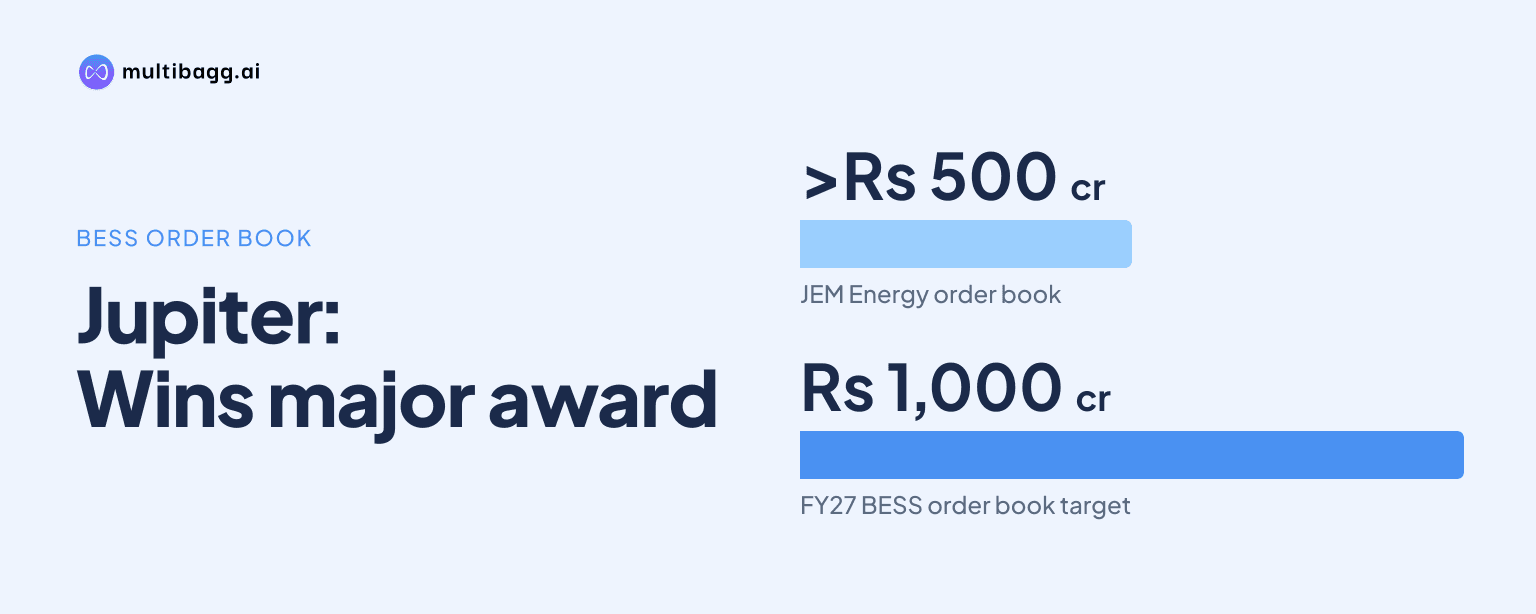
Jupiter Wagons Limited secured a 100 MW standalone battery energy storage system award in West Bengal during Q2 FY27, estimated at about Rs 400 crore under a 15-year build-own-operate model, while management targets a battery-storage order book of about Rs 1,000 crore by the end of FY27.
Know Jupiter Wagons inside out
Results, valuation, peers and who's buying, in one view.
What is Jupiter Wagons’ 100 MW West Bengal BESS award?
Jupiter Wagons’ 100 MW award covers standalone battery energy storage system, or BESS, projects in West Bengal and has an estimated value of about Rs 400 crore. Management said on November 16, 2026, that West Bengal State Electricity Distribution Company Limited had issued the formal letter of award during Q2 FY27.
The project will use a 15-year build-own-operate, or BOO, structure, meaning Jupiter Wagons will build, own and operate the storage assets rather than only supply equipment. Management did not disclose commissioning dates, storage duration in megawatt-hours, project capital expenditure, financing arrangements or expected revenue from the West Bengal projects.
The disclosed 15-year BOO model gives the award a different structure from a one-time equipment sale. The facts disclosed on the call were the 100 MW capacity, the approximately Rs 400 crore estimated value, the formal award letter and the operating model; no contract-level margin or construction schedule was provided.
How large is Jupiter Wagons’ BESS order book and FY27 target?
Jupiter Wagons said the JEM Energy order book exceeds 500 MW and is valued at more than Rs 500 crore after including earlier wins and the 100 MW West Bengal award. Management is targeting an approximately Rs 1,000 crore BESS order book by the end of FY27, which is Rs 500 crore above the currently disclosed minimum value.
Management said it was selective about new BESS orders because demand was strong, focusing on contracts that contribute significant margins and align with its eventual business goal. That is management’s stated approach, not a quantified profitability forecast, and the call gave no BESS bid conversion rate, customer concentration, margin or execution timetable for the more-than-500-MW book.
How does Jupiter Wagons plan to make BESS locally?
Jupiter Wagons said it already produces BESS locally from the container through the battery-management system, or BMS, and energy-management system, or EMS. The BMS monitors and manages battery operation, while the EMS controls energy use and dispatch across the system; management did not disclose manufacturing capacity, plant location or local-content percentages.
The next planned step is a high-voltage, high-capacity battery-cell line. Management said on November 16, 2026 that it had identified a technology partner and was finalising a technology-transfer agreement, with an announcement expected shortly, but it did not disclose the cell plant’s capital expenditure, capacity, chemistry, commissioning date or binding status of the agreement.
Jupiter Wagons said prospective cell production would target high-voltage and high-capacity applications aligned with its energy-storage offering, rather than automotive cells. Management identified access to suitable technology transfer as the key battery-manufacturing challenge, citing restrictions on transfers of the right technology, and said its FY29 aim was to become a Make in India energy-storage company.
Got a follow-up? Ask IRIS
What does the BESS plan mean within Jupiter Wagons’ wider business?
Jupiter Wagons is developing BESS alongside rail wagons, wheelsets, rail components and electric mobility rather than as its only growth business. Consolidated Q2 FY27 revenue rose to Rs 772 crore from Rs 671 crore in Q1 FY27, an increase of Rs 101 crore, while earnings before interest, tax, depreciation and amortisation, or EBITDA, were Rs 94 crore and profit after tax was Rs 46 crore.
The overall order book stood at about Rs 5,850 crore at the time of the call, while management put the wagon order book at about Rs 3,600 crore, or close to 10,000 wagons. The more-than-Rs-500-crore JEM Energy book is therefore smaller in value than the disclosed wagon book, although the BESS portfolio includes the separately structured 100 MW, 15-year BOO award.
Management separately expects Jupiter Electric Mobility to become EBITDA positive in Q3 FY27 and profitable by FY28. That expectation concerns electric mobility rather than JEM Energy, so it is not profitability guidance for BESS; Jupiter Wagons also said it was focused on the commercial and industrial, or C&I, storage segment without disclosing revenue, installed capacity or market-share targets.
What should readers watch in Jupiter Wagons’ BESS execution?
The first disclosed milestone is whether Jupiter Wagons builds the BESS order book from more than Rs 500 crore to about Rs 1,000 crore by FY27-end while maintaining management’s stated selectivity on margins. The second is progress from the formal West Bengal award to project execution under its 15-year BOO model, for which the transcript provides no construction, commissioning or financing milestone.
A further milestone is the planned cell-technology announcement and the path to management’s FY29 local-manufacturing ambition. As of November 16, 2026, the technology-transfer agreement was still being finalised, and the planned cell line was intended for high-voltage, high-capacity storage applications rather than the automotive market.
Jupiter Wagons also said it would disclose more details shortly after finalising the technology arrangement. Its next quarterly call could provide updates on JEM Energy orders, the 100 MW West Bengal project and the stated target for Jupiter Electric Mobility to reach EBITDA positivity in Q3 FY27.
Conclusion
Jupiter Wagons’ formal 100 MW West Bengal award adds an estimated Rs 400 crore, 15-year BOO storage project and takes the disclosed JEM Energy order book above 500 MW and Rs 500 crore. Management is combining further order acquisition with local production of BESS components and a proposed high-voltage, high-capacity cell line, rather than pursuing capacity growth alone.
The next disclosed tests are whether the BESS order book reaches about Rs 1,000 crore by FY27-end, whether the West Bengal project advances to execution milestones, and whether the planned technology-transfer agreement is announced. Management’s FY29 Make in India objective depends on the proposed cell-manufacturing plan progressing from an agreement under finalisation to operating capability.