










Arvind SmartSpaces net debt fell to Rs 200 crore in Q2
Key highlights
- Arvind SmartSpaces reported gross debt of Rs 712 crore at September 30, 2026, up from Rs 581 crore at June 30, 2026.
- Arvind SmartSpaces’ net debt declined to Rs 200 crore at September 30, 2026 from Rs 215 crore three months earlier.
- Arvind SmartSpaces’ borrowing cost declined to 9.2% at September 30, 2026 from 9.4% at June 30, 2026.
- Arvind SmartSpaces generated Rs 152 crore of net operating cash flow in Q2 FY27, compared with Rs 81 crore in Q1 FY27.
powered by IRIS
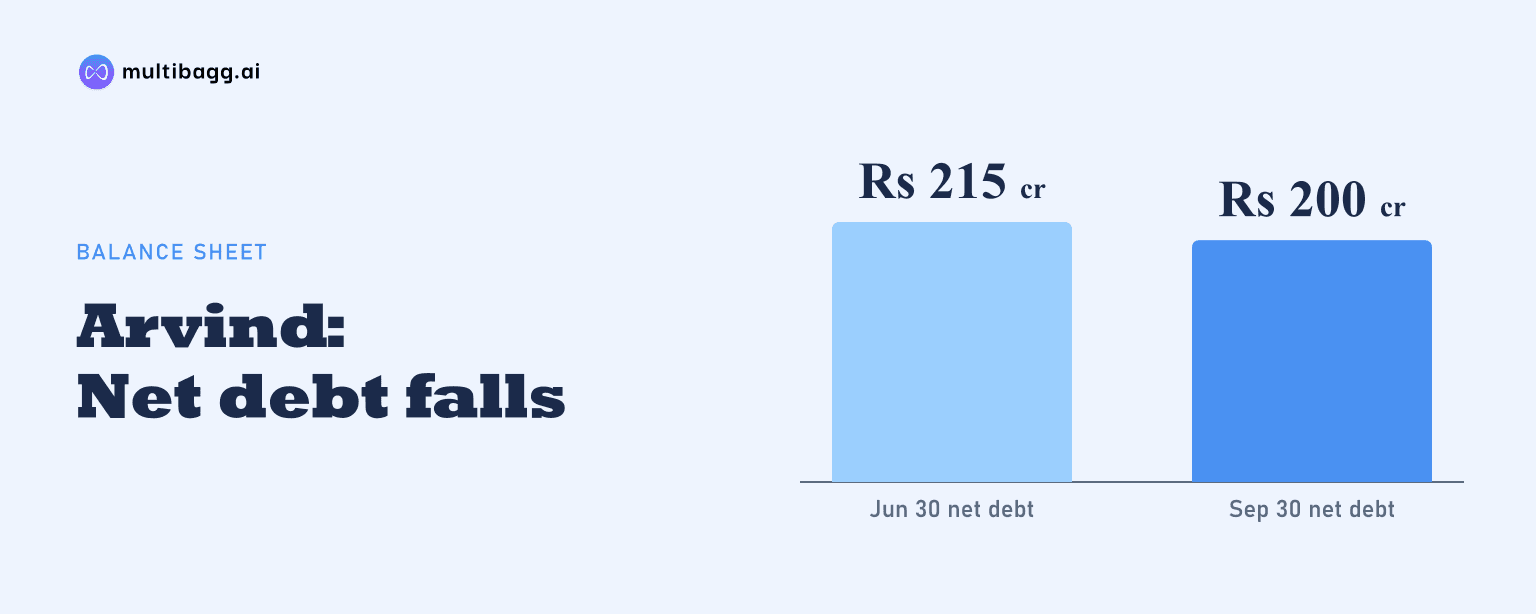
Arvind SmartSpaces reported net debt of Rs 200 crore at September 30, 2026, down from Rs 215 crore three months earlier, even as gross debt rose to Rs 712 crore and borrowing cost declined to 9.2%. The Q2 FY27 debt profile also showed net debt to equity easing to 0.26 times from 0.29 times at June 30, 2026.
Know Arvind SmartSpaces inside out
Results, valuation, peers and who's buying, in one view.
How did Arvind SmartSpaces’ debt change in Q2 FY27?
Arvind SmartSpaces’ gross debt rose by Rs 131 crore during Q2 FY27, reaching Rs 712 crore at September 30, 2026 from Rs 581 crore at June 30, 2026. In contrast, net debt fell by Rs 15 crore to Rs 200 crore from Rs 215 crore over the same period. The different movements mean the reported gross-debt increase did not translate into a higher reported net-debt balance at the quarter end.
The reported debt profile shows gross debt increasing at every disclosed date from Rs 153 crore at September 30, 2025. Net debt moved from net cash of Rs 32 crore at that date to net debt of Rs 79 crore at December 31, 2025, Rs 167 crore at March 31, 2026, and Rs 215 crore at June 30, 2026 before declining in Q2 FY27.
Arvind SmartSpaces says its gross-debt figure excludes optionally convertible debentures, or OCDs, issued to the HDFC Platform, of which Rs 195 crore was outstanding at September 30, 2026. The measure also excludes joint-venture partner infusions. The company further notes that gross debt and net debt may differ from figures in its financial statements because of reporting under accounting standards.
Why did net debt fall while gross debt increased?
Arvind SmartSpaces does not disclose a full reconciliation for the Rs 15 crore reduction in net debt alongside the Rs 131 crore increase in gross debt during Q2 FY27. Its direct cash-flow presentation, however, reported net operating cash flow of Rs 152 crore in Q2 FY27, compared with Rs 81 crore in Q1 FY27. It also reported a net financial cash outflow of Rs 40 crore in Q2 FY27, after a Rs 165 crore inflow in Q1 FY27.
Net loans and OCD drawdown or repayment generated a Rs 124 crore inflow in Q2 FY27, lower than the Rs 224 crore reported in Q1 FY27. Net investments were Rs 146 crore in Q2 FY27, compared with Rs 47 crore in Q1, while dividend payments were Rs 9 crore after no payment was shown in Q1. Finance cost was Rs 11 crore in both quarters.
Land payments and approvals fell to Rs 114 crore in Q2 FY27 from Rs 225 crore in Q1 FY27. The closing cash balance was Rs 60 crore at September 30, 2026, compared with Rs 62 crore at June 30, 2026. These cash-flow movements provide context for funding activity, but the presentation does not identify them as a complete bridge to the separately reported net-debt measure.
How did Arvind SmartSpaces’ borrowing cost and leverage change?
Arvind SmartSpaces’ borrowing cost declined to 9.2% at September 30, 2026 from 9.4% at June 30, 2026, a reduction of 0.2 percentage points in Q2 FY27. The cost was 9.5% at March 31, 2026, 10.0% at December 31, 2025, and 9.8% at September 30, 2025. The September 2026 figure was therefore below each of the four preceding reported dates.
Net debt to equity declined to 0.26 times at September 30, 2026 from 0.29 times at June 30, 2026. The ratio was also 0.26 times at March 31, 2026, after standing at 0.13 times at December 31, 2025. At September 30, 2025, it was negative 0.05 times, consistent with the Rs 32 crore net-cash position in the debt profile.
Arvind SmartSpaces does not provide a maturity schedule, security profile, or interest-rate split for the Rs 712 crore gross-debt figure. It also does not disclose the cash and other components used to calculate net debt on the debt-profile page. Those omissions limit the extent to which the quarterly difference between gross and net debt can be analysed from the presentation alone.
Got a follow-up? Ask IRIS
What do cash flow and the balance sheet show about funding?
Arvind SmartSpaces generated Rs 233 crore of net operating cash flow in H1 FY27, comprising Rs 81 crore in Q1 FY27 and Rs 152 crore in Q2 FY27. First-half collections were Rs 754 crore, while construction cost and other overheads were Rs 333 crore, direct land cost and development-management sharing were Rs 167 crore, and taxes were Rs 21 crore. The company states that its cash-flow presentation uses the direct method and may not correspond to accounting cash-flow classifications.
The balance sheet total increased to Rs 4,247 crore at September 30, 2026 from Rs 3,594 crore a year earlier. Shareholders’ funds rose to Rs 766 crore from Rs 649 crore, while non-current liabilities increased to Rs 758 crore from Rs 511 crore and current liabilities rose to Rs 2,646 crore from Rs 2,187 crore. Inventories increased by Rs 477 crore year on year to Rs 2,699 crore.
Arvind SmartSpaces reported Rs 639 crore of current assets at September 30, 2026, compared with Rs 420 crore a year earlier, while non-current assets declined to Rs 779 crore from Rs 830 crore. The presentation does not assign these balance-sheet changes directly to the debt movement. They nonetheless show that higher inventories, current assets and liabilities accompanied the rise in the reported gross-debt balance.
For projects where definitive agreements have been signed, Arvind SmartSpaces estimated operating cash flow of Rs 5,396 crore before a Rs 200 crore surplus or deficit adjustment, resulting in net estimated unrealised operating cash flow of Rs 5,197 crore. The estimate includes Rs 14,938 crore of inventory plus receivables and Rs 9,541 crore of balance cost to be incurred. The company notes that development-management project revenue and costs are grossed up, while its cash flow from that model is limited to management fees.
Conclusion
Arvind SmartSpaces ended Q2 FY27 with reported gross debt of Rs 712 crore, but its net debt fell to Rs 200 crore, net debt to equity eased to 0.26 times and borrowing cost declined to 9.2%. The comparison shows that gross borrowings, net leverage and financing cost moved differently during the quarter, while the disclosed gross-debt figure excludes Rs 195 crore of HDFC Platform OCDs.
The next reported debt profile will show whether net debt remains below the Rs 215 crore recorded at June 30, 2026 as the company manages Rs 9,541 crore of estimated remaining project costs. Investors can also watch for disclosure on the Rs 195 crore HDFC Platform OCD balance, which had an original tenure of eight years plus two years, and for changes in the company’s estimated Rs 5,197 crore net unrealised operating cash flow.