










Asahi India Glass Q2 Profit Rises 187.5% to Rs 167 Crore
Key highlights
- Asahi India Glass Limited reported Q2 FY27 consolidated profit after tax of ₹167.3 crore, up 187.5% year on year.
- Q2 FY27 consolidated total income rose 36.9% year on year to ₹1,591.0 crore.
- EBITDA increased 76.4% to ₹351.4 crore and EBITDA margin improved to 22.1% from 17.1%.
- Automotive Glass revenue grew 30.8% to ₹1,065.9 crore in Q2 FY27.
powered by IRIS
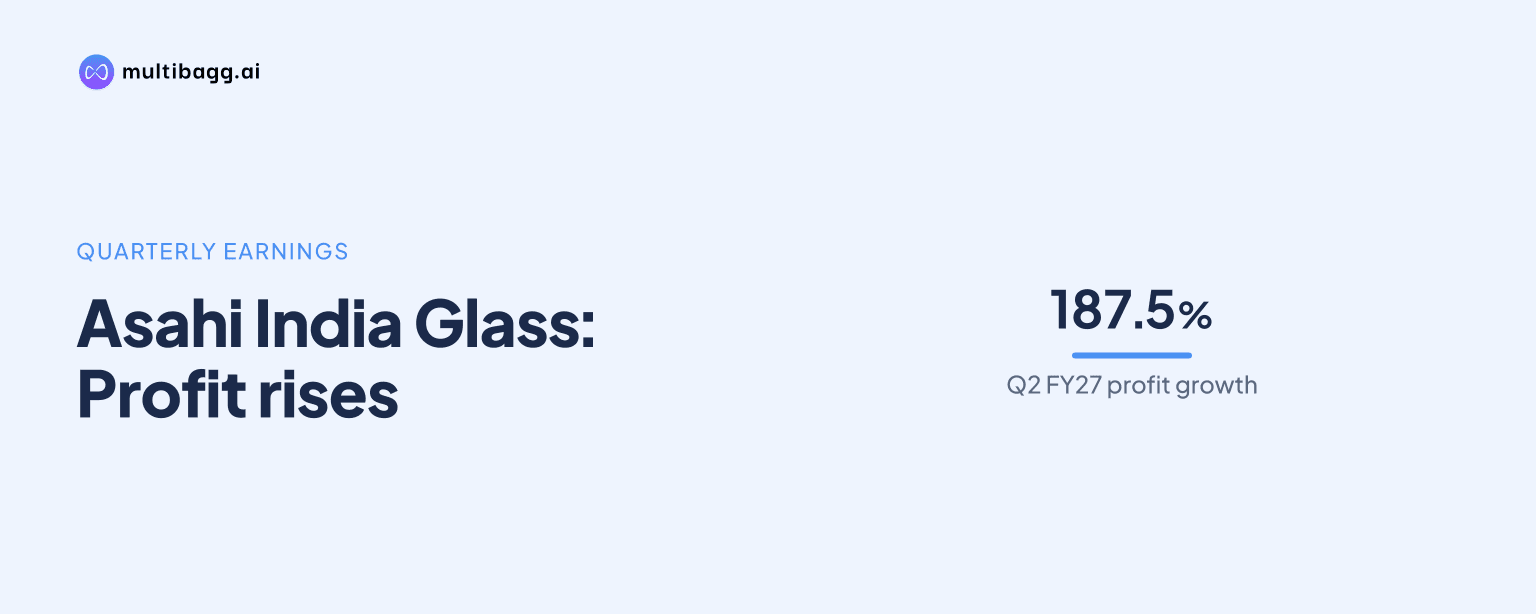
Asahi India Glass Limited reported Q2 FY27 consolidated profit after tax of ₹167.3 crore, up 187.5% year on year, as higher passenger vehicle demand and capacity additions lifted income and operating profitability. The quarter ended September 30, 2026, was described by management as the company’s best-ever quarterly financial performance.
Know Asahi India Glass inside out
Results, valuation, peers and who's buying, in one view.
What did AIS report for Q2 FY27?
AIS reported consolidated total income of ₹1,591.0 crore for Q2 FY27, a 36.9% increase from ₹1,162.2 crore in the year-ago quarter and a 12.1% rise from ₹1,419.1 crore in Q1 FY27. Consolidated profit after tax rose to ₹167.3 crore from ₹58.2 crore in Q2 FY26 and was 12.2% higher than ₹149.1 crore in the preceding quarter.
Operating performance improved at a faster pace than income. EBITDA increased 76.4% year on year to ₹351.4 crore from ₹199.2 crore, while the EBITDA margin expanded by 500 basis points to 22.1% from 17.1%. The PAT margin was 10.5% in the quarter.
What drove AIS’s Q2 FY27 growth?
Higher demand from Indian passenger vehicle original equipment manufacturers was the principal driver of AIS’s Automotive Glass business, which generated revenue of ₹1,065.9 crore, up 30.8% from ₹814.9 crore a year earlier. The company said it stabilised glass supplies for 12 new passenger vehicle model launches during the quarter.
Other businesses also reported growth. Float Glass revenue rose 58.4% year on year to ₹608.1 crore, while revenue in the Others segment increased 29.8% to ₹244.3 crore. Chairman and Managing Director Sanjay Labroo attributed the record quarter to sustained value addition and integration strategies.
The combination of stronger volumes and improved operating margins is important because the profit increase outpaced total-income growth. AIS reported that its integrated approach and higher value-added product mix supported quarterly profitability, though the company did not provide a separate financial contribution from each operational initiative.
Got a follow-up? Ask IRIS
Which capacity projects supported AIS operations?
AIS commissioned Phase III tempered glass operations at Patan, Gujarat, and expanded laminated glass-line capacity in Chennai during Q2 FY27. These projects coincided with the ramp-up of supplies for new passenger vehicle models, expanding the company’s ability to serve automotive customers.
Tempered and laminated glass are central products for vehicle applications, and the additions come as passenger vehicle manufacturers have continued to introduce new models. The company linked the quarter’s Automotive Glass revenue growth to higher volumes across Indian passenger vehicle OEMs.
The capacity steps also form part of AIS’s stated strategy of value addition and vertical integration across automotive and architectural glass. Management reaffirmed this strategy alongside the results, identifying structural growth opportunities in both segments without disclosing new financial targets or a timetable for further projects.
How does the Q2 performance affect AIS investors and the glass industry?
For investors, the results show a substantial improvement in both earnings and margins. Q2 FY27 profit after tax was nearly three times the year-ago level, while EBITDA margin rose to 22.1%. Total income also increased sequentially by 12.1%, indicating that the stronger performance extended beyond a comparison with the relatively lower base of Q2 FY26.
The first-half figures provide additional context. For H1 FY27, AIS reported consolidated total income of ₹3,010.1 crore, up 25.3% year on year, and net profit of ₹316.4 crore, up 180%. The Q2 result accounted for more than half of first-half profit after tax.
The results also underline the importance of automotive production volumes to AIS’s operating performance. Automotive Glass was the largest reported segment by quarterly revenue, and the company’s new capacity and vehicle-model launches were directly associated with its growth. No share-price movement or market valuation data was provided with the results.
Conclusion
AIS delivered stronger Q2 FY27 financial performance through higher automotive volumes, growth across other reported segments and improved margins. Total income rose to ₹1,591.0 crore, EBITDA reached ₹351.4 crore and profit after tax climbed to ₹167.3 crore, while Patan and Chennai capacity initiatives supported the operational expansion.
The next points to watch are the ramp-up of the newly commissioned tempered and laminated glass capacity, demand from passenger vehicle OEMs and the company’s ability to sustain value addition and vertical integration. AIS has confirmed supplies for 12 new vehicle model launches, but did not disclose further capacity targets or specific future financial guidance.