










Asarfi Hospital cancer revenue falls as occupancy hits 40%
Key highlights
- Asarfi Hospital’s cancer unit revenue fell by Rs 30 lakh year on year to Rs 11.6 crore in Q2’FY27.
- Surgical oncology revenue declined 56% and radiation oncology revenue declined 18% in Q2’FY27.
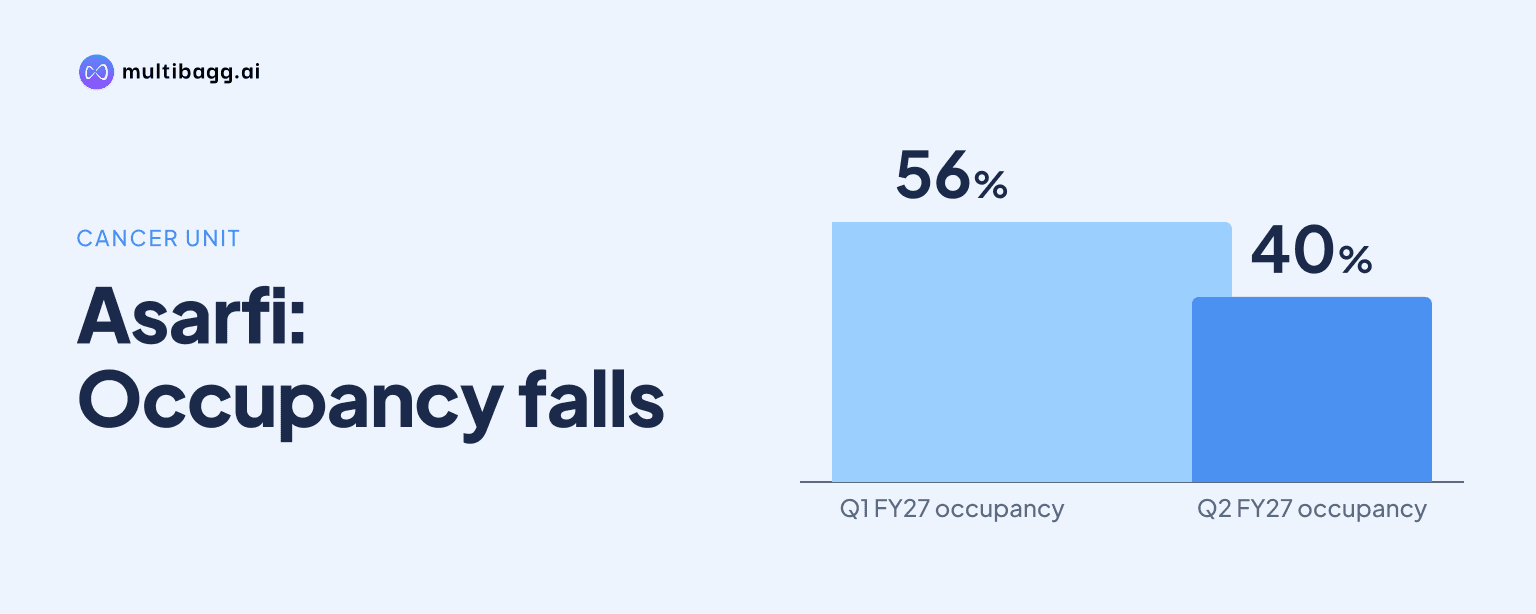
- Cancer hospital occupancy fell to 40% in Q2’FY27 from 56% in Q1’FY27, with capacity unchanged at 65 beds.
- Haemato oncology grew 46% and head-and-neck oncology grew 43% year on year in Q2’FY27.
powered by IRIS
Asarfi Hospital Limited’s cancer hospital unit recorded Rs 11.6 crore of revenue in Q2’FY27, down from Rs 11.9 crore a year earlier, as surgical oncology revenue fell 56%, radiation oncology declined 18% and occupancy dropped to 40%. Asarfi Hospital’s medical oncology revenue still grew 4% and accounted for 58% of the unit’s mix.
Know Asarfi Hospital inside out
Results, valuation, peers and who's buying, in one view.
Why did Asarfi Hospital’s cancer revenue fall in Q2’FY27?
Asarfi Hospital’s cancer revenue fell because declines in surgical and radiation oncology outweighed growth in medical, haemato and head-and-neck oncology. Cancer hospital revenue was Rs 11.6 crore in Q2’FY27 versus Rs 11.9 crore in Q2’FY26, a reduction of Rs 30 lakh. The presentation provides no separate cancer-unit revenue figure for Q1’FY27.
The cancer unit’s direction differed from the group result in the same period. Asarfi Hospital’s consolidated revenue increased 18.1% year on year to Rs 53.04 crore in Q2’FY27 from Rs 44.89 crore, while earnings before interest, tax, depreciation and amortisation, or EBITDA, rose 34.0% to Rs 11.89 crore. The cancer business therefore did not match the company’s consolidated revenue growth.
Revenue per occupied bed was broadly unchanged year on year. The cancer unit’s average revenue per occupied bed, or ARPOB, was Rs 50,572 in Q2’FY27, compared with Rs 50,614 in Q2’FY26, while its capacity remained 65 beds. The reported revenue decline occurred alongside lower occupancy rather than a decline in ARPOB versus the prior-year quarter.
Which cancer specialties changed Asarfi Hospital’s revenue mix?
Asarfi Hospital’s medical oncology remained its largest cancer revenue stream, contributing 58% in Q2’FY27 and growing 4% year on year. Its share increased from 54% in Q2’FY26, making medical oncology a larger part of a cancer revenue base that fell by Rs 30 lakh.
Surgical oncology showed the largest decline, with revenue down 56% year on year and its mix contribution falling to 6% from 14%. Radiation oncology revenue declined 18%, and its contribution reduced to 16% from 19%. Together, those two specialties represented 22% of Q2’FY27 cancer revenue, compared with 33% a year earlier.
Haemato oncology revenue grew 46% and its share rose to 10% from 6%, while head-and-neck oncology grew 43% and increased to 7% from 5%. Other revenue, including nuclear medicine, grew 86% but contributed 3% of Q2’FY27 cancer revenue. These faster-growing lines were smaller than medical oncology and did not offset the declines in surgical and radiation services.
How dependent was Asarfi Hospital on medical oncology?
Asarfi Hospital’s top three cancer specialties accounted for 84% of Q2’FY27 revenue, up from 80% in Q2’FY26. This four-percentage-point increase in concentration came as the unit’s total revenue declined to Rs 11.6 crore.
Medical oncology’s 58% share was more than half of the cancer unit’s Q2’FY27 revenue and followed 4% year-on-year growth. Surgical oncology, in contrast, supplied only 6% after its 56% revenue decline. The specialty mix shows that medical oncology became more consequential to the unit’s revenue base.
Haemato and head-and-neck oncology jointly represented 17% of Q2’FY27 cancer revenue, up from 11% in Q2’FY26. Surgical and radiation oncology jointly fell to 22% from 33%. The presentation reports the mix movement but does not state why demand, treatment volume or referral patterns changed by specialty.
Got a follow-up? Ask IRIS
What happened to Asarfi Hospital’s cancer occupancy and ARPOB?
Asarfi Hospital’s cancer hospital occupancy fell to 40% in Q2’FY27 from 56% in Q1’FY27 and 46% in Q2’FY26, with capacity unchanged at 65 beds. The quarter therefore brought a 16-percentage-point sequential decline and a six-percentage-point year-on-year decline in reported occupancy.
Cancer ARPOB recovered 59% sequentially to Rs 50,572 in Q2’FY27 from Rs 31,892 in Q1’FY27. It remained almost level with Rs 50,614 in Q2’FY26, and Asarfi Hospital reported 0% year-on-year ARPOB growth. The sequential recovery in revenue per occupied bed did not prevent occupancy from falling.
Asarfi Hospital calculates occupancy using effective beds. Across both hospital units, physical capacity was 350 beds in Q2’FY27, while effective beds totalled 297. The company does not disclose the cancer hospital’s effective-bed count separately, so the 40% occupancy figure cannot be converted into a separately verified occupied-bed total from the presentation.
How did the cancer unit compare with Asarfi Hospital’s wider patient activity?
Asarfi Hospital’s combined inpatient, or IPD, volume rose 13% year on year to 4,429 in Q2’FY27, while outpatient, or OPD, volume rose 25% to 41,285. These metrics cover both hospital units and cannot be used to identify patient volumes at the cancer hospital alone.
Combined IPD revenue rose 17% to Rs 44.00 crore, and OPD revenue increased 39% to Rs 8.87 crore in Q2’FY27. In the preceding Q1’FY27, IPD revenue was Rs 39.35 crore and OPD revenue was Rs 7.53 crore. The company-wide patient and revenue trends contrast with the cancer unit’s year-on-year revenue decline.
The cancer hospital’s average length of stay was 4.5 days in Q2’FY27, compared with 4.6 days at the super-specialty hospital unit. The super-specialty unit reported 64% occupancy on 285 beds and ARPOB of Rs 23,716, versus 40% occupancy and ARPOB of Rs 50,572 at the cancer unit. The two units therefore had different utilisation and revenue-per-occupied-bed profiles.
Conclusion
Asarfi Hospital’s cancer hospital delivered Rs 11.6 crore of Q2’FY27 revenue, below Rs 11.9 crore a year earlier, as surgical and radiation oncology contracted sharply. Growth in haemato oncology, head-and-neck oncology and medical oncology changed the revenue mix, but medical oncology’s 58% contribution also increased the unit’s reliance on its largest specialty. Lower occupancy at 40% accompanied the revenue decline, despite ARPOB returning close to its prior-year level.
The next quarterly update will show whether cancer occupancy improves from 40% and whether surgical and radiation oncology stabilise. Management disclosed outreach to 1,500 doctors across Jharkhand and parts of West Bengal, promotional expansion from seven districts to 10 districts, insurer tie-ups, health camps and outreach clinics. The presentation does not disclose a separate cancer-unit revenue target, occupancy target or timetable for restoring growth in the declining specialties.