










Swastika Castal Limited keeps seven quality gates in-house
Key highlights
- SCL performs seven of eight quality gates in-house, with non-destructive testing and dispatch handled by partners.
- Every SCL pressure part is helium leak-tested in one of four mass-spectrometer chambers.
- SCL can sand-cast components up to 250 kg, versus 80 kg for gravity die casting and 70 kg for centrifugal casting.
- More than 70% of SCL's portfolio serves power transmission and distribution, while exports were 41% of FY26 revenue.
powered by IRIS
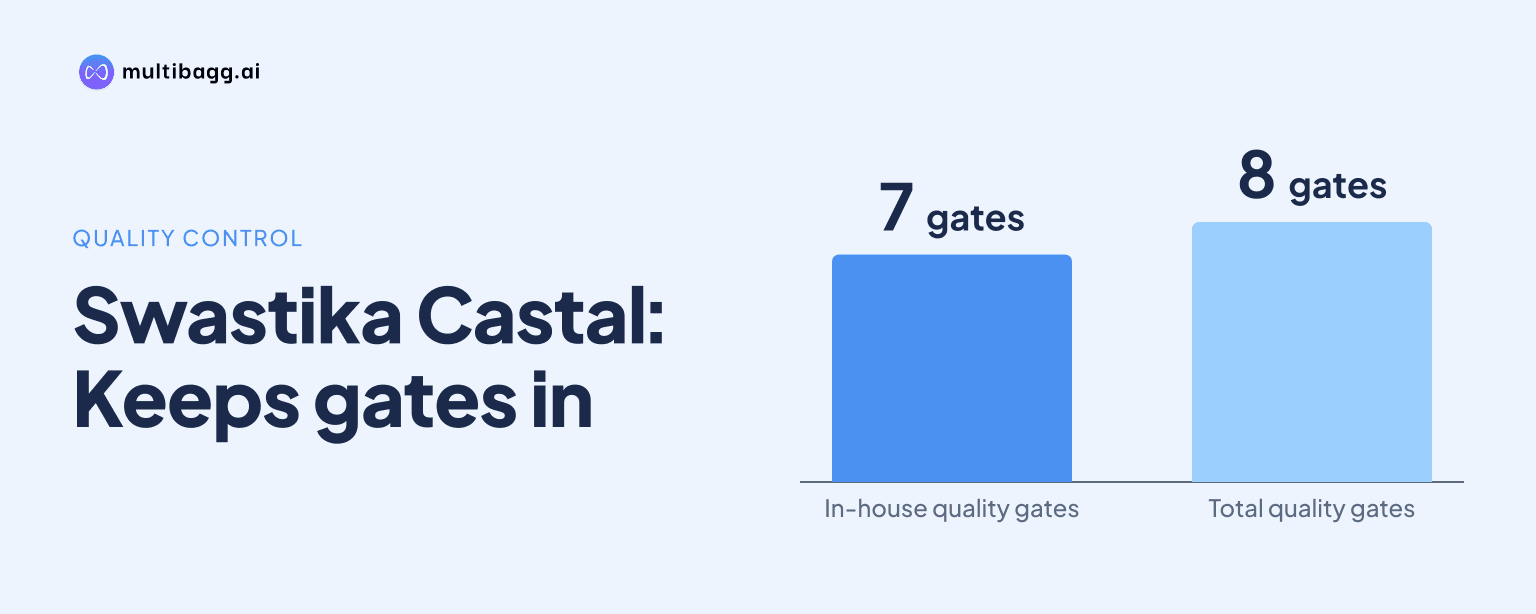
Swastika Castal Limited keeps seven of eight quality gates in-house at its Karjan, Vadodara plant, including helium mass-spectrometer testing of every pressure part, while outsourced X-ray and ultrasonic testing remain its stated process gap. The system spans three casting routes, T6 heat treatment and computer numerical control (CNC) machining for leak-tested aluminium components.
Know Swastika Castal inside out
Results, valuation, peers and who's buying, in one view.
How does SCL make leak-tested components?
SCL makes ready-to-assemble, leak-tested aluminium components for high-voltage switchgear and instrument transformers by casting, heat-treating, machining and validating them at one Karjan plant. The presentation identifies sealing faces, bores, threads and O-ring grooves as machining features, while finished parts serve gas-tight, current-carrying and mechanism-critical positions where one defect can stop a substation.
SCL describes a progression from commodity casting to validated pressure parts. An as-cast item is sold by weight with a chemistry-only specification, whereas an engineered casting is heat-treated and certified for soundness and mechanical properties; a precision component then receives CNC machining, and a validated pressure part receives helium leak testing, traceability and original equipment manufacturer (OEM) documentation. SCL says value added per kilogram and customer switching cost increase across those stages.
More than 70% of SCL's product portfolio serves power transmission and distribution, and its core includes more than 30 switchgear and transformer components. The company says it has more than 100 developed components across more than eight product divisions, alongside products for textile machinery, rail and diesel cooling, pump and valve bodies, and oil and gas. Its stated customer-approval cycle before serial supply is 12 to 36 months.
What are SCL's eight process steps and quality gates?
SCL has eight process steps and eight associated quality gates, of which seven are in-house and the final non-destructive testing and dispatch gate is handled with partners. The in-house sequence starts with melt chemistry and proceeds through melt treatment, moulding, pouring and fettling, T6 heat treatment, CNC machining, and helium leak testing.
At the melt stage, optical emission spectrometer testing checks silicon, magnesium, iron and titanium against alloy limits. Degassing and grain refinement are followed by a density-index reduced-pressure test intended to confirm low hydrogen. For moulding, SCL's sand laboratory checks grain fineness, moisture and permeability, and after pouring and fettling it conducts a first-off visual and dimensional check.
The heat-treatment gate uses a T6 cycle comprising solution treatment, quenching and ageing over eight to 12 hours, with hardness and tensile tests conducted on coupons. CNC-machined parts are inspected against the OEM drawing. At the leak-test stage, four helium mass-spectrometer chambers test every pressure part to the customer's leak limit, rather than testing only a sample.
Got a follow-up? Ask IRIS
Which casting route does SCL use for each part?
SCL matches sand casting, gravity die casting and centrifugal casting to a part's geometry, weight and pressure duty. Sand casting handles components up to 250 kg, compared with up to 80 kg for gravity die casting and up to 70 kg for centrifugal casting, giving the company three distinct production envelopes.
Sand casting uses bonded-sand moulds and cores to form internal passages, and SCL identifies breaker and current-transformer housings, drive housings and large covers as typical applications. The company says large housings can be cast in one piece, reducing bolted joints and potential leak paths. This is its highest stated component-weight capability at 250 kg.
Gravity die casting pours alloy into a reusable steel mould and is used for terminal connectors, contact holders and repeat precision parts. SCL cites a T6 minimum tensile strength of 290 megapascals for an illustrative EN AC-42100 aluminium-silicon-magnesium alloy, stating this is 26% above sand casting. The stated comparison is based on EN 1706 minimum values using separately cast test bars, not a claim about every production part.
Centrifugal casting spins the mould as metal freezes from the outside inward. SCL says rotation drives dense metal toward the wall while oxides and gas move toward the bore, which is subsequently machined away; its typical outputs include flange and adapter rings, insulator inserts and cylinders. The route is specified for components up to 70 kg and is presented as suitable for high-density engineered parts.
What remains outside SCL's factory control?
X-ray radiography and ultrasonic testing remain outsourced to third-party laboratories, making non-destructive testing and dispatch the one quality gate outside SCL's direct plant operations. Certificates from those partner labs travel with each lot, according to the presentation, after any X-ray or ultrasonic test and painting work.
This differs from the preceding seven gates because SCL performs chemistry, density, sand, dimensional, mechanical, machining and leak checks within the Karjan facility. SCL says that keeping seven gates at one plant allows a leak to be traced back to a heat, mould and machining set-up. That is a stated traceability mechanism, rather than a disclosed defect-rate measure.
SCL identifies digital radiography as the remaining capability it could bring in-house. The presentation says that internal digital radiography would close the last gate and shorten first-article cycles for new OEM part numbers, but it does not give a spending amount, installation date or committed implementation schedule. Ultrasonic testing is also listed as outsourced today.
How does the production system fit SCL's commercial mix?
SCL's integrated production system supports its focus on electrical equipment and power transmission, which account for more than 70% of its portfolio, while also serving railways, automotive, oil and gas, industrial machinery and textiles. Its components are supplied to 11 marquee OEMs, and SCL reports that exports represented 41% of financial year 2026 (FY26) revenue.
SCL was incorporated in 1996 and listed on the BSE SME platform in July 2025. Its FY26 total income was Rs 36.19 crore, with a 17.17% earnings before interest, tax, depreciation and amortisation margin and a 9.07% profit after tax margin. The presentation does not allocate revenue or margin by casting route, customer or quality gate.
Management said in its first-half financial year 2027 (H1 FY27) commentary that it plans to increase the share of machined and value-added products and has ample headroom to scale volumes within existing capacity. It also referred to a planned capacity expansion in upcoming periods, without providing capacity tonnage, capital expenditure or a timetable. The disclosed order book is more than Rs 20 crore.
Conclusion
SCL's manufacturing model combines three casting routes with internal controls from alloy chemistry through machining and helium testing. The 250 kg sand-casting limit, compared with 80 kg for gravity die casting and 70 kg for centrifugal casting, shows how production routes are separated by geometry and component requirements, while more than 70% of the portfolio remains linked to power transmission and distribution.
The next disclosed issue to watch is whether SCL moves digital radiography in-house, which management says would close the last outsourced gate and shorten first-article cycles for new OEM part numbers. Investors can also track the planned capacity expansion and management's stated objective to raise the share of machined, value-added products against the more-than-Rs 20 crore order book and the 12-to-36-month OEM approval cycle.