










Swastika Castal Limited Cites 1.9x Faster Grid Build-Out
Key highlights
- India’s plan requires 136 GVA of annual substation additions in 2024–32, versus 73 GVA achieved in 2017–22.
- National substation capacity is targeted to reach 2,342 GVA by 2032, up 87% from 1,251 GVA.
- Hitachi Energy India reported a Rs 32,222 crore backlog in June 2026, while GE Vernova T&D India cited about Rs 20,930 crore.
- SCL’s export revenue rose 41% in FY26 to Rs 14.5 crore, while domestic revenue rose about 5% to Rs 20.9 crore.
powered by IRIS
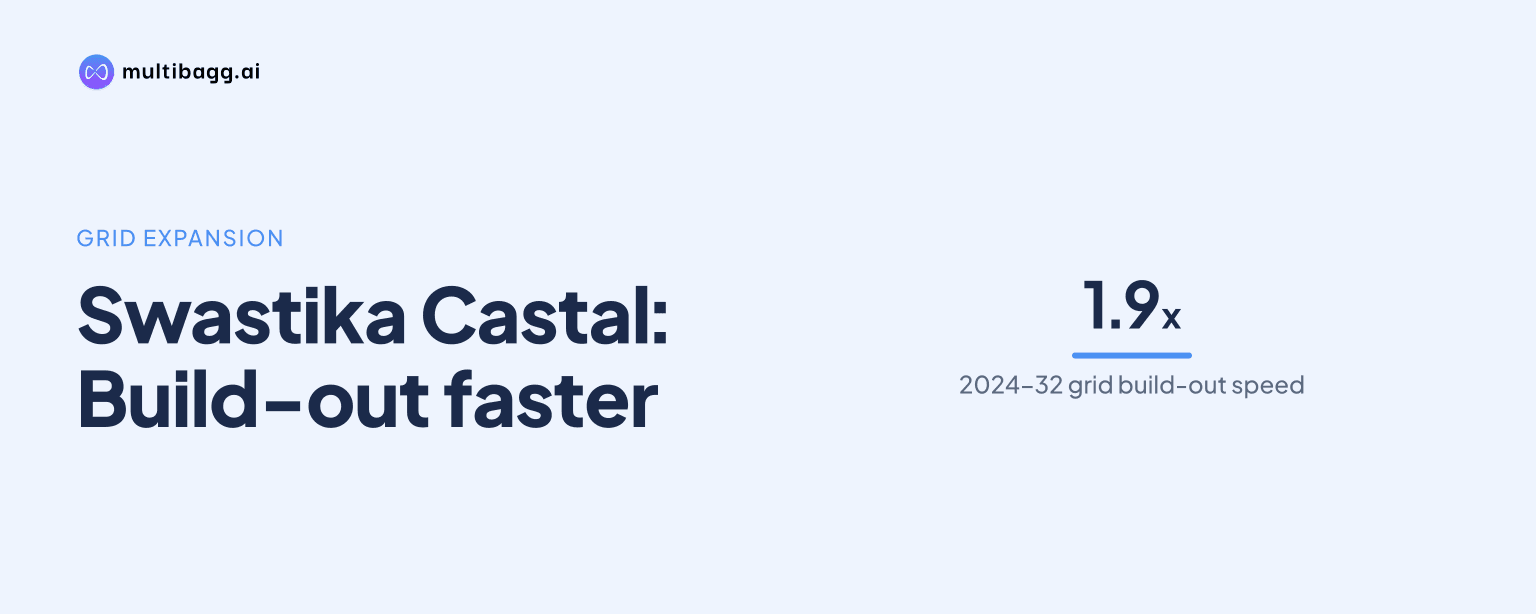
Swastika Castal Limited says India must add 136 gigavolt-amperes (GVA) of substation capacity each year during 2024–32, about 1.9 times the 73 GVA annual pace achieved in 2017–22. The comparison supports a National Electricity Plan target to increase national substation capacity from 1,251 GVA to 2,342 GVA by 2032.
Know Swastika Castal inside out
Results, valuation, peers and who's buying, in one view.
Why does SCL cite a faster substation build-out?
SCL cites a faster build-out because the National Electricity Plan (Transmission), 2023–32 requires annual substation-capacity additions of 136 GVA in 2024–32, compared with 73 GVA achieved annually in 2017–22. The required rate is 63 GVA higher per year and approximately 1.9 times the earlier pace. SCL labels both annual figures as derived calculations.
The required pace reflects the national capacity target rather than SCL’s own orders. The plan targets 2,342 GVA of substation capacity by 2032, an 87% increase from 1,251 GVA. That represents an addition of 1,091 GVA across the period covered by the stated starting level and target.
What infrastructure does India’s 2032 transmission plan include?
India’s 2032 plan includes Rs 9.15 lakh crore of central and state transmission investment, 6.48 lakh circuit kilometres of lines and 33.25 gigawatts (GW) of new high-voltage direct current, or HVDC, capacity. Transmission-line length is planned to rise from 4.85 lakh circuit kilometres to 6.48 lakh circuit kilometres, an addition of 1.63 lakh circuit kilometres.
The plan also provides for nine new HVDC systems and an increase in inter-regional transfer capacity to 168 GW from 119 GW. The resulting 49 GW increase in inter-regional capacity is separate from the stated 33.25 GW of new HVDC capacity, indicating additions across several parts of the transmission network.
SCL links this activity to gas-insulated switchgear, or GIS, equipment and its build-to-print model. Under that model, the original equipment manufacturer owns the design and type test, while SCL provides a qualified, repeatable casting and machining process. SCL says original equipment manufacturer backlogs indicate ecosystem demand rather than its own order book, which it describes as Rs 20+ crore.
How much demand do Indian equipment makers report?
SCL reports that Hitachi Energy India had a record order backlog of Rs 32,222 crore in June 2026, while its Q1 FY27 revenue increased 68.6%. Hitachi Energy India is building its 20th plant at Kadi, Vadodara, which SCL identifies as the taluka where its works started. The backlog is an indication of equipment-sector workload, not revenue booked by SCL.
GE Vernova T&D India had a backlog of about Rs 20,930 crore, or roughly 3.5 times revenue, according to SCL’s presentation. GE Vernova T&D India also exports 400 kilovolt GIS from India to Spain and Morocco. Siemens Energy India reported an order book of Rs 19,330 crore in June 2026, up 16%, with transmission accounting for about 70% of the book and growing 28%.
Other disclosed signals include Siemens Limited’s Rs 333 crore Goa expansion for medium-voltage GIS and clean-air Blue GIS. SCL also cites a Rs 300–400 crore engineering, procurement and construction award in June 2026 for a 400/220/33 kilovolt GIS substation for a Mumbai data-centre client. These examples show data centres among the buyers directly procuring GIS projects.
Got a follow-up? Ask IRIS
How does global GIS growth connect to SCL?
SCL presents global GIS expansion as a second demand context for its casting and machining operations. The global GIS market is shown rising from US$22.0 billion in 2022 to US$26.1 billion in 2024 and forecast to reach US$55.8 billion by 2034, implying a 7.8% compound annual growth rate for 2025–34. GIS is presented as requiring 60–90% less footprint than air-insulated switchgear.
SCL identifies significant original equipment manufacturer backlogs and capacity programmes. Siemens Energy’s Grid Technologies backlog was €51 billion in June 2026, with Q3 FY26 orders up 28% and a 1.48 book-to-bill ratio. GE Vernova’s Electrification equipment backlog was US$40.6 billion in June 2026, up 69% year on year, including more than US$5 billion of data-centre orders in H1 2026.
Hitachi Energy’s global capacity programme totals US$6 billion and includes a 40% expansion of GIS-component capacity at Brno and doubled switchgear and breaker capacity at Mount Pleasant in the United States. SCL’s stated mechanism is that each GIS capacity addition needs qualified casting and machining capacity. Its export revenue rose 41% in FY26 to Rs 14.5 crore, compared with about 5% domestic growth to Rs 20.9 crore.
Conclusion
The combined evidence shows that India’s transmission plan calls for a substantial acceleration in substation additions, from 73 GVA annually in 2017–22 to 136 GVA in 2024–32. Planned investment of Rs 9.15 lakh crore, alongside Indian equipment-maker backlogs ranging from Rs 19,330 crore to Rs 32,222 crore, provides the industry-demand context that SCL links to its qualified casting and machining model.
The next items to watch are progress toward the 2,342 GVA substation-capacity target by 2032, execution of the nine planned HVDC systems and expansion plans disclosed by equipment manufacturers. SCL’s presentation identifies these plans as demand indicators, while maintaining that original equipment manufacturer backlogs are distinct from its Rs 20+ crore order book.