










Swastika Castal Limited: SF6 rules create qualification window
Key highlights
- SCL shows F-gas-free requirements for MV switchgear up to 24 kV beginning in 2026.
- The timetable reaches HV equipment above 145 kV or above 50 kA in 2032 and bars virgin SF6 for servicing in 2035.
- SCL says redesigned switchgear platforms require new part numbers, tooling and supplier-qualification rounds.
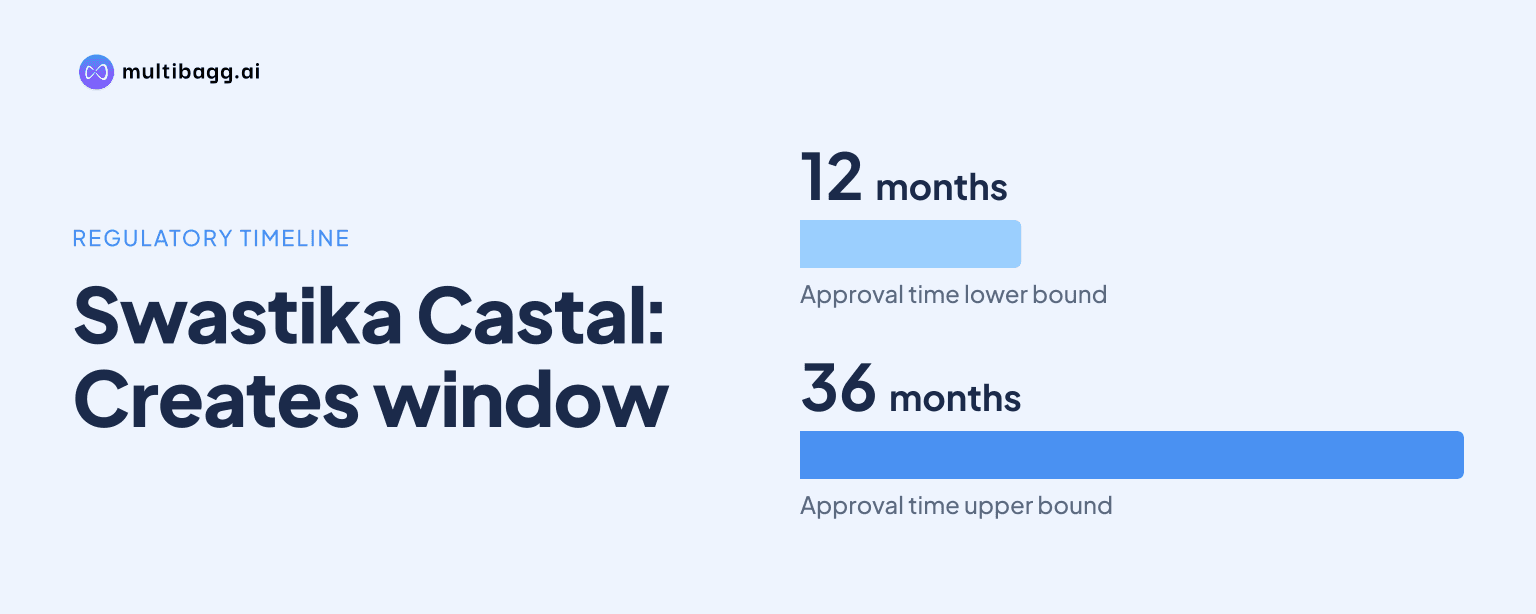
- SCL states that customer approvals can take 12 to 36 months.
powered by IRIS
Swastika Castal Limited says the European Union’s phased SF6 restrictions, starting with F-gas-free medium-voltage equipment up to 24 kilovolts in 2026, can create supplier-qualification work because redesigned switchgear platforms need new part numbers, tooling and approvals before the 2035 limit on virgin SF6 for servicing.
Know Swastika Castal inside out
Results, valuation, peers and who's buying, in one view.
What is SCL's SF6-free switchgear timetable?
SCL’s timetable begins in 2026 for medium-voltage, or MV, switchgear up to 24 kilovolts, or kV, which must be F-gas free. The schedule then moves to high-voltage, or HV, switchgear rated from 52 kV to 145 kV and at or below 50 kiloamperes, or kA, in 2028, when the insulating gas must have a global-warming potential, or GWP, below 1.
SCL shows that the restrictions widen over nine years rather than applying to every voltage class at once. MV equipment from 24 kV to 52 kV is scheduled to become F-gas free in 2030, while the 2032 threshold covers HV equipment above 145 kV or above 50 kA. From 2035, the schedule bars virgin SF6 for servicing.
The presentation also identifies regulatory moves outside the European Union. California is shown phasing out new SF6 equipment over 2025 to 2033, while New York begins its phase-out from 2027. These dates are market context rather than an SCL order forecast, but they support the company’s view that equipment makers are preparing alternative switchgear platforms across more than one geography.
Why do SF6-free switchgear designs change enclosure requirements?
SCL says SF6-free media can require larger or stronger enclosures because clean air with vacuum interrupters and fluoronitrile mixtures insulate less effectively than SF6. Designers can compensate through higher fill pressure or longer insulation distances, making the transition a physical redesign of switchgear equipment rather than a direct gas substitution.
For SCL, the relevant component remains an aluminium pressure vessel whether the equipment uses SF6, clean air or a fluoronitrile mixture. Higher fill pressure can change pressure-vessel requirements, while longer insulation distances can alter enclosure dimensions and associated parts. The company therefore links the 2026, 2028, 2030 and 2032 deadlines to potential changes in casting geometry, tooling and validation.
The distinction between voltage classes matters because a 24 kV MV platform does not necessarily require the same enclosure design as an HV product above 145 kV. SCL does not state that existing castings will automatically transfer to SF6-free designs. Its stated mechanism is that each redesigned platform can generate new pressure-part specifications and associated supplier-approval work.
How can switchgear redesigns create qualification work for SCL?
SCL says every redesigned switchgear platform brings new part numbers, new tooling and a new supplier-qualification round. The company calls this a design-in window, under which an aluminium pressure-part supplier that is approved for the revised platform may supply the enclosure for that generation of switchgear.
The presentation states that customer approval can take 12 to 36 months. That period is relevant because a redesigned pressure-tight casting requires customer validation of both the part and the manufacturing process before series production. The stated opportunity is consequently conditional on SCL being selected, completing qualification and retaining the supply position after approval.
SCL also says a customer supplier change can involve revalidation, delays and operational risk. This explains why the company describes approval cycles as an entry barrier, but it does not establish that SCL has already won an SF6-free programme. The presentation discloses a qualification mechanism and not a named customer award, platform nomination or revenue target from SF6-free switchgear.
Got a follow-up? Ask IRIS
Which OEM actions support SCL's qualification thesis?
SCL identifies several original equipment manufacturer, or OEM, actions that indicate deployment or capacity building for alternatives to SF6. Siemens Energy’s clean-air Blue gas-insulated switchgear, or GIS, is on order for Fingrid, Siemens Limited is adding Blue GIS capacity in Goa, Hitachi Energy is building EconiQ component capacity at Brno, and GE Vernova offers g³ technology.
The cited examples extend across different applications and ratings. SCL notes that SSEN is building an SF6-free 400 kV substation, while Siemens Limited’s Goa expansion concerns medium-voltage GIS and clean-air Blue GIS. These examples support the company’s case that alternative-gas switchgear is moving into equipment programmes, although none identifies SCL as the supplier of an enclosure or casting.
India’s transmission programme provides a separate demand backdrop for switchgear. The National Electricity Plan shown by SCL requires 136 gigavolt-amperes, or GVA, of substation capacity additions a year during 2024-32, compared with 73 GVA a year achieved in 2017-22, or about 1.9 times the earlier annual pace. That comparison concerns system build-out, not the probability of an SCL qualification award.
SCL explicitly separates ecosystem demand from its own disclosed order book of more than Rs 20 crore. Customer order books cited in the presentation include Hitachi Energy India’s Rs 322.22 crore backlog in June 2026, GE Vernova T&D India’s approximately Rs 209.30 crore backlog, and Siemens Energy India’s Rs 193.30 crore order book. Those figures indicate OEM activity but are not SCL revenue, backlog or contracted business.
What does the SF6 transition mean for SCL's aluminium casting position?
The SF6 transition means SCL may have opportunities to seek qualification for redesigned aluminium pressure-tight castings, rather than simply supplying unchanged enclosures with a different insulating gas. The potential arises from the combination of lower insulation performance in alternative media, new platform tooling and the 12-to-36-month approval process disclosed by SCL.
The opportunity has defined limits. SCL’s presentation does not disclose the number of SF6-free platforms it is pursuing, any tooling expenditure for those platforms, a named OEM nomination or a production order. Its own order book remains separately described as more than Rs 20 crore, while the cited global and Indian OEM figures are presented as industry demand indicators.
The regulatory sequence also means potential activity may be staggered by product category. The first stated trigger is MV equipment up to 24 kV in 2026, followed by 52-145 kV HV equipment in 2028 and 24-52 kV MV equipment in 2030. As a result, any qualification work would depend on individual OEM redesign schedules and the specifications of each platform.
Conclusion
The combined evidence indicates that SF6-free regulation can alter switchgear hardware as well as the insulating medium. SCL’s case rests on alternative media requiring higher pressure or longer insulation distances, which can lead to revised aluminium pressure vessels, new tooling and fresh supplier approvals. The 2026-35 regulatory timetable provides the timing framework, while OEM product and capacity actions show that alternative platforms are being developed.
The next disclosed milestones are the 2028 GWP-below-1 condition for 52-145 kV HV equipment, the 2030 F-gas-free requirement for 24-52 kV MV equipment and the 2032 extension to HV equipment above 145 kV or above 50 kA. Evidence to watch is SCL-specific: new design-ins, completed 12-to-36-month approvals, tooling programmes or production orders, none of which the presentation currently discloses for an SF6-free platform.