










Swastika Castal H1 FY27 Net Profit Rises 30% to ₹1.71 Crore
Key highlights
- Swastika Castal reported H1 FY27 total income of ₹21.25 crore, up 24% year on year.
- H1 FY27 EBITDA rose 27% to ₹3.34 crore and EBITDA margin increased 44 basis points to 15.71%.
- H1 FY27 net profit rose 30% to ₹1.71 crore, with EPS increasing to ₹2.09 from ₹1.62.
- Operating cash flow was positive at ₹1.04 crore in H1 FY27 versus an outflow of ₹8.72 crore in H1 FY26.
powered by IRIS
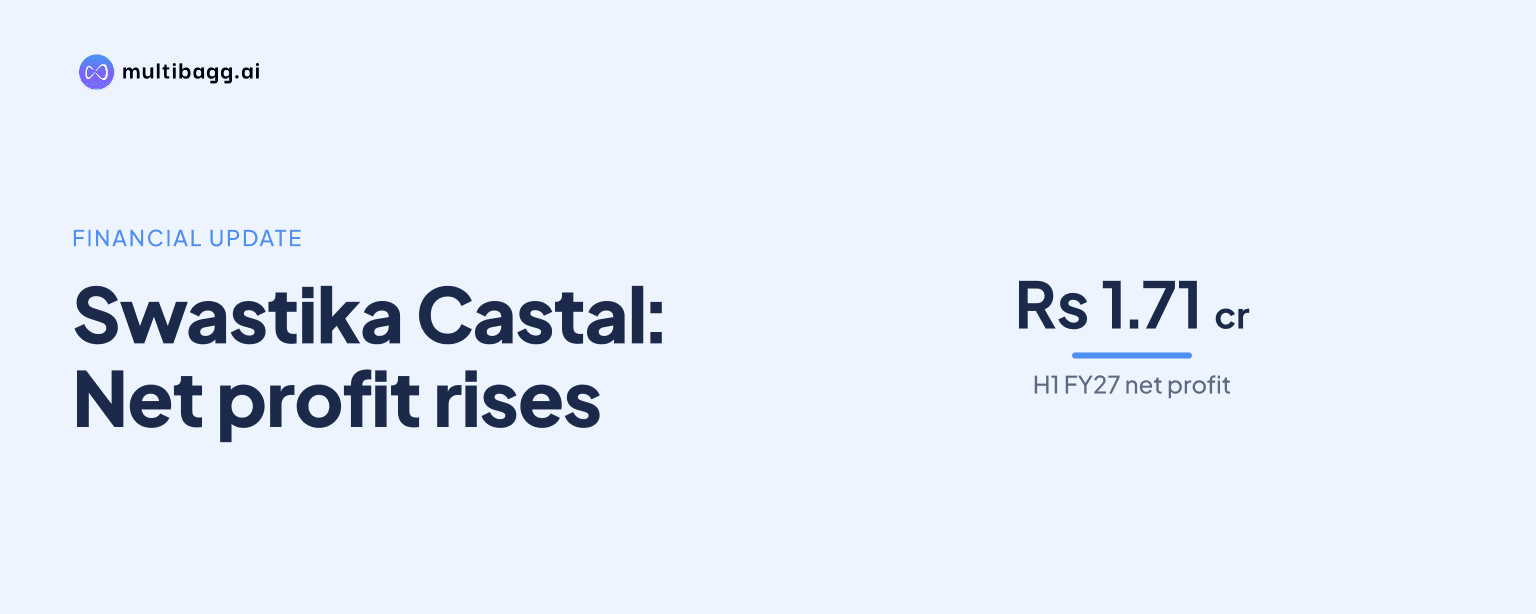
Swastika Castal Limited reported a 30% year-on-year rise in H1 FY27 net profit to ₹1.71 crore, supported by a 24% increase in total income to ₹21.25 crore and a 44-basis-point improvement in EBITDA margin to 15.71%.
Know Swastika Castal inside out
Results, valuation, peers and who's buying, in one view.
What did Swastika Castal report for H1 FY27?
Swastika Castal reported higher income, operating profit and net profit for the half year ended 30 September 2026. The Vadodara-based manufacturer of high-precision aluminium castings posted standalone total income of ₹21.25 crore, compared with the corresponding period a year earlier. EBITDA rose 27% year on year to ₹3.34 crore, while profit after tax increased 30% to ₹1.71 crore.
The company also reported improvement in profitability ratios. EBITDA margin expanded by 44 basis points to 15.71%, and PAT margin rose by 36 basis points to 8.05%. Basic and diluted earnings per share stood at ₹2.09 for H1 FY27, against ₹1.62 in H1 FY26.
A separate reported revenue figure was ₹20.77 crore, up 25.5% year on year from ₹16.54 crore. This differs from total income because total income can include items beyond revenue from operations. The reported figures show that operating growth was accompanied by a modest expansion in margins during the period.
What supported Swastika Castal's earnings growth?
Swastika Castal attributed its performance to demand for precision aluminium castings across its served industries. Managing Director Varun Sharda said demand remained healthy, supported by investment in power transmission, grid modernisation and railway expansion. The company supplies sectors including electrical equipment, railways, automotive, oil and gas, and industrial machinery.
The company said global supply-chain diversification towards Indian manufacturers has also supported export momentum. Its exports to Europe, Mexico and the United States were cited as contributors to demand. Swastika Castal operates an integrated manufacturing facility at Karjan, Vadodara, with in-house heat treatment, machining and testing capabilities.
The reported margin improvement indicates that EBITDA grew faster than total income during H1 FY27. However, the financial update also noted that lower other income and higher finance costs partly offset the improvement at the operating level. This is relevant because net profitability reflects both operating performance and costs outside core manufacturing operations.
Got a follow-up? Ask IRIS
How did operating cash flow change in H1 FY27?
Swastika Castal generated positive cash flow from operating activities of ₹1.04 crore in H1 FY27, compared with an operating cash outflow of ₹8.72 crore in H1 FY26. The swing of ₹9.76 crore marks a material change in reported operating cash generation over the comparable half-year periods.
Cash flow is an important measure alongside profit because manufacturing businesses require funding for inventories, receivables and other working-capital needs. The company reported improved operating cash flow even as its financial update flagged growth in receivables and higher short-term borrowing as working-capital concerns.
Investors will therefore be able to assess both aspects of the result: stronger accounting profit and the return to positive operating cash flow, alongside the movement in customer dues and short-term funding. The disclosed data does not provide a detailed receivable or borrowing balance, so the scale of those changes cannot be quantified from the available information.
What is Swastika Castal's capacity and market position?
Swastika Castal said it has headroom to increase volumes within its existing capacity and plans a capacity expansion by the end of FY27. The plan provides the company with an operational pathway to address additional demand without relying only on its current production base.
The company operates in the castings and forgings industry and is classified as a micro-cap company in the provided market data. Its reported current market price was ₹84.00. No share-price movement linked to the results was disclosed, so the available information does not establish a direct market reaction to the announcement.
Demand drivers identified by management - power infrastructure, grid upgrades, railways and export opportunities - are relevant to aluminium casting suppliers. At the same time, execution of the proposed expansion, working-capital management and finance costs remain relevant operating factors because the company has identified each in its financial and business update.
When will management discuss the H1 FY27 results?
Swastika Castal will hold its H1 FY27 earnings conference call on Saturday, 14 November 2026, at 3:00 PM IST. The call is hosted with Kirin Advisors and is expected to begin with a brief management discussion of the half-year results.
Varun Sharda, Managing Director, is listed as the speaker. The company said its investor presentation will be submitted to the stock exchanges and made available on its website. The call gives investors an opportunity to seek management commentary on demand, exports, capacity expansion and working-capital trends.
Conclusion
Swastika Castal's H1 FY27 results show growth in income, EBITDA and net profit, with reported margin expansion and a shift to positive operating cash flow. Total income reached ₹21.25 crore, EBITDA was ₹3.34 crore and PAT was ₹1.71 crore, while the company continued to cite demand from domestic infrastructure-linked sectors and export markets.
The next disclosed event is the earnings call scheduled for 14 November 2026 at 3:00 PM IST. Investors will watch for management's comments on the planned capacity expansion by the end of FY27, the pace of export demand, and the company's approach to receivables and short-term borrowing.