










Ashiana Housing says newer deliveries can lift margins
Key highlights
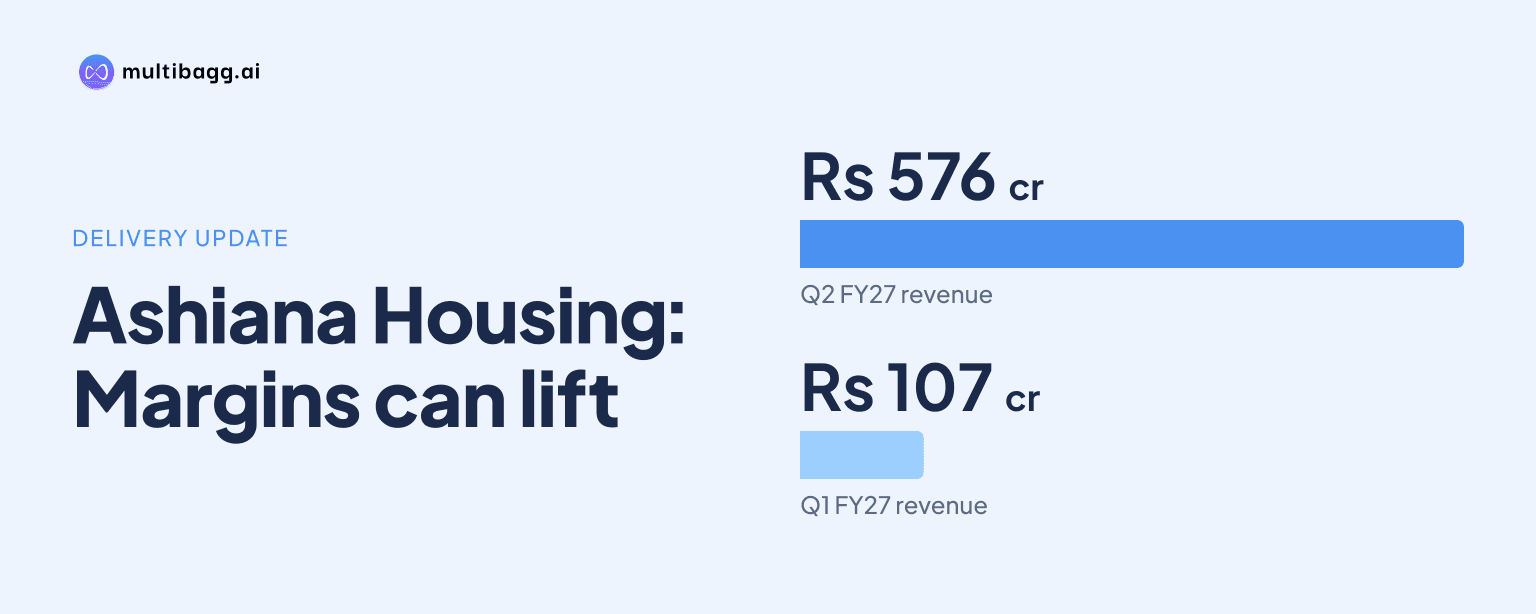
- Ashiana Housing reported Q2 FY27 revenue from operations of Rs 576 crore, versus Rs 107 crore in Q1 FY27.
- Q2 FY27 PAT was Rs 51 crore, compared with Rs 28 crore in Q2 FY26.
- Management said Ashiana Anmol had a 35% revenue share payable to the landlord, plus other land costs.
- Ashiana Housing retained its expectation of more than Rs 250 crore of PAT in FY27.
powered by IRIS
Ashiana Housing Limited said Q2 FY27 margins were held back by legacy land arrangements at Ashiana Anmol, not material construction-cost inflation, and management expects a more favourable H2 FY27 delivery mix to support more than Rs 250 crore of profit after tax, or PAT, for FY27. Q2 PAT was Rs 51 crore.
Know Ashiana Housing inside out
Results, valuation, peers and who's buying, in one view.
Why did Ashiana Housing’s Q2 FY27 margins fall?
Ashiana Housing said Q2 FY27 margin pressure arose principally from deliveries at Ashiana Anmol, which it described as a historical high-land-cost project. An analyst said earnings before interest, tax, depreciation and amortisation, or EBITDA, margin had fallen to 10% from 18% despite a 10% year-on-year rise in realisation, while management said its H1 FY27 EBITDA margin was slightly better than in H1 FY26 according to its data.
The project’s land terms explain the difference, according to management. Ashiana Housing said 35% of Anmol revenue was payable to the landlord, in addition to other land costs, and that construction costs were high relative to the project’s sale price. These project-specific costs affected Q2 FY27, when revenue recognition covered 8.63 lakh square feet and handovers started at Ashiana Amarah Phase 1 and Ashiana Anmol Phase 3 in Gurugram.
Management rejected the view that a broad rise in building costs had reduced profitability between sales booking and delivery. It said there had been no material construction-cost escalation, characterising the issue instead as a historical poor land transaction. That distinction matters because its forecast margin improvement relies on a change in delivered projects rather than an assumed reduction in construction expenses.
How can Ashiana Housing improve margins with similar realisations?
Ashiana Housing said margins can rise even if H2 FY27 delivery realisations are broadly similar because land costs and landlord revenue shares will change. The analyst cited delivery realisations of roughly Rs 6,200 to Rs 6,300 per square foot for H2 FY27, while the company reported Q2 FY27 average booking realisation of Rs 8,813 per square foot, up 20% year on year.
Management identified Ashiana Advik, Ashiana Tarang, Ashiana Ekansh and Ashiana Amodh as projects with better or more normalised margin economics. It said Advik sits on land acquired in 2011 and estimated its land cost at around 5%, though it did not provide a final calculation. For Ekansh, management put the landlord revenue share at about 22.75%, below Anmol’s 35% share.
Ashiana Housing excluded Ashiana Malhar from the broad margin-normalisation argument because it remains a lower-margin project with high land costs and a substantial landlord revenue share. Management nevertheless said it would complete future Malhar phases because the capital needed for the project had already been deployed and further phases would not require material incremental capital.
How did Ashiana Housing perform in Q2 and H1 FY27?
Ashiana Housing reported higher revenue and PAT in Q2 FY27 as Gurugram deliveries increased, with revenue from operations reaching Rs 576 crore and PAT reaching Rs 51 crore. That compared with Rs 107 crore of revenue and Rs 13 crore of PAT in Q1 FY27, and Rs 166 crore of revenue and Rs 28 crore of PAT in Q2 FY26.
H1 FY27 revenue from operations rose 49% year on year to Rs 683 crore from Rs 458 crore in H1 FY26. PAT increased 59% to Rs 64 crore from Rs 40 crore, while pre-tax operating cash flow rose 12% to Rs 259 crore from Rs 231 crore. The first-half PAT was far below the full-year objective because management expects later project deliveries to drive a larger share of FY27 recognition.
Operating indicators also increased in H1 FY27. Value of area booked reached Rs 1,192 crore, up 62% year on year, across 13.07 lakh square feet and 759 units; collections grew 13% to Rs 896 crore. In Q2 FY27, the company booked Rs 834 crore across 9.47 lakh square feet and 525 units, while constructing 7.17 lakh square feet.
Got a follow-up? Ask IRIS
Can Ashiana Housing meet its FY27 PAT target?
Ashiana Housing said it remains confident of exceeding Rs 250 crore of PAT in FY27, assuming planned deliveries take place on schedule. With PAT of Rs 64 crore in H1 FY27, the target requires substantially more profit recognition in the second half, a result management linked to delivery timing and project mix rather than higher selling prices.
Management said Anmol-heavy recognition had depressed the Q2 margin outcome and that newer projects should improve the mix during H2 FY27. It specifically said margins would improve over the second half because projects including Advik, Tarang, Ekansh and Amodh do not carry the same land-cost drag. This is management’s outlook, not a reported FY27 result.
The FY27 target is part of a longer-term delivery schedule. Ashiana Housing said it now plans for around Rs 500 crore of PAT in FY30, while acknowledging that part of its earlier cumulative Rs 2,000 crore PAT objective would shift into FY31. Management said the delay reflects a couple of heavy projects moving into the first quarter of FY31 and estimated the miss at about 15% to 20%.
What could delay Ashiana Housing’s margin recovery?
Ashiana Housing said all projects except Ashiana Swarang appeared on track for delivery as of the November 5, 2026 call. Management did not specify the size or timing of any Swarang postponement, leaving an identified exception to the delivery schedule that supports the Rs 250 crore-plus FY27 PAT expectation.
Management also flagged a possible increase in construction bans in the National Capital Region, or NCR, related to pollution controls. It said the government appeared more pre-emptive than in previous years and that some construction slippage could result. Management nevertheless said the prior two years had broadly progressed according to plan, apart from limited construction-related delays.
The company is simultaneously expanding its senior-living pipeline. Senior living represented more than Rs 9,000 crore of gross development value, or GDV, at the call date, including a Gurugram joint-development-agreement project with estimated GDV of Rs 1,300 crore across 7.25 lakh square feet. Management expects Ashiana Aaranya in Chennai to launch in Q4 FY27 as the first newly acquired senior-living project to reach launch.
Conclusion
Ashiana Housing’s explanation for Q2 FY27 profitability is based on project economics: Anmol’s 35% landlord revenue share, other legacy land costs and its construction-cost structure weighed on margins. Q2 revenue of Rs 576 crore and PAT of Rs 51 crore show that deliveries increased reported earnings, while the projected margin recovery depends on deliveries shifting to projects with lower land-cost burdens.
The next test is H2 FY27 execution, including whether all scheduled projects apart from the stated Swarang exception are delivered on time. Management’s disclosed milestones are more than Rs 250 crore of FY27 PAT, the Q4 FY27 launch of Ashiana Aaranya, and around Rs 500 crore of PAT in FY30, while the cumulative Rs 2,000 crore PAT goal is now expected in H1 FY31.