










Ashiana targets Rs 1,500 crore senior-living pre-sales by FY30
Key highlights
- Ashiana targets Rs 1,500 crore of annual senior-living pre-sales in FY30, compared with Rs 154 crore in FY23.
- Ashiana has more than Rs 9,000 crore of signed senior-living GDV and targets another Rs 8,000 crore to Rs 9,000 crore in 24 to 30 months.
- Senior-living bookings were Rs 310 crore in the first half, against Ashiana’s current-year objective of more than Rs 700 crore.
- Management expects senior-living gross margins to be around 5 percentage points above regular housing through market cycles.
powered by IRIS
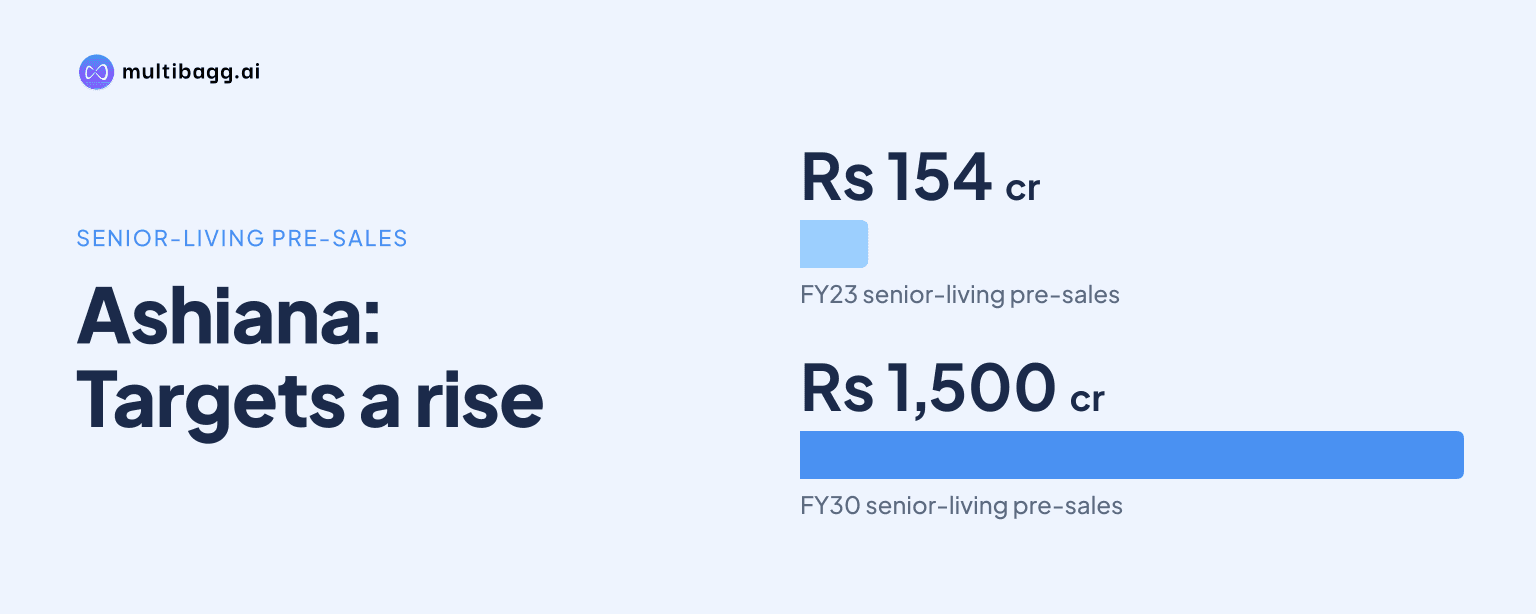
Ashiana is targeting Rs 1,500 crore of annual senior-living pre-sales in FY30, compared with Rs 154 crore in FY23, supported by more than Rs 9,000 crore of signed gross development value and plans to add Rs 8,000 crore to Rs 9,000 crore of further projects over 24 to 30 months.
Know Ashiana Housing inside out
Results, valuation, peers and who's buying, in one view.
What is Ashiana’s FY30 senior-living pre-sales target?
Ashiana’s FY30 target is Rs 1,500 crore of annual senior-living pre-sales. Management chose to express the strategy in absolute sales rather than as a percentage of company business, comparing the objective with Rs 154 crore of senior-living pre-sales achieved in FY23.
The nearer-term sales trajectory is also rising. Ashiana said senior-living pre-sales were more than Rs 570 crore last year and that it is looking to cross Rs 700 crore in the current year. First-half booking value was Rs 310 crore, and management said it remained on track for that annual objective.
The target implies that launches must convert the project base into bookings. Management identified Ashiana Aaranya in Chennai as the key new project for the current year, alongside phase launches at Ashiana Advik, Ashiana Swarang and Ashiana Amodh.
How large is Ashiana’s senior-living project pipeline?
Ashiana has more than Rs 9,000 crore of signed senior-living gross development value, or GDV. GDV refers to the expected development sales value of projects, rather than reported revenue or bookings, so the figure represents a base for future launches rather than completed sales.
Management is seeking another Rs 8,000 crore to Rs 9,000 crore of senior-living GDV over the next 24 to 30 months. It said it was in active discussions on much of that potential pipeline, but those discussions are not signed projects and therefore remain an acquisition target.
The next step is launching the acquired projects. Ashiana Aaranya in Chennai is expected to be the first newly acquired senior-living project launched after a two- to three-year gap, with high-end villas planned for its first phase.
Management said Ashiana is mostly through the approvals process for Ashiana Aaranya, although some permissions remain pending. It expects a launch in the next quarter, making the remaining approvals a direct execution point for the current-year goal of more than Rs 700 crore in pre-sales.
Which markets and products will support Ashiana’s expansion?
Ashiana identified Chennai, the National Capital Region, or NCR, the Mumbai-Pune region and Bengaluru as its principal current senior-living opportunity areas. Hyderabad is under consideration, but management said it was later in the plan and that Ashiana is looking to appoint a business-development executive there.
Chennai is Ashiana’s largest senior-living market by both senior-living revenue and area sold, according to management. It said this market depth supported another Chennai launch, Ashiana Aaranya, after Ashiana Vatsalya Phase 3 sold well at better pricing than Phase 2.
Ashiana has created two product formats: Active Senior Living and Sophisticated Senior Living. Management described Sophisticated Senior Living as a higher-price-point offering, with the first project launched in Chennai, another planned in Chennai, a third planned in Panvel and a higher-end project contemplated in Gurugram.
The Mumbai-Pune opportunity is intended to serve customers beyond Pune alone. Management cited Ashiana’s Talegaon project, where roughly half of buyers are from Mumbai and half from Pune, while a Bengaluru project could launch late next financial year or in the first half of FY29 if its condition precedent is signed in the current financial year.
Got a follow-up? Ask IRIS
Why does Ashiana expect senior living to add profit?
Ashiana’s management expects senior living to deliver gross margins around 5 percentage points above regular housing through market cycles. It attributed the expected difference to senior living’s more difficult supply expansion, while noting that conventional housing has recently benefited from premiumisation and an upcycle.
Management said reported profits from the regular-housing margin expansion should emerge year by year as pre-sales are reflected in the accounts. Its view that senior-living margins will be more stable is an assessment, rather than a reported financial outcome, based on its expectation that oversupply is less likely in the segment.
Sophisticated Senior Living is expected to have a broadly similar long-term margin profile, with management suggesting it could be 2 to 3 percentage points higher. The format has higher land and construction costs, but also higher sales prices and ticket sizes, which management said should create a larger absolute profit pool.
Management said senior living could become Ashiana’s largest business component by profits beyond FY30. It expects the segment to take a larger share of incremental capital and management attention, with land and project deals accounting for a large part of capital deployment.
What does Ashiana see as its senior-living advantage?
Ashiana says its differentiator is a 22-year senior-living record, beginning with its first launch in 2004. Management said senior buyers tend to be risk averse and value an operator with experience in running senior-living communities, which it considers important to the brand proposition.
The company said sales, design, construction and maintenance differ from conventional housing. Management also said the sales channel has a limited role because most sales are direct through referrals, although it did not disclose a numerical split between referrals and other booking sources.
Ashiana permits ownership by any buyer but restricts residency in these projects to seniors. Management said it has not encountered a resale constraint, citing good resale markets, higher rental prices and occupancy, but it did not provide figures for prices, rents or occupancy.
Management said larger developers may show more interest in Gurugram because regulatory provisions have unlocked some land opportunities. Its position is that the category remains too small for larger developers to commit extensively, while its claimed lead in unit volumes, annual sales and available GDV was not supported by disclosed market-share data.
Conclusion
Ashiana’s plan combines a Rs 1,500 crore FY30 pre-sales target with more than Rs 9,000 crore of signed GDV and a further Rs 8,000 crore to Rs 9,000 crore acquisition objective. From Rs 154 crore of pre-sales in FY23, management expects senior living to become a larger contributor to sales and potentially its largest profit contributor beyond FY30.
The next item to watch is the expected next-quarter launch of Ashiana Aaranya in Chennai, where some approvals are still pending, and its contribution toward the current-year target of more than Rs 700 crore from Rs 310 crore booked in the first half. Over the next 24 to 30 months, signed additions to the GDV pipeline and launch timing will determine the project base behind the FY30 objective.