










Ashoka Buildcon H1 EBITDA falls 16% as margin reaches 9.7%
Key highlights
- Standalone H1 FY27 EBITDA was Rs 259.4 crore, down 16.43% year on year.
- Standalone H1 FY27 EBITDA margin declined to 9.7% from 11.8%.
- H1 FY27 profit after tax was Rs 59.5 crore, down 59.07% from Rs 169.8 crore.
- Ashoka Buildcon's order book stood at Rs 15,964 crore on September 30, 2026.
powered by IRIS
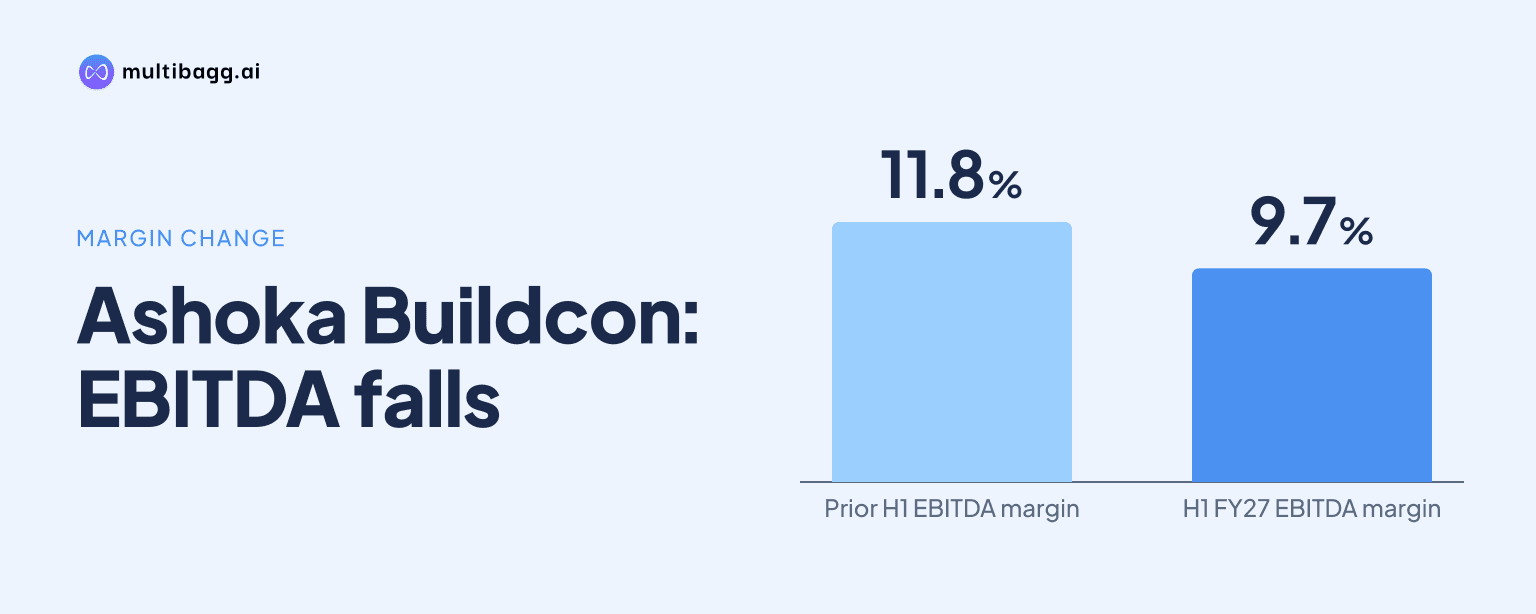
Ashoka Buildcon Limited reported standalone H1 FY27 EBITDA of Rs 259.4 crore, down 16.43% year on year, as EBITDA margin fell to 9.7% from 11.8% despite total income rising 1.32% to Rs 2,676.6 crore in the half year ended September 30, 2026.
Know Ashoka Buildcon inside out
Results, valuation, peers and who's buying, in one view.
Why did Ashoka Buildcon's H1 FY27 EBITDA decline?
Ashoka Buildcon's release does not identify specific cost, project or segment factors behind the EBITDA decline, but it shows operating earnings falling while income rose modestly. Standalone EBITDA decreased by Rs 51.1 crore to Rs 259.4 crore in H1 FY27 from Rs 310.5 crore in H1 FY26, while total income increased by Rs 34.9 crore to Rs 2,676.6 crore.
The difference between income growth and EBITDA movement reduced the standalone EBITDA margin by 2.1 percentage points. Margin was 9.7% in H1 FY27, compared with 11.8% in H1 FY26. Profit before tax, stated before exceptional gains, declined 6.04% to Rs 94.4 crore from Rs 100.5 crore over the same period.
Profit after tax fell more sharply than EBITDA, declining 59.07% to Rs 59.5 crore from Rs 169.8 crore. The company identifies its profit-before-tax measure as being before exceptional gains, but the release does not provide a reconciliation of exceptional gains, finance costs, tax expense or other items that would explain the difference between the EBITDA and profit-after-tax declines.
How did Ashoka Buildcon perform in Q2 FY27?
Ashoka Buildcon recorded 4.12% growth in standalone total income in Q2 FY27, but EBITDA fell 16.18% to Rs 133.9 crore. Quarterly total income was Rs 1,356.2 crore, compared with Rs 1,302.6 crore in Q2 FY26, extending the half-year pattern of higher income alongside lower operating earnings.
Quarterly EBITDA margin narrowed by 2.5 percentage points to 9.8% from 12.3% a year earlier. Profit before tax before exceptional gains declined 10.06% to Rs 51.4 crore from Rs 57.2 crore. Q2 FY27 EBITDA of Rs 133.9 crore was slightly more than half of the H1 FY27 total of Rs 259.4 crore, while the quarterly margin was 0.1 percentage point above the half-year margin.
Ashoka Buildcon reported Q2 FY27 profit after tax of Rs 37.9 crore, against Rs 139.2 crore in Q2 FY26. Its financial table labels the year-on-year change for this line as 2.80%, which does not correspond with the displayed profit figures. The release gives no explanation that resolves this difference.
What is in Ashoka Buildcon's order book?
Ashoka Buildcon had an order book of Rs 15,964 crore as of September 30, 2026, led by Road engineering, procurement and construction, or EPC, projects worth Rs 6,173 crore. Road EPC represented 38.7% of the order book, followed by Power transmission and distribution, or Power T&D, at Rs 3,820 crore and 23.9%.
The two largest segments, Road EPC and Power T&D, together accounted for Rs 9,993 crore, or 62.6%, of the total disclosed order book. The remaining mix comprised special purpose vehicle, or SPV, projects at Rs 1,928 crore, railways at Rs 1,666 crore, Road Hybrid Annuity Model, or HAM, projects at Rs 1,436 crore, and Building EPC at Rs 941 crore.
The disclosure provides values and percentage shares for each segment but does not state expected execution timing, margin assumptions or anticipated revenue conversion. Road HAM accounted for 9.0% of the order book, while Building EPC was the smallest reported segment at 5.9%, compared with 12.1% for SPV projects and 10.4% for railways.
Got a follow-up? Ask IRIS
What debt and project updates did Ashoka Buildcon disclose?
Ashoka Buildcon reported standalone debt of Rs 1,169 crore and consolidated debt of Rs 2,781 crore in its results update. Standalone debt comprised Rs 77 crore of equipment loans, Rs 893 crore of working-capital loans and Rs 200 crore of commercial papers, or CPs. The listed components total Rs 1,170 crore, Rs 1 crore above the stated total, reflecting the company’s presented figures.
In the build-operate-transfer, or BOT, division, Ashoka Buildcon reported toll collection of Rs 73.5 crore for Q2 FY26 and described this as a 9% year-on-year decline. The company used the Q2 FY26 label for this metric, although its financial-results disclosure covers Q2 and H1 FY27. It did not provide a comparable toll-collection figure or explain the stated decline.
After September 30, 2026, Ashoka Buildcon received a letter of intent for a 400/220/132 kilovolt air-insulated Sakoli substation in Bhandara, Maharashtra. The project value was stated as Rs 126.537 crore annually for 35 years, with a 24-month execution period and 35 years of operations and maintenance. Ashoka Buildcon also acquired a 100% equity stake in Sakoli Power Transmission Limited, the SPV for the project.
Ashoka Buildcon also received a letter of acceptance for a Rs 602.16 crore, goods and services tax-inclusive, rail contract covering electro-mechanical systems for tunnels T-13 to T-16 on the Rishikesh-Karnprayag New BG Rail Line Project in Uttarakhand. The stated execution timeline is 30 months. Separately, October 2026 provisional commercial operation dates covered 45.05 kilometres and 4.221 kilometres on separate Tumkur-Shivamogga HAM stretches, while certificates covered an aggregate 47.196 kilometres after de-scoping.
Conclusion
Ashoka Buildcon's H1 FY27 figures show that 1.32% growth in standalone total income did not translate into higher operating profit. EBITDA fell 16.43%, the margin contracted by 2.1 percentage points, and profit after tax declined 59.07%. The Rs 15,964 crore order book remains concentrated in Road EPC and Power T&D, which together represent 62.6% of the disclosed total.
The next disclosed milestones are execution of the Rs 602.16 crore rail contract over 30 months and construction of the Sakoli substation over 24 months, followed by its 35-year operations and maintenance period. Future results may also clarify the factors behind the margin contraction, the gap between the reported quarterly profit-after-tax figures and percentage change, and the effect of October 2026 HAM commercial-operation milestones.