










Ashoka Buildcon targets Rs 600-700 crore debt by March
Key highlights
- Ashoka Buildcon expects approximately Rs 1,000 crore from six HAM asset sales, including about Rs 600 crore from four assets.
- Ashoka Buildcon targets standalone external lender debt of Rs 600 crore to Rs 700 crore by March 2027.
- Ashoka Buildcon reported gross third-party debt of Rs 2,781 crore and expects about Rs 2,000 crore after four asset sales.
- Ashoka Buildcon has about Rs 340 crore of remaining HAM equity commitments, including Rs 153 crore planned in FY27.
powered by IRIS
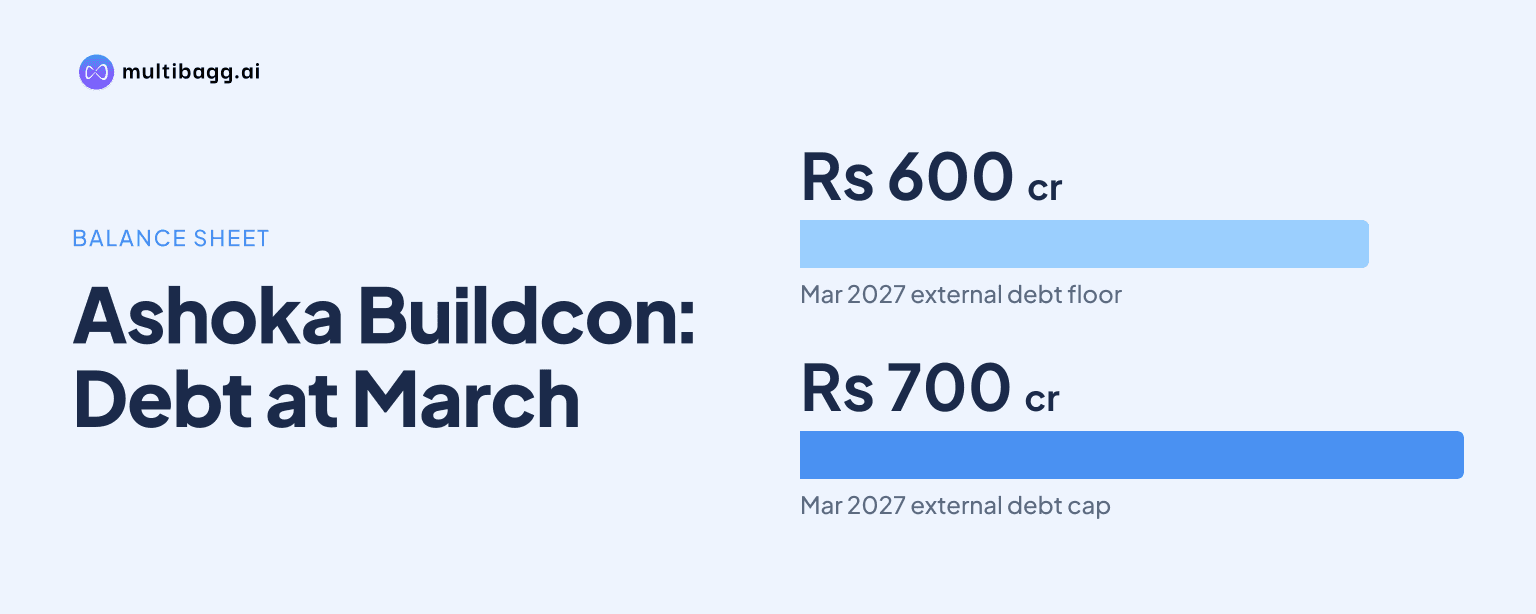
Ashoka Buildcon Limited expects approximately Rs 1,000 crore from the sale of six hybrid annuity model assets and, after allowing for new-project investments, management targets standalone external lender debt of Rs 600 crore to Rs 700 crore by March 2027. The first four assets are expected to account for an initial tranche of about Rs 600 crore.
Know Ashoka Buildcon inside out
Results, valuation, peers and who's buying, in one view.
How much will Ashoka Buildcon receive from HAM asset sales?
Ashoka Buildcon expects approximately Rs 1,000 crore from six hybrid annuity model, or HAM, asset sales, comprising about Rs 600 crore from the first four assets and about Rs 400 crore from the remaining two. Management said it had signed off on the sale transaction for the first four assets during its Q2 FY27 earnings call, covering the quarter ended September 30, 2026.
Management identified Basawantpur and Tumkur-Shivamogga 4 as the two assets expected to be monetised in Q4 or the following Q1. In the same discussion, management said the four-asset sale had been signed off, while also describing actual monetisation as occurring in Q4 or Q1. It did not name the buyers or disclose individual asset values.
Tumkur-Shivamogga 4 has received milestones that affect its annuity eligibility. Ashoka Buildcon said the special purpose vehicle, or SPV, received commercial operation date, or COD, for the balance 45.05 kilometres of the Tumkur-Shivamogga HAM project in Karnataka, making it eligible for its first annuity. A third provisional COD for 4.22 kilometres in package three, after de-scoping by the National Highways Authority of India, made the SPV eligible for full annuity.
How will HAM sales change Ashoka Buildcon debt by March 2027?
Ashoka Buildcon said selling the first four assets would reduce total gross third-party debt to about Rs 2,000 crore from Rs 2,781 crore. Management said the post-sale balance would include about Rs 800 crore of project debt, with the remainder comprising working-capital borrowing.
The Rs 600 crore to Rs 700 crore March 2027 objective covers only external debt from lenders at the standalone level, management clarified. It excludes inter-company balances with wholly owned group companies. When an analyst noted that interest would continue on sister-concern debt, management agreed that interest expense would remain, while saying those balances stay within the group.
The two debt measures therefore cover different scopes. At the consolidated level, management expects the sale of four HAM assets to reduce gross third-party debt by about Rs 781 crore, from Rs 2,781 crore to about Rs 2,000 crore. At the standalone level, its target is for external lender debt to decline from Rs 1,169 crore to Rs 600 crore to Rs 700 crore by March 2027.
Got a follow-up? Ask IRIS
What funding commitments remain before March 2027?
Ashoka Buildcon has about Rs 340 crore of equity still to invest in HAM projects, including Bowaichandi, across FY27 to FY29. Management allocated Rs 153 crore to FY27, Rs 114 crore to FY28 and Rs 72 crore to FY29, and said Rs 68 crore had already been invested during the first half of FY27.
Bowaichandi is a near-term funding requirement because its appointed date was received recently. Management expects an equity infusion of around Rs 25 crore into that project and said its Rs 600 crore to Rs 700 crore standalone lender-debt estimate already accounts for investments in Bowaichandi and other new projects.
Ashoka Buildcon also reported capital expenditure of about Rs 62 crore to date in FY27 and set a full-year capital-expenditure target of approximately Rs 125 crore. This capex plan is separate from the Rs 153 crore of HAM equity planned for FY27, meaning both operating investment and project equity funding remain relevant to cash deployment before March 2027.
What operating results and order book support the plan?
Ashoka Buildcon reported standalone total income of Rs 1,356.24 crore in Q2 FY27, compared with Rs 1,302.62 crore in Q2 FY26. Earnings before interest, tax, depreciation and amortisation, or EBITDA, were Rs 133.94 crore, equivalent to a 9.88% margin, while profit after tax was Rs 37.96 crore versus Rs 139.18 crore a year earlier, when the prior result included Rs 112 crore of exceptional items.
For H1 FY27, standalone income rose to Rs 2,676.68 crore from Rs 2,641.73 crore in H1 FY26, while EBITDA was Rs 259.47 crore at a 9.69% margin. Management expects margins to increase by 1.5 percentage points by the end of FY27 and indicated a second-half margin of 9% to 9.5%, citing ramp-up in Maharashtra road projects, other projects and international projects.
The order book was Rs 15,964 crore as of September 30, 2026, excluding orders received after that date, and Rs 17,222 crore including them. Roads and railways accounted for Rs 9,275 crore, or 58%, while power transmission and distribution represented Rs 3,820 crore, or about 24%. Management also targets another Rs 3,000 crore to Rs 5,000 crore of orders beyond those received through October.
Conclusion
The proposed HAM monetisation combines approximately Rs 1,000 crore of expected proceeds with a management target to reduce standalone external lender debt to Rs 600 crore to Rs 700 crore by March 2027. The outcome depends on completing the signed-off four-asset transaction, receiving the planned Rs 600 crore first tranche and funding Rs 153 crore of FY27 HAM equity commitments.
The next disclosed milestones are the receipt and completion timing of proceeds from the first four assets, followed by sales of Basawantpur and Tumkur-Shivamogga 4 in Q4 or the following Q1. Management’s Rs 125 crore FY27 capital-expenditure plan, Rs 3,000 crore to Rs 5,000 crore order-inflow target and March 2027 lender-debt target will also determine the pace of funding needs and deleveraging.